Summer is here and the mercury is rising… literally
July 15, 2009
Summer is here and the mercury is rising… literally

Enlarge

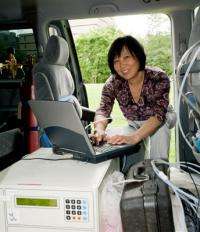
Ryerson University researcher Julia Lu investigates forms of trace metals in the environment, especially mercury. Her latest study finds that higher levels of atmospheric mercury exist in urban areas as compared to rural regions, and that summer is the peak season for mercury, with highest levels being reached in June.

Hot town, summer in the city. When it comes to air-quality advisories, city residents are no strangers, especially during the dog days of summer. But smog is made up of an array of air pollutants, including the mad hatter’s muse, mercury. One Ryerson University researcher has found that summer is the peak season for this atmospheric toxin, and that higher levels of mercury species exist in the urban atmosphere as compared to rural regions.

Julia Lu is an Associate Professor in Ryerson’s Department of Chemistry and Biology, where she conducts research identifying and quantifying different forms of trace metals in the environment. Her main focus, however, is mercury, an element that can be found in many places, which explains why Dr. Lu’s work has involved such diverse locales as the Canadian and, more recently, Toronto, Canada’s largest city.

One of many contributing poor air factors, mercury is well-known for its toxic effects on the environment and human health. Airborne mercury’s greatest threat is that it will settle into the surface environment and be converted into the much more toxic organomercury species which can be accumulated and magnified up the food chain, reaching our dinner table through fish and shellfish consumption.

Mercury measurements in the urban atmosphere have been very limited in contrast to rural and remote areas. So, in order to investigate this particular field, Dr. Lu and her then-graduate students Xinjie Song and Irene Cheng mounted specialized equipment - including air sampling units and a meteorological station - atop a three-storey building on Ryerson’s campus in downtown Toronto. From there, the team simultaneously measured three types of mercury: atmospheric gaseous elemental mercury (GEM), reactive gaseous mercury (RGM) and mercury associated with particles with sizes less than 2.5 micrometres.

In addition to finding higher mercury levels in urban areas, the team discovered those levels seemed to be affected by human-produced emissions, rather than chemical and photochemical reactions in the environment. Finally, while the concentrations of all mercury species varied during the year - and were lower in the winter - the amount of GEM spiked in June. A concern, according to Dr. Lu, because GEM stays in the atmosphere longer and travels further than its chemical counterparts. The result, she believes, is a global-scale problem.

“Sometimes the spikes were as high as what you would find near point sources of mercury,” says Dr. Lu, citing coal-powered and metal-processing plants as examples.“We need to further our understanding of how cities contribute to the mercury problem. And it’s not just GEM that requires attention. Other forms of mercury stay in the atmosphere for a shorter duration and therefore negatively impact local and regional areas.”

As next steps, Dr. Lu is working to pinpoint sources of mercury in the urban environment. To help accomplish her objective, Dr. Lu has moved her measurement equipment to the top of a taller building on campus and has outfitted a car that will drive around and measure mercury at street-level. At the same time, a group of more than 10 Ryerson researchers are developing a weather network that is trying to figure out air-flow patterns in the city, which will also benefit Dr. Lu’s research.

The goal of the initiatives is simple, Dr. Lu says: to positively influence population health.

Annual Atmospheric Species in Downtown Toronto, Canada appeared in a recent edition of the Journal of Environmental Monitoring.

Source: Ryerson University

Filter


Move the slider to adjust rank threshold, so that you can hide some of the comments.


Display comments: newest first

omatumr
Jul 15, 2009

Rank: 1 / 5 (1)
MERCURY IS ONE OF MANY VOLATILE ELEMENTS

The above is a well-established, but hardly newsworthy, fact.

Oliver K. Manuel
Rank 4 /5 (3 votes)
Related Stories
Relevant PhysicsForums posts
  • Do some geologists actually act a lot like Randy Marsh?
    createdFeb 11, 2012
  • Discrepancy between oxygen and carbon-dioxide levels
    createdFeb 09, 2012
  • where gems are found in the world
    createdFeb 09, 2012
  • Wind Waves in Reservoir ~ Wind run-up and Wind set-up
    createdFeb 08, 2012
  • Balance of oxygen in the atmosphere
    createdFeb 01, 2012
  • The case for a methanol-based economy
    createdJan 30, 2012
  • More from Physics Forums - Earth

More news stories

Planck mission steps closer to the cosmic blueprint

(PhysOrg.com) -- ESA's Planck mission has revealed that our Galaxy contains previously undiscovered islands of cold gas and a mysterious haze of microwaves. These results give scientists new treasure to mine ...

Space & Earth / Astronomy

created 2 minutes ago | popularity not rated yet | comments 0 | with audio podcast

Scientists drill two miles down to ancient Lake Vostok

(PhysOrg.com) -- Russian scientists last week finished penetrating more than two miles through the Antarctic ice sheet to Lake Vostok, a huge freshwater lake that has been buried under the ice for millions ...

Space & Earth / Earth Sciences

created 1 hour ago | popularity 5 / 5 (1) | comments 0

Transforming galaxies

(PhysOrg.com) -- Many of the Universe's galaxies are like our own, displaying beautiful spiral arms wrapping around a bright nucleus. Examples in this stunning image, taken with the Wide Field Camera 3 on ...

Space & Earth / Astronomy

created 1 hour ago | popularity 5 / 5 (1) | comments 0 | with audio podcast

New European rocket lifts off on maiden flight

Europe on Monday successfully launched a new lightweight rocket carrying a test payload, culminating a more than 12-year quest to master the entire range of space launchers.

Space & Earth / Space Exploration

created 3 hours ago | popularity 5 / 5 (5) | comments 2

Alien matter in the solar system: A galactic mismatch

This just in: The Solar System is different from the space just outside it.

Space & Earth / Space Exploration

created 1 hour ago | popularity 4 / 5 (5) | comments 6 | with audio podcast


Fast photon control brings quantum photonic technologies closer

(PhysOrg.com) -- Using photons instead of electrons to transmit information could lead to faster and more secure ways to communicate, among other advantages. Now a team of physicists has taken another step toward realizing ...

New ability to regrow blood vessels holds promise for treatment of heart disease

(Medical Xpress) -- University of Texas at Austin researchers have demonstrated a new and more effective method for regrowing blood vessels in the heart and limbs — a research advancement that could have ...

Nanostructured electrodes for rechargeable sodium-Ion batteries

Highly efficient 3V cathodes for rechargeable sodium-ion batteries have been developed by users from Argonne National Laboratory's Materials Science, Chemical Sciences & Engineering, and X-ray Sciences Divisions, ...

A lost world? How zooarchaeology can inform biodiversity conservation

A new study of tropical forests will provide a 50,000-year perspective on how animal biodiversity has changed, explored through an archaeological investigation of animal bones.

Myths and shame keep many from seeking bankruptcy protection

(PhysOrg.com) -- Two interesting facts that may counter modern ideas about bankruptcy: The overwhelming majority of U.S. filings belong to individuals rather than corporations or entities, and most of these ...

Teaching teens safety in the virtual world

A new cyber safety program on the dangers of social networking is being developed by Flinders University, in light of an alarming report which shows children as young as 12 are meeting internet strangers in ...