No ivory-billed woodpecker, but plenty of data
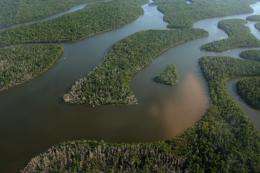
(PhysOrg.com) -- They have searched the old-growth forests of the Carolinas, the swamps of Arkansas, the woods of Alabama and Mississippi, and now the vast river of grass, mangrove, cypress and wildlife that make up the Florida Everglades. But if the legendary ivory-billed woodpecker still inhabits any corner of the southeast United States, the bird remains -- by humans, at least -- unseen and unheard.
The Cornell Lab of Ornithology's six-person mobile search team, which has spent the last three winters combing the southeastern United States, has wrapped up what is likely to be its last large-scale search.
"The lab will continue to be a hub for information, reports and scholarship about the ivory-billed woodpecker," said Ron Rohrbaugh, director of the lab's Ivory-billed Woodpecker Research Project -- "including through an online database where members of the public can report sightings."
"But unless new evidence surfaces, it's probably safe to say that we're not going to put forward any more comprehensive, systematic searches like we've been doing for the last five years in Arkansas and with the mobile team," Rohrbaugh said.
The Cornell team is now sifting through data and will publish reports later this summer. Along with a trove of valuable ecological data on the region's diverse and changing habitats of the southeast, the team also logged every bird they spotted for eBird, a project of the Cornell Lab of Ornithology and National Audubon Society that catalogs and reports information provided by birders around the world.
This year's search in the tall coastal mangrove forests and inland hammock forests of south Florida came after project scientist Martjan Lammertink and a colleague at the U.S. Fish and Wildlife Service uncovered specimen records from the 1890s and reports of ivory-bill sightings there through present day.
That much of the region is nearly impenetrable to humans made it even more enticing, Lammertink said. But it also made for the toughest search conditions yet.
"We knew it was going to be difficult," he said. Some of the sites were only accessible by swamp buggy or helicopter. Almost all included some brew of stifling heat, humidity, insects, mud, muck, thorns, vines, razor-sharp grass, snakes and swarming mosquitoes. And, of course, alligators.
Fortunately, Lammertink said, the team made it out with no casualties or lost limbs. Unfortunately, though, they found no sign of current habitation by ivory-bills. And what they did find -- evidence of old logging activity from the 1930s and '40s in even some of the remotest areas -- was discouraging.
"We had hoped that some of those sites that, at least now, look very remote from any access still had some truly untouched habitat -- and that some birds might have slipped through," Lammertink said. "But the results from our season seem to indicate that even though habitat in this day and age seems to have very high potential for supporting ivory-bills, if they were reduced sufficiently for collapse in those years, they may not have been able to recover."
The possibility still exists that a small number of birds survived and have managed to evade researchers, Rohrbaugh added. But despite the lack of conclusive evidence, Rohrbaugh said, the search was fruitful in other ways.
"Through the years the search teams have had an opportunity to talk with people in local communities about the bird conservation and the economic impacts of bird watching. There's a keen new awareness about bird conservation and the importance of birds to ecosystems and to people's lives at a very local level," he said.
The effort has also created strong partnerships between the Lab of Ornithology and state and local agencies in the areas of the search, he added. "It's very much a team effort."
The coming months will be a time for reflection, data analysis and decisions about the next steps. One project in the planning stages is a scholarly book with collaborators at the U.S. Fish and Wildlife Service and other partners on the woodpecker's historic distribution and use of habitat; and on the current habitat status in each of the states searched.
"Cornell has a long history with ivory-bill searching and research," Rohrbaugh said, and that connection will continue.
"So although we won't be doing systematic searching like we have been, we're certainly engaged with this process," he added. "And we'll see it through to whatever the end happens to be."
Provided by Cornell University


