Greater Yellowstone elk suffer worse nutrition and lower birth rates due to wolves
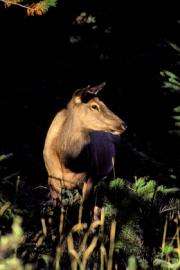
(PhysOrg.com) -- Wolves have caused elk in the Greater Yellowstone Ecosystem to change their behavior and foraging habits so much so that herds are having fewer calves, mainly due to changes in their nutrition, according to a study published this week by Montana State University researchers.
During winter, nearly all elk in the Greater Yellowstone Ecosystem are losing weight, said Scott Creel, ecology professor at MSU, and lead author on the study which appears in the Proceedings of the National Academy of Sciences.
"Essentially, they are slowly starving," Creel said. "Despite grazing and browsing during the winter, elk suffer a net loss of weight. If winter continued, they would all die, because dormant plants provide limited protein and energy, and snow makes it more difficult to graze efficiently."
With the presence of wolves, elk browse more - eating woody shrubs or low tree branches in forested areas where they are safer - as opposed to grazing on grass in open meadows where they are more visible, and therefore more vulnerable to wolves.
Browsing provides food of good quality, but the change in foraging habits results in elk taking in 27 percent less food than their counterparts that live without wolves, the study estimates.
"Elk regularly hunted by wolves are essentially starving faster than those not hunted by wolves," said Creel, who shares authorship on the paper with his former doctoral students John Winnie, Jr., and David Christianson.
The decline in the Greater Yellowstone's elk population since the reintroduction of wolves in 1995 has been greater than was originally predicted. In the three winters prior to the reintroduction of wolves, elk on Yellowstone's northern range numbered roughly between 17,000 and 19,000. In the three winters prior to 2008, annual elk counts had declined to between 6,738 and 6,279.
Obviously, wolves kill elk, and direct predation is responsible for much of the decline in elk numbers, but the rate of direct killing is not great enough to account for the elk population declines observed since 1995 in the Northern Range, the Gallatin Canyon, and the Madison-Firehole herds, all well-colonized by Yellowstone wolves. In addition to direct predation, the decline is due to low calving rates, which are a subtle but important effect of the wolves' presence, Creel said.
Two studies following radio-collared elk calves found that during the calves' first six months of life, relatively few of them were killed by wolves, Creel said.
"We knew the presence of wolves caused lower calf-cow ratios, but we didn't know why," he said. "Radiocollaring calves revealed that calf numbers were low immediately after the birth pulse, suggesting that a decline in the birth rate was part of the population decline."
The birth pulse is that time in spring when most cow elk have their calves.
This suggestion was confirmed when the researchers found that elk facing high levels of predation risk had substantially decreased progesterone levels prior to the annual birth pulse. Progesterone is necessary to maintain pregnancy, but a question remained: what was responsible for the decrease in progesterone?
There were two competing theories: One suggested elk suffered from chronic stress due to the wolves' presence. In all mammals, stress causes the release of cortisol, a hormone that helps free up energy to either fight or flee. But too much cortisol from chronic stress can cause the immune and reproductive systems to shut down.
The other theory was that the elk weren't getting enough to eat because they were always on the run from the wolves and spending more time in the forest, where food is sparse compared to grassy meadows. For wintering elk that are already on the edge of starvation, anything compromising nutrition could also cause the reproductive system to shut down.
The MSU researchers did chemical analysis of 1,200 fecal samples collected over 4 years, as well as urine samples for the study. They did not find the elevated levels of cortisol that would support the chronic stress theory. However, they did find that those elk living in the presence of wolves had lower levels of progesterone, a hormone necessary to maintain pregnancy, than those elk that didn't live with wolves.
"The elk are trading reproduction for longevity," Creel said. "Elk are potentially long-lived, and many prior studies have shown that, in species like this, natural selection favors individuals who do not compromise their own survival for the sake of a single reproductive opportunity."
If predators commonly affect the reproduction of their prey, it will change the thinking about predator-prey dynamics, and might change how wildlife managers plan for the reintroduction of predators, Creel said.
"This research shows that the total effect of a predator on prey numbers can be larger than one would determine simply by looking at the number that are killed," he said.
Until now, it would have seemed obvious to conclude that a herd losing many of its number to predators would decline faster than a herd where predators were less successful, Creel said.
"However, now it is conceivable that the herd with the lower direct predation rate could decline faster, if it spends more of its time and energy avoiding being eaten and less on reproduction," Creel said.
Creel and his current doctoral student Paul Schuette are seeing if the theory holds up with other prey-predator populations, with a study of lions, spotted hyenas and a diverse array of prey animals on a Maasai Community Conservation Area in the South Rift of Kenya.
The study of Montana elk ruled out weather as the cause of poor calf production, because elk populations that were exposed to little or no wolf predation had good calf production during the study period, which was typified by winters with little snow accumulation -- ideal for elk.
The study also considered grizzly bears.
"It is true that grizzlies prey on elk calves, and grizzly numbers have increased in the region," Creel said. "However, the increase in total grizzly numbers has mainly been due to geographical expansion, rather than increases in the number of bears in places where they were already well-established at the time of wolf reintroduction."
Provided by Montana State University (news : web)


