'Contact lenses' for animals
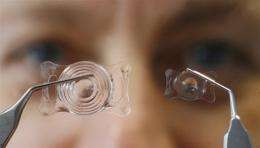
Lions, giraffes, tigers, rabbits, bears, rhinos and even owls can go blind from cataracts, but an east German firm has an answer: custom-made "contact lenses".
The procedure is delicate, to say the least, and requires special training for veterinarians.
But it has propelled tiny S & V Technologies, founded by Bavarian chemist and entrepreneur Christine Kreiner in the former communist east, to global leadership in a highly specialised field.
The acrylic intraocular lenses are implanted into animals' eyes when their vision has clouded to the point of total impairment, and are fitted for various species, from cat-eye-sized to fist-width for rhinos.
"Cataracts generally means blindness for animals, unlike for humans," said the head of the company's veterinary division, Ingeborg Fromberg.
"And because animals have short life spans, it means losing quality of life in a greater share of that life."
Since its launch in 2008, the firm has fielded calls from Sea World in San Diego (a sea lion who had trouble performing his tricks due to severely blurry vision), an Australia nature park (a blind kangaroo) and a Romanian zoo (a visually impaired lioness).
The German lenses have helped turn the lights back on for dozens of house pets, racehorses, circus animals, guide dogs -- literally preventing the blind leading the blind -- and even wild creatures roaming nature reserves.
Special lenses that absorb UV rays can also be used to help horses afflicted with "head shaker syndrome", an excruciating and ultimately life-threatening ailment.
Although the expense of such an operation and subsequent check-ups can run into the thousands of euros (dollars), the procedure is often worth it for animals that have gone blind -- and for their owners.
"When something is unsettling for an animal, when they don't have a good sense of their surroundings, they can begin to get aggressive or unpredictable or withdrawn," Fromberg said.
That can mean the pricey investment in training an animal is wasted.
Impaired vision can also blunt the sex drive, stopping animals from reproducing. The World Wildlife Fund, for example, has paid for lens transplants for brown bears in a preserve in China.
"Of course that is only one side of it -- some are pets and seen as members of the family and worth any expense," Fromberg said.
She said the trickiest part of treating big animals such as elephants and rhinos is the anesthesia.
"If larger animals lie for too long on one side during an operation then it puts too much pressure on the heart. That makes things a bit harder," she said.
"With a giraffe, for example, its head may never be lower than its heart. Every animal has its peculiarities that you have to contend with."
CEO Kreiner, a 64-year-old from Munich, chose to set up her unusual firm in Hennigsdorf, a sleepy riverside town that has become a high-tech haven in the 20 years since the Berlin Wall fell.
On the capital's northern outskirts, Henningsdorf also made smart business sense because the European Union and the German government both pitched in to provide one-third of the startup costs.
Kreimer has founded five different firms in her years in business and said she was drawn to Germany's ex-communist east in the heady trailblazing mood of national unification in 1990.
"I thought at the time that it would be better to go to a poorer part of Germany rather than stay in Bavaria," the prosperous southern state, she said.
"The thinking was that it would be less bureaucratic in an eastern state, and that the subsidies would be better than in the west. It was the right decision."
Her various enterprises blossomed and evolved over the years, culminating in the founding of S & V Technologies in January 2008. The company now even has a US subsidiary in Salt Lake City.
S & V posted turnover of nearly 2.5 million euros (3.5 million dollars) last year and Kreiner expects it to grow by one-third this year based on lens sales but also a thriving anti-wrinkle products division -- for humans.
She employs 32 people with another five to join this year.
"There are no global players active in this area that are able to crush medium-sized firms with a major marketing operation," Kreiner said, adding that her few competitors -- in Canada, France and the United States -- were all smaller than S & V.
The main limit to her business's growth is a lack of vets able to perform the implantation procedure, which is why she now organises training weekends for animal doctors from around the globe.
Participants have come from as far as Australia, Brazil, Japan, Taiwan and the United States to learn the procedure in the company laboratory on eyes harvested from animal cadavers.
(c) 2009 AFP


