A new software to assess driving behaviour and driving risks
July 16, 2009
Software seen with Google Earth
One of the aims imposed by the European Union in 2004 is to reduce the number of traffic accidents. However, despite the measures taken by the different administrations and the consequent decrease in the number of accidents, the results for 2010 are not close to those set by Europe. Gerardo Reveriego, a young researcher of the University of Málaga, has designed software that informs drivers of the risk situations s/he has while driving. This allows drivers to self-assess themselves and improve their driving behaviour.
'Our main idea is that the system can be used by a large number of people. That's why we have worked so that the program does not have any cost, everything is based on free software', Reveriego says. Moreover, in order to be able to use it, it is not necessary to have complex expensive accessories. ‘Just with a mobile phone that has a global positioning system (GPS) and an accelerometer, users will be able to know their driving behaviour' the researcher added.
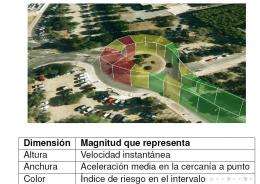
This software gathers data on the acceleration and speed of the car and after a driving route, it generates a file that is displayed on a computer. ‘The route that is made can be seen on a free Google map reader, such as Google Earth. In such route, you can see a series of polygons with different colours, width and height that provide information on the levels of risk, centripetal acceleration and speed, respectively' Gerardo Reveriego explained.
For example, if we have taken a curve too fast, the program will display a series of red polygons which indicate a high risk of having an accident; certain width indicating the acceleration we had when taking the curve, and a height indicating the speed. ‘The higher the acceleration, the higher the risk' , this software-designer said.
This software has several applications: ‘We would like the Spanish General Traffic Directorate DGT to receive anonymous reports -provided that drivers agree with that- on the places that are a risk for drivers, as these are indicative of accident concentration spots. Therefore these spots could be corrected or signposted so as to avoid more deaths' ,Reveriego added.
This system can also be implemented in driving schools. ‘Students often have difficulties to follow their instructor's commands and drive at the same time; that's why our idea is for them to have a mobile device in their cars so that they can analyse their route afterwards' this telecommunications engineer said.
Insurance companies could also be interested in using this system, as they can give a bonus or penalise depending on the driver's driving style. ‘With this product, travellers transportation companies can get to know their users' level of satisfaction, as if drivers make abrupt manoeuvres this software would indicate so' Reveriego said.
In addition to the help this system supposes, this researcher is already looking for future research lines. ‘One of our objectives is for cars to have this new facility from the factory. In order to do so, we would need to start collaborating with a car company interested in it. This way we would manage to implement this program in the new navigation system cars have, and then car dealers would contribute to reduce the number of accidents' he said.
Source: Andalucía Innova
-
Saving on fuel and safeguarding the environment with smart driving
Feb 16, 2009 |
not rated yet |
0
-
Rural drivers using cell phones are likely to cause accidents
Jun 24, 2005 |
not rated yet |
0
-
Passengers, not just mobile phones, contribute to road accidents
May 22, 2007 |
not rated yet |
0
-
"Buddy List" in the Car - Transmitting to Friends on the Road
Jan 28, 2005 |
not rated yet |
0
-
Hazards on the road ahead
Jul 25, 2007 |
not rated yet |
0
-
Engineers build first sub-10-nm carbon nanotube transistor
Feb 01, 2012 |
4.9 / 5 (33) |
30
-
Something old, something new: Evolution and the structural divergence of duplicate genes
Jan 31, 2012 |
4.6 / 5 (7) |
1
-
The hidden nanoworld of ice crystals: Revealing the dynamic behavior of quasi-liquid layers
Jan 30, 2012 |
5 / 5 (4) |
1
-
Stock market network reveals investor clustering
Jan 27, 2012 |
3.9 / 5 (23) |
8
-
Of microchemistry and molecules: Electronic microfluidic device synthesizes biocompatible probes
Jan 26, 2012 |
5 / 5 (2) |
0
-
How to tilt a object
5 hours ago
-
How to calculate total compressibility in liquid porous solid system
10 hours ago
-
Need help reading 3-D
Feb 11, 2012
-
A way to send and receive wireless data
Feb 11, 2012
-
Calling function with no input argument
Feb 10, 2012
-
Force free body diagram problem on gym equipment
Feb 10, 2012
- More from Physics Forums - General Engineering
More news stories
Google might launch Drive for cloud storage soon
(PhysOrg.com) -- Google's next big move, according to the Wall Street Journal, is a cloud storage service called Drive. Hardly first to the plate, Google is simply catching up to introducing its cloud reposi ...
Iran blocks email, restricts net access: reports
Iran has further restricted access to the Internet and blocked popular email services for the past few days, in a move a top lawmaker said could "cost the regime dearly," media reports said on Sunday.
11 hours ago |
5 / 5 (2) |
5
Walney offshore wind farm is world's biggest (for now)
(PhysOrg.com) -- The Walney wind farm on the Irish Sea--characterized by high tides, waves and windy weather--officially opened this week. The farm is treated in the press as a very big deal as the Walney ...
Navy to begin tests on electromagnetic railgun prototype launcher
The Office of Naval Research (ONR)'s Electromagnetic (EM) Railgun program will take an important step forward in the coming weeks when the first industry railgun prototype launcher is tested at a facility ...
Feb 06, 2012 |
4.6 / 5 (20) |
95
|
New power source discovered
(PhysOrg.com) -- Researchers at the Massachusetts Institute of Technology (MIT) and RMIT University have made a breakthrough in energy storage and power generation.
Technology / Energy & Green Tech
Feb 10, 2012 |
4.6 / 5 (51) |
51
|
Scientists discover molecular secrets of 2,000-year-old Chinese herbal remedy
For roughly two thousand years, Chinese herbalists have treated Malaria using a root extract, commonly known as Chang Shan, from a type of hydrangea that grows in Tibet and Nepal. More recent studies suggest that halofuginone, ...
New method to examine batteries -- MRI from the inside
There is an ever-increasing need for advanced batteries for portable electronics, such as phones, cameras, and music players, but also to power electric vehicles and to facilitate the distribution and storage of energy derived ...
A mitosis mystery solved: How chromosomes align perfectly in a dividing cell
Although the process of mitotic cell division has been studied intensely for more than 50 years, Whitehead Institute researchers have only now solved the mystery of how cells correctly align their chromosomes during symmetric ...
Lab study raises questions over nano-particle impact
Tests involving chickens have raised questions about the impact on health from engineered nano-particles, the ultra-fine grains commonly used in drugs and processed foods, scientists said on Sunday.
Starve a virus, feed a cure? Findings show how some cells protect themselves against HIV
A protein that protects some of our immune cells from the most common and virulent form of HIV works by starving the virus of the molecular building blocks that it needs to replicate, according to research published online ...
Researchers find extensive RNA editing in human transcriptome
In a new study published online in Nature Biotechnology, researchers from BGI, the world's largest genomics organization, reported the evidence of extensive RNA editing in a human cell line by analysis of RNA-seq data, demons ...