OLED Tunes its Colors for Sunlight-Style Illumination
July 16, 2009 By Lisa Zyga feature
OLED Tunes its Colors for Sunlight-Style Illumination

Enlarge

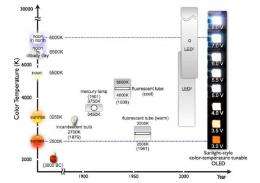
This chart shows the color temperature of sunlight at different times of day, along with the color temperatures of various lighting devices: candles, incandescent bulbs, mercury lamps, fluorescent tubes, LEDs, and the new sunlight-style OLEDs. Image credit: Jou, et al.

(PhysOrg.com) -- Scientists have developed a lighting device that can change its color temperature throughout the day, matching the natural daylight chromaticities produced by the sun. Currently, no other type of lighting device is capable of producing this wide a span of sunlight-style illumination, which could make the new technology an attractive future high-quality lighting source.

The developers, from National Tsing Hua University in Hsinchu, Taiwan, have designed an organic light-emitting diode (OLED) whose color temperatures range between 2300 and 8200 K, fully covering those of daylight at different times and regions. The color temperatures are controlled by varying the applied voltage to the device. By providing a natural outdoor light, the device could have an especially strong effect on human psychology and creating a more natural looking environment.

As the researchers explain, no other single lighting device can exhibit daylight-like emission with a color-temperature range that covers the entire spectrum of sunlight (2500 K - 8000 K). This breaks down to 2500 K at dawn, 3250 K at dusk, and 5500 K at noon or 8000 K at noon in high-latitude regions. Currently, lighting devices have different color temperatures that make them resemble a specific time of day; for example, the color temperature is 2000 K for candles, 2700 K for , 2500-3000 K for warm-white fluorescent bulbs, and 4000-5000 K for cool-white fluorescent bulbs. Some white LEDs can cover a wider - but still limited - range of color temperatures, but require a complicated structure.

The sunlight-style OLEDs demonstrated here have a relatively simple design, consisting of layers just a few thick of various color-emitting materials, as well as an electron-transporting layer and an electron-injection layer. As the researchers explain, changing the voltage varies the color temperature by increasing the number of electrons and holes transported between certain layers. For example, at 3 volts, the illumination is predominantly red, at 5.5 volts it turns to pure white, and at 9 volts becomes bluish white. The scientists also experimented with devices using slightly different layer thicknesses for comparison.

“The daylight color and its corresponding color temperature is currently manually controlled for the prototype,” Professor Jwo-Huei Jou of National Tsing Hua University told PhysOrg.com. “A simple driver-IC can be used to automatically modulate its applied voltage to give any desired color temperature between 2300 and 9000 K at any designated time.”

Besides having a wide color temperature span, the OLED device also emits high luminescence at relatively low applied voltages, and can cover large areas with the potential for flexibility. With these advantages, the color temperature tunable OLED could one day provide a possible alternative for the replacement of incandescent and fluorescent bulbs and even LEDs, especially if the OLEDs can be made as efficient as previous research suggests they can be.

“Our future plans are to use phosphorescent in lieu of fluorescent materials to enhance the device efficiency and to investigate the color temperature effect on plant and animal growth,” Jou said. “Of course, we mostly hope to have some lighting devices made so that people in northern countries can have sun-like daylight even in winter time.”

More information: Jwo-Huei Jou, et al. “Sunlight-style color-temperature tunable organic light-emitting diode.” Applied Physics Letters 95, 013307 (2009).

Copyright 2009 PhysOrg.com.
All rights reserved. This material may not be published, broadcast, rewritten or redistributed in whole or part without the express written permission of PhysOrg.com.

Filter


Move the slider to adjust rank threshold, so that you can hide some of the comments.


Display comments: newest first

Soylent
Jul 16, 2009

Rank: not rated yet
Why bother when people have made it abundantly clear that they want fugly yellow ~3000K, like an incandescent light bulb?
Velanarris
Jul 16, 2009

Rank: 3 / 5 (1)
Better question would be, why bother when we don't use lights during the day, but at night, when the sun is not available.

The only possible application for this would be in offices, which won't purchase OLED lights due to cost.
Bob_B
Jul 16, 2009

Rank: not rated yet
I'm sure the ISS crew would like to grow some fresh tomatoes and herbs.
The CFL's they used in earlier experiments went OK, but this sounds better.

What are the expected costs.
deatopmg
Jul 16, 2009

Rank: not rated yet
besides costs; what is the CRI at various color temp's, what is the conversion efficiency, i.e lumens/W at various color T (voltage), and what is the light output at various voltages??? Without these the report is just fluff and most of us don't have access to APL.
RayCherry
Jul 16, 2009

Rank: 5 / 5 (1)
Any one from Scandanavia, Canada, or Siberia care to make a comment? :-)
Sounds like a great step in lighting. How soon can Philips put it on the local shelves, for us to 'play' with?
poi
Jul 16, 2009

Rank: 4 / 5 (1)
The next step of verifying its effects on living things will make this a real development. if it has the same effect as the natural sun, think of the implications. Have your vitD without worrying about sunburns or an enclosed beach with just the right sunlight. No more need for sun screens. oooh, may be bad for the cosmetic companies but good for the resort and those indoor businesses.
Having an enclosure in the moon to protect from violent sun rays and still have the benefit of the OLED sun. Why limit to the moon... let's make a starship!
But first, the effects please. ;)
rasselas21
Jul 16, 2009

Rank: 5 / 5 (1)
"why bother when we don't use lights during the day, but at night... The only possible application for this would be in offices, which won't purchase OLED lights due to cost."

As mentioned above:

For regions in the north when there is just 10hours of daylight in the winter, even though there is 14hours of sun in the summer. So "night" is a relative term... and might be seen as "day" to those who could afford these lights.

Also: all-night facilities, hospitals (for patient mood elevation), mental wards, prisons (where there's little window light), basements, coal-mines, etc. See above for more alternatives.

The sky's the limit when you expand your horizons...

Arikin
Jul 17, 2009

Rank: 5 / 5 (2)
I would love to use these as a wake up alarm. It would mimic the gradual increase of a sunrise at any given time (at a faster pace) just before the alarm is to go off.

Otherwise I'll just keep turning off that annoying beeping noise and end up being late for work. :-(
Bob_Kob
Jul 17, 2009

Rank: 4 / 5 (2)
I love new lighting methods, and cant wait until this becomes commercial. As the post above stated one great application would be stimulating natural wake cycle by use of the oleds to make sunrise (it may be raining, winter, very early in the morning etc).
Mercury_01
Jul 17, 2009

Rank: 1 / 5 (1)
This light is for growing pot.
Sonhouse
Jul 19, 2009

Rank: 3 / 5 (1)
One big problem with OLED's is lifetime. Organic compounds break down rapidly, for instance, chlorophyll breaks down rapidly in plants but they get around that by continuously making more to replace the degraded chemicals. In OLED's, there is no replacement of these fragile molecules so they have a short lifetime, at least in its present form. So they probably would wear out within a year or so, meaning if they aren't a penny apiece, the product would not be commercially viable. Then you can talk about efficiency and such. Without some long lasting compounds, the whole effort will be a failure.
RayCherry
Jul 20, 2009

Rank: not rated yet
If that is the case, Sonhouse, then the Sony and LG OLED backlit televisions and computer screens are going to have to be replaced before the end of the standard two-year guarantee. Not sure about your claim, but would be interesting to see trend setters getting two TVs for the price of one.

http://www.physor...837.html
Velanarris
Jul 20, 2009

Rank: 5 / 5 (1)
One big problem with OLED's is lifetime. Organic compounds break down rapidly, for instance, chlorophyll breaks down rapidly in plants but they get around that by continuously making more to replace the degraded chemicals. In OLED's, there is no replacement of these fragile molecules so they have a short lifetime, at least in its present form. So they probably would wear out within a year or so, meaning if they aren't a penny apiece, the product would not be commercially viable. Then you can talk about efficiency and such. Without some long lasting compounds, the whole effort will be a failure.

There is a big difference between "organic" in the wild and "organic" in material.

OLEDs last far longer than photosynthesizing cells for two reasons:

1) The filament material is not exposed to the elements like a photosynthate is.
2) "Organic" means it contains molecules that are carbon chain based. For example, methane is organic, but doesn't break down until exposed to UV.

Organic is a fairly generic term that was pre-empted by the trendy food distributors.
dachpyarvile
Jul 21, 2009

Rank: not rated yet
Sign me up for the list ot those to be notified when the technology is commercially viable! This would be perfect for me when cooped up indoors in places where there are no windows while working!

On another level, I think this would be a good thing for those who live within the Arctic circle or on Antarctica. It just might lower the incidence of depression in these regions.
oled
Aug 09, 2009

Rank: not rated yet
Oled-Tv Displays blazing fast response times, wide viewing angles, exceptional color reproduction, outstanding contrast levels, and high brightness. The nature of its technology lends itself to extremely thin and lightweight designs along with the ability to use it in a variety of different applications!

You can view more details at:
http://www.oled-display.net
Rank 5 /5 (39 votes)
Related Stories
Relevant PhysicsForums posts
  • Worked Physics Examples
    created1 hour ago
  • electrostatic induction in a conductor should be immpossible
    created2 hours ago
  • Help! Physics Momentum/Impulse problem!
    created5 hours ago
  • Gauss' law cubes, how to prove
    created7 hours ago
  • A grandfather pulls his granddaughter, whose mass is 20.5 kg
    created8 hours ago
  • what is significance of torque
    created8 hours ago
  • More from Physics Forums - General Physics

More news stories

Explained: Sigma

It's a question that arises with virtually every major new finding in science or medicine: What makes a result reliable enough to be taken seriously? The answer has to do with statistical significance -- but ...

Physics / General Physics

created 22 hours ago | popularity 5 / 5 (13) | comments 32

Borexino Collaboration succeeds in spotting pep neutrinos emitted from the sun

(PhysOrg.com) -- To learn more about how the sun works, scientists study particles that are emitted from it into space due to thermonuclear reactions that occur inside; by applying known physics principles, ...

Physics / General Physics

created 22 hours ago | popularity 4.6 / 5 (7) | comments 0 | with audio podcast report

Physics research suggests new pathways for cancer progression

Observing that certain cancer cells may exhibit greater flexibility than normal cells, some scientists believe that this capability promotes rapid tumor growth. Now computer simulations developed by Boston University Biomedical ...

Physics / General Physics

created 20 hours ago | popularity 5 / 5 (1) | comments 0

Quantum physicist explains $100K offer for proof scaled-up quantum computing is impossible

(PhysOrg.com) -- MIT researcher Scott Aaronson has certainly riled the physics community with his offer this past Friday, of $100,000 to anyone who can prove that scaled-up quantum computing is impossible. ...

Physics / Quantum Physics

created Feb 08, 2012 | popularity 4.1 / 5 (11) | comments 32 | with audio podcast weblog

Physicists 'record' magnetic breakthrough

An international team of scientists has demonstrated a revolutionary new way of magnetic recording which will allow information to be processed hundreds of times faster than by current hard drive technology.

Physics / General Physics

created Feb 07, 2012 | popularity 4.5 / 5 (39) | comments 14 | with audio podcast


Humans may have helped the decline of African rainforests 3000 years ago

(PhysOrg.com) -- Large areas of rainforests in Central Africa mysteriously disappeared over three thousand years ago, to be replaced by savannas. The prevailing theory has been that the cause was a change ...

Japan scientist makes 'Avatar' robot

A Japanese-developed robot that mimics the movements of its human controller is bringing the Hollywood blockbuster "Avatar" one step closer to reality.

Sleep breathing machine shows clear benefits in children with sleep apnea

Children and adolescents with obstructive sleep apnea had substantial improvements in attention, anxiety and quality of life after treatment with positive airway pressure (PAP)—a nighttime therapy in which a machine ...

Neurologic improvement detected in rats receiving stem cell transplant

In a study to be presented today at the Society for Maternal-Fetal Medicine's annual meeting, The Pregnancy Meeting, in Dallas, Texas, researchers will report that early transplantation of human placenta-derived mesenchymal ...

Miami battling invasion of giant African snails

No one knows how they got there. But an invasion of African giant snails has southern Florida in a panic over potential crop damage, disease and general yuckiness surrounding the slimy gastropods.

NASA budget will axe Mars deal with Europe: scientists

US President Barack Obama's budget proposal to be submitted next week for 2013 will cut NASA's budget by 20 percent and eliminate a major partnership with Europe on Mars exploration, scientists said Thursday.