An Eagle of Cosmic Proportions
July 16, 2009
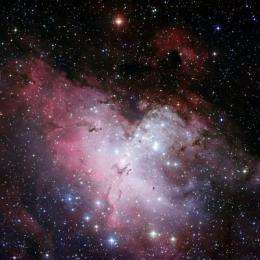
This three-color composite mosaic image of the Eagle Nebula (Messier 16) is based on images obtained with the Wide-Field Imager camera on the MPG/ESO 2.2m telescope at the La Silla Observatory. At the center, the so-called "Pillars of Creation" can be seen. This wide-field infrared image shows not only the central pillars, but also several others in the same star-forming region, as well as a huge number of stars in front of, in, or behind the Eagle Nebula. The cluster of bright stars to the upper right is NGC 6611, home to the massive and hot stars that illuminate the pillars. The "Spire" -- another large pillar -- is in the middle left of the image. Credit: ESO
(PhysOrg.com) -- Today ESO has released a new and stunning image of the sky around the Eagle Nebula, a stellar nursery where infant star clusters carve out monster columns of dust and gas.
Located 7000 light-years away, towards the constellation of Serpens (the Snake), the Eagle Nebula is a dazzling stellar nursery, a region of gas and dust where young stars are currently being formed and where a cluster of massive, hot stars, NGC 6611, has just been born. The powerful light and strong winds from these massive new arrivals are shaping light-year long pillars, seen in the image partly silhouetted against the bright background of the nebula. The nebula itself has a shape vaguely reminiscent of an eagle, with the central pillars being the "talons".
The star cluster was discovered by the Swiss astronomer, Jean Philippe Loys de Chéseaux, in 1745. It was independently rediscovered about twenty years later by the French comet hunter, Charles Messier, who included it as number 16 in his famous catalogue, and remarked that the stars were surrounded by a faint glow. The Eagle Nebula achieved iconic status in 1995, when its central pillars were depicted in a famous image obtained with the NASA/ESA Hubble Space Telescope. In 2001, ESO's Very Large Telescope (VLT) captured another breathtaking image of the nebula, in the near-infrared, giving astronomers a penetrating view through the obscuring dust, and clearly showing stars being formed in the pillars.
The newly released image, obtained with the Wide-Field Imager camera attached to the MPG/ESO 2.2-metre telescope at La Silla, Chile, covers an area on the sky as large as the full Moon, and is about 15 times more extensive than the previous VLT image, and more than 200 times more extensive than the iconic Hubble visible-light image. The whole region around the pillars can now be seen in exquisite detail.
The "Pillars of Creation" are in the middle of the image, with the cluster of young stars, NGC 6611, lying above and to the right. The "Spire" — another pillar captured by Hubble — is at the centre left of the image.
Finger-like features protrude from the vast cloud wall of cold gas and dust, not unlike stalagmites rising from the floor of a cave. Inside the pillars, the gas is dense enough to collapse under its own weight, forming young stars. These light-year long columns of gas and dust are being simultaneously sculpted, illuminated and destroyed by the intense ultraviolet light from massive stars in NGC 6611, the adjacent young stellar cluster. Within a few million years — a mere blink of the universal eye — they will be gone forever.
-
New portrait of Omega Nebula's glistening watercolors
Jul 07, 2009 |
not rated yet |
0
-
Peering into the Pillars of Creation
Feb 15, 2007 |
not rated yet |
0
-
Spitzer Captures Cosmic 'Mountains of Creation'
Nov 10, 2005 |
not rated yet |
0
-
Strong winds over the keel
Feb 12, 2009 |
not rated yet |
0
-
Super-detailed image of giant stellar nursery
Apr 19, 2007 |
not rated yet |
0
-
Engineers build first sub-10-nm carbon nanotube transistor
Feb 01, 2012 |
4.9 / 5 (33) |
30
-
Something old, something new: Evolution and the structural divergence of duplicate genes
Jan 31, 2012 |
4.6 / 5 (7) |
1
-
The hidden nanoworld of ice crystals: Revealing the dynamic behavior of quasi-liquid layers
Jan 30, 2012 |
5 / 5 (4) |
1
-
Stock market network reveals investor clustering
Jan 27, 2012 |
3.9 / 5 (23) |
8
-
Of microchemistry and molecules: Electronic microfluidic device synthesizes biocompatible probes
Jan 26, 2012 |
5 / 5 (2) |
0
-
Never ending outer space.....
23 hours ago
-
Neutron Star fragments?
Feb 11, 2012
-
stationary or not?
Feb 11, 2012
-
Scale of the Universe
Feb 10, 2012
-
Titan's lack of impact craters
Feb 09, 2012
-
Real pictures of black hole eating a star?
Feb 08, 2012
- More from Physics Forums - General Astronomy
More news stories
Salvage workers begin pumping fuel from Italian shipwreck
Salvage workers Sunday began pumping fuel from the shipwrecked Italian cruise liner Costa Concordia, a day ahead of schedule, officials said.
8 hours ago |
5 / 5 (1) |
0
Latin America mining boom clashes with conservation
Latin America is experiencing a mining boom as prices rise fuelled by a hike in global demand, but the region is also being hit by a wave of violent protests, strikes and rallies by environmentalists.
16 hours ago |
5 / 5 (1) |
1
Political leaders play key role in how worried Americans are by climate change: study
More than extreme weather events and the work of scientists, it is national political leaders who influence how much Americans worry about the threat of climate change, new research finds.
Feb 06, 2012 |
5 / 5 (7) |
73
NASA budget will axe Mars deal with Europe: scientists
US President Barack Obama's budget proposal to be submitted next week for 2013 will cut NASA's budget by 20 percent and eliminate a major partnership with Europe on Mars exploration, scientists said Thursday.
Space & Earth / Space Exploration
Feb 10, 2012 |
5 / 5 (3) |
58
Humans may have helped the decline of African rainforests 3000 years ago
(PhysOrg.com) -- Large areas of rainforests in Central Africa mysteriously disappeared over three thousand years ago, to be replaced by savannas. The prevailing theory has been that the cause was a change ...
Scientists discover molecular secrets of 2,000-year-old Chinese herbal remedy
For roughly two thousand years, Chinese herbalists have treated Malaria using a root extract, commonly known as Chang Shan, from a type of hydrangea that grows in Tibet and Nepal. More recent studies suggest that halofuginone, ...
New method to examine batteries -- MRI from the inside
There is an ever-increasing need for advanced batteries for portable electronics, such as phones, cameras, and music players, but also to power electric vehicles and to facilitate the distribution and storage of energy derived ...
A mitosis mystery solved: How chromosomes align perfectly in a dividing cell
Although the process of mitotic cell division has been studied intensely for more than 50 years, Whitehead Institute researchers have only now solved the mystery of how cells correctly align their chromosomes during symmetric ...
Google might launch Drive for cloud storage soon
(PhysOrg.com) -- Google's next big move, according to the Wall Street Journal, is a cloud storage service called Drive. Hardly first to the plate, Google is simply catching up to introducing its cloud reposi ...
Lab study raises questions over nano-particle impact
Tests involving chickens have raised questions about the impact on health from engineered nano-particles, the ultra-fine grains commonly used in drugs and processed foods, scientists said on Sunday.
Overeating may double risk of memory loss
New research suggests that consuming between 2,100 and 6,000 calories per day may double the risk of memory loss, or mild cognitive impairment (MCI), among people age 70 and older. The study was released today and will be ...
Jul 17, 2009
Rank: 1 / 5 (1)
But what is the basis for saying that this "is a dazzling stellar nursery, a region of gas and dust where young stars are currently being formed and where a cluster of massive, hot stars, NGC 6611, has just been born."
With kind regards,
Oliver K. Manuel
http://www.omatumr.com