NASA lost moon footage, but Hollywood restores it (Update)
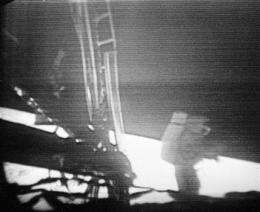
(AP) -- NASA could put a man on the moon but didn't have the sense to keep the original video of the live TV transmission.
In an embarrassing acknowledgment, the space agency said Thursday that it must have erased the Apollo 11 moon footage years ago so that it could reuse the videotape.
But now Hollywood is coming to the rescue.
The studio wizards who restored "Casablanca" are digitally sharpening and cleaning up the ghostly, grainy footage of the moon landing, making it even better than what TV viewers saw on July 20, 1969. They are doing it by working from four copies that NASA scrounged from around the world.
"There's nothing being created; there's nothing being manufactured," said NASA senior engineer Dick Nafzger, who is in charge of the project. "You can now see the detail that's coming out."
The first batch of restored footage was released just in time for the 40th anniversary of the "one giant leap for mankind," and some of the details seem new because of their sharpness. Originally, astronaut Neil Armstrong's face visor was too fuzzy to be seen clearly. The upgraded video of Earth's first moonwalker shows the visor and a reflection in it.
The $230,000 refurbishing effort is only three weeks into a monthslong project, and only 40 percent of the work has been done. But it does show improvements in four snippets: Armstrong walking down the ladder; Buzz Aldrin following him; the two astronauts reading a plaque they left on the moon; and the planting of the flag on the lunar surface.
Nafzger said a huge search that began three years ago for the old moon tapes led to the "inescapable conclusion" that 45 tapes of Apollo 11 video were erased and reused. His report on that will come out in a few weeks.
The original videos beamed to Earth were stored on giant reels of tape that each contained 15 minutes of video, along with other data from the moon. In the 1970s and '80s, NASA had a shortage of the tapes, so it erased about 200,000 of them and reused them.
How did NASA end up looking like a bumbling husband taping over his wedding video with the Super Bowl?
Nafzger, who was in charge of the live TV recordings back in the Apollo years, said they were mostly thought of as data tapes. It wasn't his job to preserve history, he said, just to make sure the footage worked. In retrospect, he said he wished NASA hadn't reused the tapes.
Outside historians were aghast.
"It's surprising to me that NASA didn't have the common sense to save perhaps the most important historical footage of the 20th century," said Rice University historian and author Douglas Brinkley. He noted that NASA saved all sorts of data and artifacts from Apollo 11, and it is "mind-boggling that the tapes just disappeared."
The remastered copies may look good, but "when dealing with historical film footage, you always want the original to study," Brinkley said.
Smithsonian Institution space curator Roger Launius, a former NASA chief historian, said the loss of the original video "doesn't surprise me that much."
"It was a mistake, no doubt about that," Launius said. "This is a problem inside the entire federal government. ... They don't think that preservation is all that important."
Launius said federal warehouses where historical artifacts are saved are "kind of like the last scene of `Raiders of the Lost Ark.' It just goes away in this place with other big boxes."
The company that restored all the Indiana Jones movies, including "Raiders," is the one bailing out NASA.
Lowry Digital of Burbank, Calif., noted that "Casablanca" had a pixel count 10 times higher than the moon video, meaning the Apollo 11 footage was fuzzier than that vintage movie and more of a challenge in one sense.
Of all the video the company has dealt with, "this is by far and away the lowest quality," said Lowry president Mike Inchalik.
Nafzger praised Lowry for restoring "crispness" to the Apollo video. Historian Launius wasn't as blown away.
"It's certainly a little better than the original," Launius said. "It's not a lot better."
The Apollo 11 video remains in black and white. Inchalik said he would never consider colorizing it, as has been done to black-and-white classic films. And the moon is mostly gray anyway.
The restoration used four video sources: CBS News originals; kinescopes from the National Archives; a video from Australia that received the transmission of the original moon video; and camera shots of a TV monitor.
Both Nafzger and Inchalik acknowledged that digitally remastering the video could further encourage conspiracy theorists who believe NASA faked the entire moon landing on a Hollywood set. But they said they enhanced the video as conservatively as possible.
Besides, Inchalik said that if there had been a conspiracy to fake a moon landing, NASA surely would have created higher-quality film.
Back in 1969, nearly 40 percent of the picture quality was lost converting from one video format used on the moon - called slow scan - to something that could be played on TVs on Earth, Nafzger said.
NASA did not lose other Apollo missions' videos because they weren't stored on the type of tape that needed to be reused, Nafzger said.
As part of the moon landing's 40th anniversary, the space agency has been trotting out archival material. NASA has a Web site with audio from private conversations in the lunar module and command capsule. The agency is also webcasting radio from Apollo 11 as if the mission were taking place today.
The video restoration project did not involve improving the sound. Inchalik said he listened to Armstrong's famous first words from the surface of the moon, trying to hear if he said "one small step for man" or "one small step for A man," but couldn't tell.
Through a letter read at a news conference Thursday, Armstrong had the last word about the video from the moon: "I was just amazed that there was any picture at all."
---
On the Net:
NASA restored video: http://www.nasa.gov/multimedia/hd/apollo11.html
NASA audio from the lunar module and command capsule:
http://www.nasa.gov/mission(underscore)pages/apollo/40th/apollo11(underscore)audio.html
NASA's replay of the Apollo radio in real-time minus 40 years:
http://www.nasa.gov/externalflash/apollo11(underscore)radio
©2009 The Associated Press. All rights reserved. This material may not be published, broadcast, rewritten or redistributed.


