Estrogen can reduce stroke damage by inactivating protein
July 16, 2009 Estrogen can reduce stroke damage by inactivating protein

Enlarge

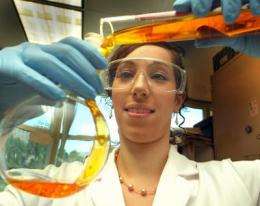
Limor Raz, a fourth-year Ph.D. student at the Medical College of Georgia, will present her research on how estrogen can reduce stroke damage by inactivating a tumor-suppressing protein at the American Physiological Society conference. Credit: Medical College of Georgia

Estrogen can halt stroke damage by inactivating a tumor-suppressing protein known to prevent many cancers, Medical College of Georgia researchers say.

"Our research suggests that estrogen suppresses p53 after stroke, which stops the damage," says Limor Raz, a fourth-year Ph.D. student in the MCG School of Graduate Studies.

P53, the protein in the , or powerhouse, of the cell, is known as "the guardian of the genome" because it regulates the cell cycle and prevents genome mutation. It also can prevent cancer by suppressing tumor growth.

It is known that stressful conditions such as a stroke activate p53, triggering unfavorable changes in the cell. One change is the activation of another protein called PUMA, which signals a cascading effect that destroys the mitochondria and causes cell death, or apoptosis.

Ms. Raz found that estrogen can chemically alter p53 and attenuate the cascade, thus leading to reduced stroke damage.

She has been working with Dr. Darrell Brann, chief of developmental neurobiology and associate director of the MCG Institute of Molecular Medicine and Genetics, and will present her findings today in Colorado at the American Physiological Society conference focusing on the cardiovascular effects of sex steroids and gender.

Global cerebral ischemia, the most common type of , in which blood flow to the brain is disrupted, was induced, damaging primarily the hippocampal CA1 region of the brain. In this study, a group of female rats were treated with estrogen versus placebo for seven days and estrogen's effect on p53 signaling was examined.

"This part of the brain is extremely important because it is where our memory and learning occur," Ms. Raz says. "During a , you have all these things happening in your , and we've found that treatment is effective in reducing some of the damage."

The next step, she says, is to determine why. "We know that it does, and now we need to find out how."

Source: Medical College of Georgia


print this article email this article download pdf blog this article bookmark this article     Stumble it Digg this share on Facebook retweet share on Reddit add to delicious
Rate this story - not rated yet


July 16, 2009 all stories

Comments: 0

not rated yet
  • Stumble this up

  • Digg this

  • share this

  • hide
  • Related Stories

  • Stabilizing cancer-fighting p53 can also shield a metastasis-promoter
    created May 22, 2008 | popularity not rated yet | comments 0
  • Effect of mutant p53 stability on tumorigenesis and drug design
    created May 15, 2008 | popularity not rated yet | comments 0
  • Study details regulation of vital tumor suppressor gene p53
    created Sep 05, 2007 | popularity not rated yet | comments 0
  • Gene Gives a Boost to Tumor Suppression
    created Aug 18, 2006 | popularity not rated yet | comments 0
  • Scientists find guardian gene's choices crucial to stopping cancer process
    created Jan 08, 2007 | popularity not rated yet | comments 0


  • hide
  • Relevant PhysicsForums posts

  • 23 Years in a Vegetative State....or not?
    created Nov 25, 2009
  • Has the H1N1 vaccine been scientifically proven to work?
    created Nov 24, 2009
  • nesfatin
    created Nov 22, 2009
  • Obsessive Compulsive Disorder
    created Nov 20, 2009
  • More from Physics Forums - Medical Sciences

Other News

Coma recovery case attracts doubters

Medicine & Health / Other

created 9 hours ago | popularity 5 / 5 (1) | comments 1

(AP) -- Rom Houben's mother remembers her son's amazement when he finally started communicating again after spending 23 years locked in a paralyzed body that was misdiagnosed as vegetative.


Girl's progress after pioneering brain surgery gives hope to other parents

Medicine & Health / Other

created 10 hours ago | popularity 5 / 5 (3) | comments 0

Lexi Haas is awakening into a world of new possibilities. Miracle by tiny miracle, she is making her body do what she wants -- instead of her body always controlling her. She looked up at her mother a few weeks ago, pursed ...


Physician-scientist proves stem cells heal lungs of newborn animals

Medicine & Health / Research

created 10 hours ago | popularity 5 / 5 (1) | comments 0

Dr. Bernard Thébaud lives in two very different worlds. As a specialist in the Stollery Children's Hospital's Neonatal Intensive Care Unit at the Royal Alexandra Hospital, he cares for tiny babies, many of whom struggle ...


Heavy drinkers exercise to burn off alcohol: British study

Medicine & Health / Health

created 12 hours ago | popularity not rated yet | comments 0

More than a quarter of drinkers in England who exercise regularly do so in an attempt to make up for bingeing on alcohol, according to a survey published Thursday.


WHO says Tamiflu still works against swine flu

Medicine & Health / Medications

created 12 hours ago | popularity not rated yet | comments 0

(AP) -- The World Health Organization says isolated cases of drug-resistant swine flu in Britain and the United States have not changed the agency's assessment of the disease.