Scientists say that microbial mats built 3.4-billion-year-old stromatolites
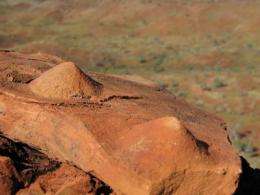
Stromatolites are dome- or column-like sedimentary rock structures that are formed in shallow water, layer by layer, over long periods of geologic time. Now, researchers from the California Institute of Technology (Caltech) and the Jet Propulsion Laboratory (JPL) have provided evidence that some of the most ancient stromatolites on our planet were built with the help of communities of equally ancient microorganisms, a finding that "adds unexpected depth to our understanding of the earliest record of life on Earth," notes JPL astrobiologist Abigail Allwood, a visitor in geology at Caltech.
Their research, published in a recent issue of the Proceedings of the National Academy of Sciences (PNAS), might also provide a new avenue for exploration in the search for signs of life on Mars.
"Stromatolites grow by accreting sediment in shallow water," says John Grotzinger, the Fletcher Jones Professor of Geology at Caltech. "They get molded into these wave forms and, over time, the waves turn into discrete columns that propagate upward, like little knobs sticking up."
Geologists have long known that the large majority of the relatively young stromatolites they study—those half a billion years old or so—have a biological origin; they're formed with the help of layers of microbes that grow in a thin film on the seafloor.
How? The microbes' surface is coated in a mucilaginous substance to which sediment particles rolling past get stuck. "It has a strong flypaper effect," says Grotzinger. In addition, the microbes sprout a tangle of filaments that almost seem to grab the particles as they move along.
"The end result," says Grotzinger, "is that wherever the mat is, sediment gets trapped."
Thus it has become accepted that a dark band in a young stromatolite is indicative of organic material, he adds. "It's matter left behind where there once was a mat."
But when you look back 3.45 billion years, to the early Archean period of geologic history, things aren't quite so simple.
"Because stromatolites from this period of time have been around longer, more geologic processing has happened," Grotzinger says. Pushed deeper toward the center of Earth as time went by, these stromatolites were exposed to increasing, unrelenting heat. This is a problem when it comes to examining the stromatolites' potential biological beginnings, he explains, because heat degrades organic matter. "The hydrocarbons are driven off," he says. "What's left behind is a residue of nothing but carbon."
This is why there has been an ongoing debate among geologists as to whether or not the carbon found in these ancient rocks is diagnostic of life or not.
Proving the existence of life in younger rocks is fairly simple—all you have to do is extract the organic matter, and show that it came from the microorganisms. But there's no such cut-and-dried method for analyzing the older stromatolites. "When the rocks are old and have been heated up and beaten up," says Grotzinger, "all you have to look at is their texture and morphology."
Which is exactly what Allwood and Grotzinger did with samples gathered at the Strelley Pool stromatolite formation in Western Australia. The samples, says Grotzinger, were "incredibly well preserved." Dark lines of what was potentially organic matter were "clearly associated with the lamination, just like we see in younger rocks. That sort of relationship would be hard to explain without a biological mechanism."
"We already knew from our earlier work that we had an assemblage of stromatolites that was most plausibly interpreted as a microbial reef built by Early Archean microorganisms," adds Allwood, "but direct evidence of actual microorganisms was lacking in these ancient, altered rocks. There were no microfossils, no organic material, not even any of the microtextural hallmarks typically associated with microbially mediated sedimentary rocks."
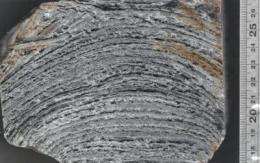
So Allwood set about trying to find other types of evidence to test the biological hypothesis. To do so, she looked at what she calls the "microscale textures and fabrics in the rocks, patterns of textural variation through the stromatolites and—importantly—organic layers that looked like actual fossilized organic remnants of microbial mats within the stromatolites."
What she saw were "discrete, matlike layers of organic material that contoured the stromatolites from edge to edge, following steep slopes and continuing along low areas without thickening." She also found pieces of microbial mat incorporated into storm deposits, which disproved the idea that the organic material had been introduced into the rock more recently, rather than being laid down with the original sediment. "In addition," Allwood notes, "Raman spectroscopy showed that the organics had been 'cooked' to the same burial temperature as the host rock, again indicating the organics are not young contaminants."
Allwood says she, Grotzinger, and their team have collected enough evidence that it's no longer any "great leap" to accept these stromatolites as biological in origin. "I think the more we dig at these stromatolites, the more evidence we'll find of Early Archean life and the nature of Earth's early ecosystems," she says.
That's no small feat, since it's been difficult to prove that life existed at all that far back in the geologic record. "Recently there has been increasing but still indirect evidence suggesting life existed back then, but direct evidence of microorganisms, at the microscale, remained elusive due to poor preservation of the rocks," Allwood notes. "I think most people probably thought that these Early Archean rocks were too poorly preserved to yield such information."
The implications of the findings don't stop at life on Earth.
"One of my motivations for understanding stromatolites," Allwood says, "is the knowledge that if microbial communities once flourished on Mars, of all the traces they might leave in the rock record for us to discover, stromatolite and microbial reefs are arguably the most easily preserved and readily detected. Moreover, they're particularly likely to form in evaporative, mineral-precipitating settings such as those that have been identified on Mars. But to be able to interpret stromatolitic structures, we need a much more detailed understanding of how they form."
Source: California Institute of Technology (news : web)


