'Motion picture' of past warming paves way for snapshots of future climate change

July 16, 2009
Supercomputer simulations of the Earth’s most recent natural global warming (more than 14,000 years ago) show melting ice sheets and a 15-degree Celsius temperature spike over the course of a few centuries. Extended 200 years into our future, the simulations - led by University of Wisconsin-Madison climatologists - will provide insight on climate changes in our own time. Image credit: Jamison Daniel/National Center for Computational Sciences.
(PhysOrg.com) -- By accurately modeling Earth's last major global warming -- and answering pressing questions about its causes -- scientists led by a University of Wisconsin-Madison climatologist are unraveling the intricacies of the kind of abrupt climate shifts that may occur in the future.
"We want to know what will happen in the future, especially if the climate will change abruptly," says Zhengyu Liu, a UW-Madison professor of atmospheric and oceanic sciences and director of the Center for Climatic Research in the Nelson Institute for Environmental Studies. "The problem is, you don't know if your model is right for this kind of change. The important thing is validating your model."
To do so, Liu and his colleagues run their mode back in time and match the results of the climate simulation with the physical evidence of past climate.
Starting with the last glacial maximum about 21,000 years ago, Liu's team simulated atmospheric and oceanic conditions through what scientists call the Bølling-Allerød warming, the Earth's last major temperature hike, which occurred about 14,500 years ago. The simulation fell in close agreement with conditions — temperatures, sea levels and glacial coverage — collected from fossil and geologic records.
"It's our most serious attempt to simulate this last major global warming event, and it's a validation of the model itself, as well," Liu says.
The results of the new climate modeling experiments are presented today (July 17) in the journal Science.
The group's simulations were executed on "Phoenix" and "Jaguar," a pair of Cray supercomputers at Oak Ridge National Laboratory in Oak Ridge, Tenn., and helped pin down the contributions of three environmental factors as drivers of the Bølling-Allerød warming: an increase in atmospheric carbon dioxide, the jump-start of stalled heat-moving ocean currents and a large buildup of subsurface heat in the ocean while those currents were dormant.
The climate dominoes began to fall during that period after glaciers reached their maximum coverage, blanketing most of North America, Liu explains. As glaciers melted, massive quantities of water poured into the North Atlantic, lowering the ocean salinity that helps power a major convection current that acts like a conveyor belt to carry warm tropical surface water north and cooler, heavier subsurface water south.
As a result, according to the model, ocean circulation stopped. Without warm tropical water streaming north, the North Atlantic cooled and heat backed up in southern waters. Subsequently, glacial melt slowed or stopped as well, and eventually restarted the overturning current — which had a much larger reserve of heat to haul north.
"All that stored heat is released like a volcano, and poured out over decades," Liu explains. "That warmed up Greenland and melted (arctic) sea ice."
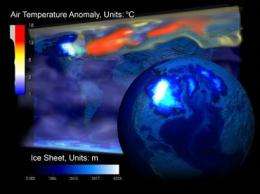
Supercomputer simulations of the Earth's most recent natural global warming (more than 14,000 years ago) show melting ice sheets and a 15-degree Celsius temperature spike over the course of a few centuries. Extended 200 years into our future, the simulations - led by University of Wisconsin-Madison climatologists - will provide insight on climate changes in our own time. Image credit: Jamison Daniel/National Center for Computational Sciences. Image by: Jamison Daniel/National Center for Computational Sciences.
The model showed a 15-degree Celsius increase in average temperatures in Greenland and a 5-meter increase in sea level over just a few centuries, findings that squared neatly with the climate of the period as represented in the physical record."Being able to successfully simulate thousands of years of past climate for the first time with a comprehensive climate model is a major scientific achievement," notes Bette Otto-Bliesner, an atmospheric scientist and climate modeler at National Center for Atmospheric Research (NCAR) and co-author of the Science report. "This is an important step toward better understanding how the world's climate could change abruptly over the coming centuries with increasing melting of the ice caps."
The rate of ice melt during the Bølling-Allerød warming is still at issue, but its consequences are not, Liu says. The modelers simulated both a slow decrease in melt and a sudden end to melt run-off. In both cases, the result was a 15-degree warming.
"That happened in the past," Liu says. "The question is, in the future, if you have a global warming and Greenland melts, will it happen again?"
Time — both actual and computing — will tell. In 2008, the group simulated about one-third of the last 21,000 years. With another 4 million processor hours to go, the simulations being conducted by the Wisconsin group will eventually run up to the present and 200 years into the future.
Traditional climate modeling approaches were limited by computer time and capabilities, Lieu explains.
"They did slides, like snapshots," Liu says. "You simulate 100 years, and then you run another 100 years, but those centuries may be 2,000 years apart (in the model). To look at abrupt change, there is no shortcut."
Using the interactions between land, water, atmosphere and ice in the Community Climate System Model developed at NCAR, the researchers have been able to create a much more detailed and closely spaced book of snapshots, "giving us more of a motion picture of the climate" over millennia, Liu said.
He stressed the importance of drawing together specialists in computing, oceanography, atmospheric science and glaciers — including John Kutzbach, a UW-Madison climate modeler, and UW-Madison doctoral student Feng He, responsible for modeling the glacial melt. All were key to attaining the detail necessary in recreating historical climate conditions, Liu says.
"All this data, it's from chemical proxies and bugs in the sediment," Liu said. "You really need a very interdisciplinary team: people on deep ocean, people on geology, people who know those bugs. It is a huge — and very successful — collaboration."
-
Scientists confirm historic massive flood in climate change
Feb 28, 2006 |
not rated yet |
0
-
Abrupt ice retreat could produce ice-free arctic summers by 2040
Dec 11, 2006 |
not rated yet |
0
-
Researchers confirm role of massive flood in climate change
Jan 10, 2006 |
not rated yet |
0
-
Shutdown of circulation pattern could be disastrous, researchers say
Dec 13, 2004 |
not rated yet |
0
-
Ecologists use oceanographic data to predict future climate change
Nov 06, 2008 |
not rated yet |
0
-
Engineers build first sub-10-nm carbon nanotube transistor
Feb 01, 2012 |
4.9 / 5 (33) |
30
-
Something old, something new: Evolution and the structural divergence of duplicate genes
Jan 31, 2012 |
4.6 / 5 (7) |
1
-
The hidden nanoworld of ice crystals: Revealing the dynamic behavior of quasi-liquid layers
Jan 30, 2012 |
5 / 5 (4) |
1
-
Stock market network reveals investor clustering
Jan 27, 2012 |
3.9 / 5 (23) |
8
-
Of microchemistry and molecules: Electronic microfluidic device synthesizes biocompatible probes
Jan 26, 2012 |
5 / 5 (2) |
0
-
Do some geologists actually act a lot like Randy Marsh?
Feb 11, 2012
-
Discrepancy between oxygen and carbon-dioxide levels
Feb 09, 2012
-
where gems are found in the world
Feb 09, 2012
-
Wind Waves in Reservoir ~ Wind run-up and Wind set-up
Feb 08, 2012
-
Balance of oxygen in the atmosphere
Feb 01, 2012
-
The case for a methanol-based economy
Jan 30, 2012
- More from Physics Forums - Earth
More news stories
Salvage workers begin pumping fuel from Italian shipwreck
Salvage workers Sunday began pumping fuel from the shipwrecked Italian cruise liner Costa Concordia, a day ahead of schedule, officials said.
7 hours ago |
5 / 5 (1) |
0
Latin America mining boom clashes with conservation
Latin America is experiencing a mining boom as prices rise fuelled by a hike in global demand, but the region is also being hit by a wave of violent protests, strikes and rallies by environmentalists.
15 hours ago |
5 / 5 (1) |
1
Political leaders play key role in how worried Americans are by climate change: study
More than extreme weather events and the work of scientists, it is national political leaders who influence how much Americans worry about the threat of climate change, new research finds.
Feb 06, 2012 |
5 / 5 (7) |
73
NASA budget will axe Mars deal with Europe: scientists
US President Barack Obama's budget proposal to be submitted next week for 2013 will cut NASA's budget by 20 percent and eliminate a major partnership with Europe on Mars exploration, scientists said Thursday.
Space & Earth / Space Exploration
Feb 10, 2012 |
5 / 5 (3) |
58
Humans may have helped the decline of African rainforests 3000 years ago
(PhysOrg.com) -- Large areas of rainforests in Central Africa mysteriously disappeared over three thousand years ago, to be replaced by savannas. The prevailing theory has been that the cause was a change ...
Scientists discover molecular secrets of 2,000-year-old Chinese herbal remedy
For roughly two thousand years, Chinese herbalists have treated Malaria using a root extract, commonly known as Chang Shan, from a type of hydrangea that grows in Tibet and Nepal. More recent studies suggest that halofuginone, ...
New method to examine batteries -- MRI from the inside
There is an ever-increasing need for advanced batteries for portable electronics, such as phones, cameras, and music players, but also to power electric vehicles and to facilitate the distribution and storage of energy derived ...
A mitosis mystery solved: How chromosomes align perfectly in a dividing cell
Although the process of mitotic cell division has been studied intensely for more than 50 years, Whitehead Institute researchers have only now solved the mystery of how cells correctly align their chromosomes during symmetric ...
Overeating may double risk of memory loss
New research suggests that consuming between 2,100 and 6,000 calories per day may double the risk of memory loss, or mild cognitive impairment (MCI), among people age 70 and older. The study was released today and will be ...
Lab study raises questions over nano-particle impact
Tests involving chickens have raised questions about the impact on health from engineered nano-particles, the ultra-fine grains commonly used in drugs and processed foods, scientists said on Sunday.
Google might launch Drive for cloud storage soon
(PhysOrg.com) -- Google's next big move, according to the Wall Street Journal, is a cloud storage service called Drive. Hardly first to the plate, Google is simply catching up to introducing its cloud reposi ...

Jul 16, 2009
Rank: 4 / 5 (9)
As a scientist I take exception to how she worded this... The important thing is not finding some evidence to validate your model, it's to find that your model is validated by all the evidence. Two different things.
And if you're using the data your model is based off of to validate it, of course you will find it validated.
Jul 16, 2009
Rank: 4 / 5 (4)
Well I definitely agree... :)
Jul 16, 2009
Rank: 3 / 5 (6)
Jul 16, 2009
Rank: 2.3 / 5 (4)
Jul 17, 2009
Rank: 5 / 5 (1)
How is this any different then what I said: finding that evidence supports your model?
Maybe I misinterpreted her then when she describes what they are modeling,
"Bølling-Allerød warming: an increase in atmospheric carbon dioxide, the jump-start of stalled heat-moving ocean currents and a large buildup of subsurface heat in the ocean while those currents were dormant"
Which are events derived from chemical proxies as well as anthropological, plant and animal records. Then she goes on to describe the data they are comparing it against...
"All this data, it's from chemical proxies and bugs in the sediment,"
Hmmm...
My problem was mainly with how she spoke, the article doesn't really say anything at all about how they scripted the coding so that leaves it open to speculation, but the way she phrases their goal, it just sounded like they set out to find data that supports their model.
Jul 17, 2009
Rank: not rated yet
Jul 17, 2009
Rank: not rated yet
the inputs for their simulation were the initial conditions for the Bølling-Allerød warming, as derived from empirical data. However, to validate their outputs:
Which, while still empirical data, is empirical data distinct from that which established the initial conditions. It's the difference between inputting the initial numbers, vs. computationally reproducing the observed time-curves of the relevant parameters. The latter is what constitutes validation of the model.
Jul 19, 2009
Rank: not rated yet
Falsifying it says that you can determine when somebody is pulling your chain.
If you can't distinguish between a well designed experiment and faked data you can't prove the correctness (or incorrectness) of your hypothesis.
I would add another step to thermodynamics' posting. You start with an observation and then create a hypothesis to explain your observations. After that you test your hypothesis, write it up, and let everybody else take pot-shots at it.