Researchers discover evolutionary event underlying the origin of dachshunds, dogs with short legs
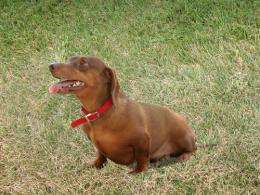
A single evolutionary event appears to explain the short, curved legs that characterize all of today's dachshunds, corgis, basset hounds and at least 16 other breeds of dogs, a team led by the National Human Genome Research Institute (NHGRI), part of the National Institutes of Health, reported today. In addition to what it reveals about short-legged dogs, the unexpected discovery provides new clues about how physical differences may arise within species and suggests new approaches to understanding a form of human dwarfism.
In a study published in the advance online edition of the journal Science, the researchers led by NHGRI's Elaine Ostrander, Ph.D., examined DNA samples from 835 dogs, including 95 with short legs. Their survey of more than 40,000 markers of DNA variation uncovered a genetic signature exclusive to short-legged breeds. Through follow-up DNA sequencing and computational analyses, the researchers determined the dogs' disproportionately short limbs can be traced to one mutational event in the canine genome — a DNA insertion — that occurred early in the evolution of domestic dogs.
"Every species, including canine and human, carries an amazing record of evolution scripted in its genome that can teach us about the mechanisms at work in biology, as well as about human health and disease," said NHGRI Scientific Director Eric Green, M.D., Ph.D. "This work provides surprising evidence of a new way in which genome evolution may serve to generate diversity within a species."
Specifically, the researchers found that in contrast to other dog breeds, all short-legged dog breeds have an extra copy of the gene that codes for a growth-promoting protein called fibroblast growth factor 4 (FGF4). Although functional, the extra gene lacks certain parts of the DNA code, called introns, found in normal genes. These characteristics led researchers to conclude that the extra gene is a so-called retrogene that was inserted into the dog genome some time after the ancestor of modern dog breeds diverged from wolves.
To understand retrogenes, one first needs to understand how the cell normally makes proteins. To produce a protein, a gene's DNA code is transcribed into a molecule called messenger RNA (mRNA). The mRNA then leaves the cell's nucleus and enters the outer region of the cell, called the cytoplasm. There the mRNA is read by tiny molecular machines, called ribosomes, which use the information to assemble proteins.
Retrogenes are formed when the mRNA encounters something — often a type of virus called a retrovirus — that turns it back into DNA through a process referred to as reverse transcription. This new piece of DNA, which contains the same protein-coding information as the gene that produced the mRNA, may then be inserted back into the genome, usually at a much different place than the original gene. Depending on where it is inserted, this piece of DNA may or may not be capable of producing proteins. If it is functional, it is called a retrogene.
In the case of short-legged dogs, the inserted retrogene results in the overproduction of the FGF4 protein, which researchers hypothesize may turn on key growth receptors at the wrong times during fetal development. Veterinary researchers already know that in certain dog breeds the development of long bones is curtailed due to calcification of growth plates, resulting in short legs with a curved appearance. The trait, called disproportional dwarfism, or chondrodysplasia, is an American Kennel Club standard for more than a dozen domestic dog breeds, including the dachshund, corgi, Pekingese and basset hound. This trait is distinct from the uniformly miniature size of toy breeds, such as the toy poodle.
"Our findings suggest that retrogenes may play a larger role in evolution than has been previously thought, especially as a source of diversity within species," said the study's first author, Heidi G. Parker, Ph.D. of NHGRI. "We were surprised to find that just one retrogene inserted at one point during the evolution of a species could yield such a dramatic physical trait that has been conserved over time."
In the past, retrogenes have been recognized as an important source of changes that have fueled the divergence of species. However, the dog findings are the first example of a retrogene that has spurred significant and long-lasting variation within a single species.
The findings also may have implications for understanding human biology and disease. Researchers note that some people are affected by a similar appearing growth disorder, called hypochondroplasia, which belongs to a group of conditions commonly referred to as dwarfism. While about two-thirds of cases of human hypochondroplasia have been linked to a different gene, the cause of the other one-third remains a mystery.
"This study points to a new gene that should be investigated for its possible role in human hypochondroplasia," said Dr. Ostrander, the study's senior author and a senior investigator in NHGRI's Division of Intramural Research. "Our findings may prove valuable to scientists studying other aspects of human growth and development. The work also underscores the value of canine studies for uncovering new biological mechanisms that are likely relevant to human disease."
Source: NIH/National Human Genome Research Institute


