After Five Years, NASA's Aura Shines Brightly
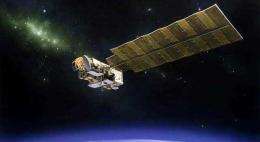
(PhysOrg.com) -- On July 15, 2004, NASA's Aura spacecraft launched from California's Vandenberg Air Force Base on a mission to study Earth's ozone layer, air quality and climate. Aura's data are helping scientists address global climate change issues such as global warming; the global transport, distribution and chemistry of polluted air; and ozone depletion in the stratosphere, the layer of Earth's atmosphere that extends from roughly 15 to 50 kilometers (10 to 30 miles) in altitude.
Two of Aura's four instruments were designed, built and managed by NASA's Jet Propulsion Laboratory, Pasadena, Calif.: the Microwave Limb Sounder and the Tropospheric Emission Spectrometer. Five years after launch, both instruments are still going strong, providing a wealth of data to climate scientists around the world.
Microwave Limb Sounder
The Microwave Limb Sounder is a second-generation instrument that is helping scientists improve our understanding of ozone in Earth's stratosphere, especially how it is depleted by processes of chlorine chemistry. The instrument measures naturally occurring microwave thermal emission from the edge of Earth's atmosphere to remotely sense vertical profiles of atmospheric gases, temperature, pressure and cloud ice.
Research results to date from Aura's Microwave Limb Sounder include findings pertinent to the loss of ozone in the polar stratosphere; water vapor and cloud ice processes in the upper troposphere--the region of our atmosphere that extends from roughly 10 to 15 kilometers (6 to 10 miles) in altitude--that affect climate; measurements of stratospheric chlorine and bromine, two gases involved in the destruction of ozone; the chemistry of hydrogen in the stratosphere and mesosphere (the layer of Earth's atmosphere directly above the stratosphere); chemical and physical processes at and near the tropical tropopause (the boundary between the troposphere and the stratosphere); the dynamics and transport of chemicals in the stratosphere; and pollution in the upper troposphere, to name just a few.
"It has been extremely gratifying to see how the Microwave Limb Sounder observations have been used by scientists around the world in important and creative studies that have improved our understanding of the complex processes affecting our atmosphere," said Microwave Limb Sounder Principal Investigator Nathaniel Livesey of JPL.
Tropospheric Emission Spectrometer
The Tropospheric Emission Spectrometer is an infrared sensor designed to study Earth's troposphere, the layer of Earth's atmosphere where we live. The spectrometer is gathering data on how gases are distributed globally in Earth's lower atmosphere. These data are being used to create three-dimensional models of the chemistry of the lower atmosphere, the interactions between the lower atmosphere and the biosphere, and the exchange of gases between Earth's troposphere and stratosphere.
While the Tropospheric Emission Spectrometer can detect and measure many components of the troposphere, one of its main purposes is to study ozone. Low levels of ozone are a natural component of the troposphere, but higher levels, usually associated with polluted environments, are dangerous to plants and animals, including humans. The spectrometer is providing important data on where ozone in the troposphere comes from and how it interacts with other chemicals in the atmosphere.
Research highlights so far from the spectrometer include studies that validate how pollutants are transported globally from continent to continent; differentiation of "heavy" water vapor from normal vapor, which can be used to track evaporation and precipitation cycles in the atmosphere; the first direct measurements of how ozone in the upper troposphere contributes to climate change; monitoring ozone and its transport at or near Earth's surface; and measuring ammonia-a significant source of aerosols-in the lower atmosphere.
"The biggest impact made by the Tropospheric Emission Spectrometer to date has been to demonstrate that it is possible to make accurate measurements of ozone in the lower atmosphere (troposphere) despite the fact that there is 10 times more ozone in the stratosphere," said Tropospheric Emission Spectrometer Principal Investigator Reinhard Beer of JPL.
Provided by JPL/NASA (news : web)


