Edible coating makes fish filets longer-lasting, healthier
July 16, 2009 Edible coating makes fish filets longer-lasting, healthier

Enlarge

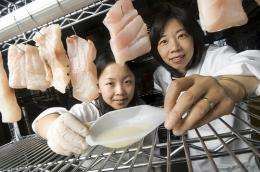
Oregon State University's Jingyun Duan (left) and Yanyun Zhao show off a liquid coating into which they've dipped lingcod fillets to make them longer-lasting and possibly healthier. Photo by Lynn Ketchum.

Consumers may be able to eat longer-lasting, potentially healthier fish fillets if research at Oregon State University makes its way to the supermarket.

That's because OSU scientists have extended the shelf life of lingcod fillets and possibly made them more nutritious by dipping them into an edible, protective enriched with oil.

"With this coating, you can easily keep the fillets in the display case for two to three more days," said OSU food science professor Yanyun Zhao, the lead researcher in the study.

The liquid coating contained chitosan, which comes from crustacean shells and can be made into film for food wrapping to keep out bacteria and fungi and prolong storage life. What's unusual about the OSU study is that was added to the chitosan coating, which wasn't visible once it dried. After the coating was applied, some fillets were refrigerated for three weeks while others were frozen for three months.

The study, which has been accepted for publication in the journal Food Chemistry and has been published on its Web site, found that the coating tripled the omega-3 in the refrigerated and frozen fish when compared against the uncoated fish.

Omega-3 fatty acids are essential nutrients, and research suggests that increasing them may have a number of health benefits. The U.S. Food and Drug Administration says specific ones may reduce the risk of coronary heart disease. But questions still remain about how these fatty acids might prevent or treat certain diseases.

are found in oily fish like salmon, mackerel and sardines, but lean fish such as cod, grouper, catfish and swordfish have lower amounts. Lingcod was chosen for the study because it's a popular fish on the West Coast and doesn't have much fat.

In addition to increasing the omega-3 levels in the lingcod, the OSU study also found that the coating reduced lipid oxidation, which causes rancidity, in the refrigerated and frozen samples when compared with the uncoated fillets. The coating also kept the fish moister than the uncoated samples as the frozen ones were thawing. Additionally, the coating delayed the growth of microorganisms in the fresh fillets, and it prevented their growth in the frozen ones. The coating did not affect the color of the fillets.

Source: Oregon State University (news : web)


print this article email this article download pdf blog this article bookmark this article     Stumble it Digg this share on Facebook retweet share on Reddit add to delicious
Rate this story - 2.8 /5 (4 votes)

Rank Filter

Move the slider to adjust rank threshold, so that you can hide some of the comments.


Display comments: newest first

  • Egnite - Jul 17, 2009
    • Rank: not rated yet
    "Although there are no well-known adverse side effects of chitosan, perhaps one reason for this is that there are still no long-term studies of the side effects of chitosan on human health as most of the studies were conducted on animals. However, if we will look at those animal studies and the first published 1999 clinical trial done on humans, results suggest that chitosan could inhibit the absorption of minerals and fat soluble vitamins. Also, studies have shown certain adverse side effects of chitosan to pregnant women, particularly on the growth of children and the outcome of pregnancy. Experts also found out other minor side effects of chitosan. These possible side effects may include respiratory problems or tightness in your chest or throat, as well as chest pain and skin hives, rash, or itchy or swollen skin, headaches and swollen heels and wrists but these were mainly associated with an allergic rection to shellfish."


    Sounds like the usual routine of creating preservatives without researching long term side effects. Think I'll stick to eating the freshest fish I can find since they are always the best tasting!

    http://chitosanpl...san.html

July 16, 2009 all stories

Comments: 1

2.8 /5 (4 votes)
  • Stumble this up

  • Digg this

  • share this

  • hide
  • Related Stories


  • hide
  • Relevant PhysicsForums posts

  • a question in Lewis structure???
    created 7 hours ago
  • Paint Technology
    created 23 hours ago
  • About pH, Metallic electrodes
    created Nov 24, 2009
  • Rate Laws
    created Nov 21, 2009
  • More from Physics Forums - Chemistry

Other News

Blocking biofilms: Alzheimer's research sheds light on potential treatments for urinary tract infections

Chemistry / Biochemistry

created 5 hours ago | popularity 5 / 5 (1) | comments 0

(PhysOrg.com) -- Research into Alzheimer's disease seems an unlikely approach to yield a better way to fight urinary tract infections (UTIs), but that's what scientists at Washington University School of Medicine in St. Louis ...


Chemists get custom-designed microscopic particles to self-assemble in liquid crystal

Chemists get custom-designed microscopic particles to self-assemble in liquid crystal

Chemistry / Materials Science

created 5 hours ago | popularity 5 / 5 (4) | comments 0

(PhysOrg.com) -- The scientists anticipate their "LithoParticles" will have significant applications in photonics, optical communications and other areas.


Study shows flavanol antioxidant content of US chocolate and cocoa-containing products

Chemistry / Other

created 7 hours ago | popularity 1 / 5 (1) | comments 0

A recent study confirms that the antioxidants and other plant-based nutrients in chocolate and cocoa products are highly associated with the amount of non-fat cocoa-derived ingredients in the product. The study expands on ...


Sandia CR5

Machine Converts CO2 into Gasoline, Diesel, and Jet Fuel

Chemistry / Biochemistry

created Nov 23, 2009 | popularity 4.6 / 5 (30) | comments 19

(PhysOrg.com) -- Researchers at Sandia National Laboratories have built a machine that uses the sun's energy to convert carbon dioxide waste from power plants into transportation fuels such as gasoline, diesel, ...


New hydrogen-storage method discovered

New hydrogen-storage method discovered

Chemistry / Materials Science

created Nov 22, 2009 | popularity 4.3 / 5 (41) | comments 15

Scientists at the Carnegie Institution have found for the first time that high pressure can be used to make a unique hydrogen-storage material. The discovery paves the way for an entirely new way to approach ...