Baby bathwater contains fragrance allergens
July 17, 2009
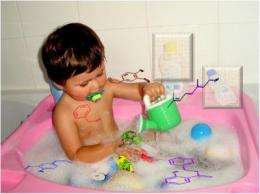
A team of scientists from the USC has developed a method to detect and quantify the 15 most common fragrance allergens included in soap, gel, cologne and other personal hygiene products. Credit: Llompart et al./SINC
A group of chemists from the University of Santiago de Compostela (USC, Spain) has developed a method to quantify the fragrance allergens found in baby bathwater. The researchers have analysed real samples and detected up to 15 allergen compounds in cosmetics and personal hygiene products.
A team of scientists from the Department of Analytical Chemistry, Nutrition and Bromatology at the USC has developed a method to detect and quantify the 15 most common fragrance allergens included in soap, gel, cologne and other personal hygiene products.
"Applying the method to eight real samples obtained from the daily baths of a series of babies aged between six months and two years old, we discovered the presence of all the compounds under study in at least one of the samples," co-author of the study published this month in Analytical and Bioanalytical Chemistry, María Llompart, explained to SINC.
The scientists found at least six of the 15 compounds in all the samples. In some cases, concentrations were "extremely high", exceeding 100ppm (parts per million = nanograms/millilitre). Some of the substances that appeared were benzyl salicylate, linalol, coumarin and hydroxycitronellal.
"The presence and levels of these chemical agents in bathwater should be cause for concern," Llompart said, "bearing in mind that babies spend up to 15 minutes or more a day playing in the bath and that they can absorb these and other chemicals not only through their skin, but also by inhalation and often ingestion, intentional or not."
New Method to Detect Fragrances
Allergens were able to be detected due to the high level of sensitivity of the method, which for the first time applies the Solid-Phase Micro Extraction (SPME) technique to determining the ingredients of cosmetics and child hygiene products. This technique makes it possible to concentrate and isolate chemical components from a sample by absorbing them into fibres with a certain coating.
The researchers have also employed gas chromatography to separate compounds and mass spectrometry to identify and measure the abundance of each of the fragrances.
European regulations stipulate that the presence of such substances should be indicated on the label of the product when levels exceed a certain limit (0.1 or 0.01%, depending on the type of compound), but some associations believe these limits are excessively tolerant, particularly where child hygiene and baby and child care products are concerned.
More information: J. Pablo Lamas, Lucia Sánchez-Prado, Carmen Garcia-Jares y María Llompart. "Solid-phase microextraction gas chromatography-mass spectrometry determination of fragrance allergens in baby bathwater". Analytical and Bioanalytical Chemistry 394 (5): 1399-1411, julio de 2009.
Source: FECYT - Spanish Foundation for Science and Technology
-
Mass Spectrometry of Living Subjects
Sep 21, 2007 |
not rated yet |
0
-
Use of baby personal care products associated with higher levels of phthalates
Feb 04, 2008 |
not rated yet |
0
-
Toxic chemicals found in common scented laundry products, air fresheners
Jul 23, 2008 |
not rated yet |
0
-
New method reveals substances on surfaces of any kind
Sep 07, 2007 |
not rated yet |
0
-
New test to identify illegal steroids in cattle
Feb 20, 2009 |
not rated yet |
0
-
Engineers build first sub-10-nm carbon nanotube transistor
Feb 01, 2012 |
4.9 / 5 (33) |
30
-
Something old, something new: Evolution and the structural divergence of duplicate genes
Jan 31, 2012 |
4.6 / 5 (7) |
1
-
The hidden nanoworld of ice crystals: Revealing the dynamic behavior of quasi-liquid layers
Jan 30, 2012 |
5 / 5 (5) |
1
-
Stock market network reveals investor clustering
Jan 27, 2012 |
3.9 / 5 (23) |
8
-
Of microchemistry and molecules: Electronic microfluidic device synthesizes biocompatible probes
Jan 26, 2012 |
5 / 5 (2) |
0
-
Reference electrode
2 hours ago
-
How to tell if ionic compound has a higher melting point?
6 hours ago
-
How to determine zinc in a plant.
Feb 11, 2012
-
Boiling and melting point of impure substances
Feb 10, 2012
-
Safe nitrogen compound to decompose a 500 deg C in a furnace?
Feb 09, 2012
-
[ask]electron inside drinking water
Feb 08, 2012
- More from Physics Forums - Chemistry
More news stories
Manipulating genes with hidden TALENs
(PhysOrg.com) -- A better understanding of gene function in model plant and animal systems could be used to develop useful traits in livestock and crop plants, and might someday lead to developments in stem ...
1 hour ago |
5 / 5 (2) |
0
|
Ordered planar polymers created for the first time
(PhysOrg.com) -- Scientists under the direction of ETH Zurich have created a minor sensation in synthetic chemistry. They succeeded for the first time in producing regularly ordered planar polymers that form ...
2 hours ago |
5 / 5 (4) |
1
|
Scientists discover molecular secrets of 2,000-year-old Chinese herbal remedy
For roughly two thousand years, Chinese herbalists have treated Malaria using a root extract, commonly known as Chang Shan, from a type of hydrangea that grows in Tibet and Nepal. More recent studies suggest that halofuginone, ...
19 hours ago |
4.5 / 5 (19) |
18
|
New method to examine batteries -- MRI from the inside
There is an ever-increasing need for advanced batteries for portable electronics, such as phones, cameras, and music players, but also to power electric vehicles and to facilitate the distribution and storage of energy derived ...
Chemistry / Analytical Chemistry
19 hours ago |
5 / 5 (7) |
0
|
Hydrogen from acidic water: Researchers develop potential low cost alternative to platinum for splitting water
A technique for creating a new molecule that structurally and chemically replicates the active part of the widely used industrial catalyst molybdenite has been developed by researchers with the Lawrence Berkeley ...
Feb 09, 2012 |
4.8 / 5 (16) |
21
|
Alien matter in the solar system: A galactic mismatch
This just in: The Solar System is different from the space just outside it.
Transforming galaxies
(PhysOrg.com) -- Many of the Universe's galaxies are like our own, displaying beautiful spiral arms wrapping around a bright nucleus. Examples in this stunning image, taken with the Wide Field Camera 3 on ...
'Smart' microcapsules in a single step
(PhysOrg.com) -- A new, single-step method of fabricating microcapsules, which have potential commercial applications in industries including medicine, agriculture and diagnostics, has been developed by researchers ...
Tenofovir, leading HIV medication, linked with risk of kidney damage
(Medical Xpress) -- Tenofovir, one of the most effective and commonly prescribed antiretroviral medications for HIV/AIDS, is associated with a significant risk of kidney damage and chronic kidney disease that increases over ...
A continent ablaze in auroral and manmade light
The North American continent is literally set ablaze in a confluence of Auroral and Manmade light captured in spectacular new videos snapped by the astronauts serving aboard the International Space Station ...
Jul 27, 2009
Rank: not rated yet
Recent study%u2019s inaccuracies raise undue concern
Fragrance ingredients used in baby bath products are safe.
The International Fragrance Association (IFRA) is aware of a study by researchers at the University of Santiago de Compostela (Anal Bioanal Chem, 2009, 394:1399-1411) but finds the claims about the levels of %u201Cfragrance allergens%u201D found in test samples of baby%u2019s bathwater highly inaccurate.
Fragrance levels detected by the study were extremely low; for example one of the materials detected with the highest concentration, linalool, was detected at 108 nanograms per millilitre. This is an extremely small, trace amount that is one thousand times less than the specified No Adverse Effect Level (NOAEL) for linalool. It is the equivalent of one drop in a swimming pool.
The study appears to demonstrate a new method of analysis for detecting materials; however the weak assumptions using references to children%u2019s health concerns are not appropriate. Scientifically, a baby%u2019s skin barrier is similar to that of an adult, and age is considered when developing safe use levels for fragrance applications.
The study refers to the European Cosmetics Directive, specifically to the list of 26 ingredients identified as potential skin sensitizers in some people, which the Directive states must be listed on product ingredient labels if present in the formulation. The objective of this legislation is to enable consumers to make informed choices about the products they buy and does not suggest that use of the named ingredients is unsafe.
The fragrance industry and its clients work to comply with the Cosmetic Directive and the REACH regulations in Europe. In addition the industry operates under a strict Code of Practice, which includes a set of Standards for use levels defined by expert fragrance scientists and the IFRA Compliance Program which ensures that the Code is adhered to.
The IFRA Code of Practice is distributed worldwide to all member associations and their member companies. It is publically available to governmental regulatory bodies and interested parties. It can be found on the IFRA website: www.ifraorg.org.