Mystery Source of Solar Wind Heating Identified
July 17, 2009 by Dr. Tony Phillips Mystery Source of Solar Wind Heating Identified

Enlarge

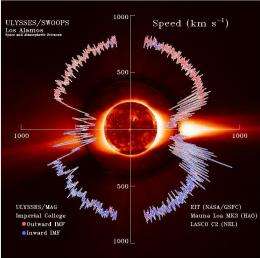
The solar wind, shown here in a plot of data from the Ulysses spacecraft, flows away from the sun at a million miles per hour and is heated by a "turbulent cascade." Credit: NASA

(PhysOrg.com) -- The solar wind is hotter than it should be, and for decades researchers have puzzled over the unknown source of energy that heats it. In a paper published in the June 12 issue of Physical Review Letters, NASA scientists say they may have found the answer.

"The energy source is turbulence," says co-author Melvyn Goldstein, chief of the Geospace Physics Laboratory at NASA's Goddard Space Flight Center, Greenbelt, Md. "The sun heats the solar wind by stirring it up."

It's a bit like stirring your coffee--in reverse. When you stir your morning cup of Joe, the coffee cools off. But when the sun stirs the solar wind, the solar wind heats up.

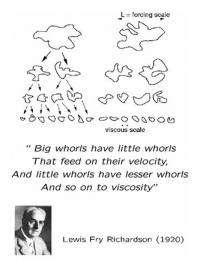
Consider the coffee. When you stir it with a spoon, the stirring produces swirls and vortices in the liquid. The vortices fragment into smaller and smaller eddies until, at the smallest scales, the motions dissipate and the energy turns into heat. Because energy cascades down from the large swirls to the smaller ones, the process is called a turbulent cascade.

Theoretically, the turbulent cascade should heat the coffee. Real coffee cools off, however, because the act of stirring brings warm coffee from the depths of the cup into contact with cooler air above. Cool air absorbs the heat—the heat the coffee had to begin with plus the heat you added by stirring—and you can take a sip without scalding yourself.

But there is no cool air in space, and therein lies the difference between coffee and solar wind.

The sun stirs the solar wind with fast streams of gas that pour out of holes in the sun's atmosphere. Essentially, the solar wind stirs itself. The stirring produces swirls and eddies; larger eddies break into smaller ones, producing a cascade of energy that eventually dissipates as heat. The temperature shoots up and there is no cool air to stop it.

"We've suspected for years that turbulence heats the solar wind," says Fouad Sahraoui, lead author of the paper and a visiting NASA Fellow from the Centre National de la Recherche Scientifique (CNRS) in France. "Now we're getting detailed measurements of the process in action."
Mystery Source of Solar Wind Heating Identified
Enlarge

The basic concept introduced by physicist Lewis Richardson in 1920. Credit: Antonio Celani

The key data came from a quartet of European spacecraft collectively known as Cluster, launched in 2000 to study the giant bubble of magnetism that surrounds Earth. The magnetosphere protects our planet from solar wind and cosmic rays. It contains the Van Allen radiation belts, auroras, and giant electrical "ring currents" of staggering power. Cluster spends much of its time inside the magnetosphere, where the spacecraft can study the wide variety of phenomena at work there.

One day in March 2006, the four spacecraft took a brief excursion outside the bubble into the solar wind. For three hours, their sensors made rapid-fire measurements of electromagnetic waves and turbulent eddies in the million-kilometer-per-hour gas flowing past them.

"That was when we made the discovery," says Goldstein. "Turbulent energy was cascading from large scale structures around 1,000,000 kilometers (621,400 miles) in size all the way down to structures as small as 3 kilometers (1.8 miles). At the small end of the cascade, energy was absorbed by electrons in the solar wind."

Sahraoui and Goldstein would like to confirm their findings and flesh out the details by sending Cluster back into the solar wind for more than "three lucky hours." But the basic result seems solid enough: Turbulent heating boosts the temperature of the solar wind near Earth from tens of thousands of degrees (the value theoreticians expect) to hundreds of thousands or more.

Goldstein says such turbulent heating probably happens in many other astrophysical situations, from stellar winds to planetary magnetospheres to black holes. There's even a down-to-Earth application: nuclear fusion reactors. Turbulence inside experimental fusion chambers can produce instabilities that destroy the confinement of the fusion plasma.

"The is a natural laboratory for understanding this physics," says Sahraoui, "and we are planning more observations to see how common the phenomenon might be."

Provided by JPL/NASA (news : .gov/index.cfm" target="_blank">web)


print this article email this article download pdf blog this article bookmark this article     Stumble it Digg this share on Facebook retweet share on Reddit add to delicious
Rate this story - 4.6 /5 (18 votes)

Rank Filter

Move the slider to adjust rank threshold, so that you can hide some of the comments.


Display comments: newest first

  • E_L_Earnhardt - Jul 17, 2009
    • Rank: 1 / 5 (1)
    E=MC2 The basic electron is invisable, (except by its shadow when it absorbs energy.) It contains energy when in motion, (spin or vector). It has mass when in motion. It expresses its energy when its vector is changed. IE "The electron IS Energy"!
  • brant - Jul 17, 2009
    • Rank: 3 / 5 (4)
    Baloney. This is a terrible article. Where does the energy come from????


    "The energy source is turbulence," is complete BS.


    Turbulence is an energy sink.


    An accelerated particle is a hot particle. Turbulence slows things down.
  • KBK - Jul 18, 2009
    • Rank: 3 / 5 (2)
    Electric Universe.
  • omatumr - Jul 18, 2009
    • Rank: 1 / 5 (1)
    "HOTTER THAN IT SHOULD BE"?

    That attitude says a lot about the problem.

    Let's focus on "what is" and ask:

    a.) What produces the turbulence?

    b.) What accelerates the "fast streams of gas that pour out of holes in the sun's atmosphere"?

    c.) Are these the same H ions that are accelerated upward by deep-seated magnetic fields, maintaining mass separation in the sun, and producing sun spots when they protrude through the visible solar "surface"?

    The solar wind is exactly as hot as it should be for the sun as it really is.

    With kind regards,
    Oliver K. Manuel
    http://www.omatumr.com
  • JukriS - Jul 18, 2009
    • Rank: 1 / 5 (2)
    When you blow an insane campfire, campfire gets hot!

    Energy From outside can get Sun by the fire burning up.

    Waves of energy coming to Sun all a time.

    Sometimes there mide coming some strong energypulse and next one coming after 11 years etc.

    Sometimes coming some very strong energypulse and next one after 10 000 years or maybe after millions years!

    http://onesimplep....com/296

    .

  • Velanarris - Jul 18, 2009
    • Rank: not rated yet
    Baloney. This is a terrible article. Where does the energy come from????

    "The energy source is turbulence," is complete BS.

    Turbulence is an energy sink.

    An accelerated particle is a hot particle. Turbulence slows things down.

    Turbulence increases friction, which in turn increases energy release.
  • Torbjorn_Larsson_OM - Jul 18, 2009
    • Rank: 4.3 / 5 (3)
    ""The energy source is turbulence," is complete BS."

    No, the article is quite clear that it is the fragmentation of the solar wind that is responsible (by way of turbulence), not a steady state flow.

    "The solar wind is exactly as hot as it should be for the sun as it really is."

    I'm not sure what you mean by "as it really is". Solar surface temperature as it really is, is easily measured to ~ 6*10^3 K. That is magnitudes lesser than solar wind temperatures mentioned above.

    Even if the effective temperature is set in large by the wind accelerated by the Sun average E & M fields in the solar atmosphere, this effect may be short of what is measured. What the research presumably does is to explain the discrepancy.
  • regnevacs - Jul 19, 2009
    • Rank: not rated yet
    cosmic rays are hitting the earth and some are going right through it so the magnetosphere isn't doing its job!
  • earls - Jul 19, 2009
    • Rank: not rated yet
    So what creates the turbulence? I mean, space is a near vacuum, so it's not like the wind is blowing the candle.

    Hot gas rises which becomes turbulent, interfering with itself, then rises faster as it fragments? An exchange of volume for velocity?
  • Velanarris - Jul 20, 2009
    • Rank: not rated yet
    So what creates the turbulence? I mean, space is a near vacuum, so it's not like the wind is blowing the candle.

    Hot gas rises which becomes turbulent, interfering with itself, then rises faster as it fragments? An exchange of volume for velocity?


    The intrasolar medium is far from a vaccuum. I hate the fact they taught that in high school science. The turbulence is caused by many things, cosmic radiation, the magnetospheres, atmospheres, gravity, and electric fields of the planets, the constant rotation of the Milky Way, outer gasses slowing down as their energy has been emitted being hit from behind by more energetic particles, etc.
  • omatumr - Jul 20, 2009
    • Rank: 1 / 5 (2)
    BRANT IS EXACTLY RIGHT

    Baloney. This is a terrible article. Where does the energy come from????

    "The energy source is turbulence," is complete BS.

    Turbulence is an energy sink.

    An accelerated particle is a hot particle. Turbulence slows things down.


    Thanks, Brant! Keep telling it like it is.

    With kind regards,
    Oliver K. Manuel
    http://www.omatumr.com
  • Velanarris - Jul 20, 2009
    • Rank: not rated yet
    Thanks, Brant! Keep telling it like it is.

    With kind regards,
    Oliver K. Manuel
    http://www.omatumr.com
    That's very far from "how it is", and I'm quite frankly surprised by your statement.
  • superhuman - Jul 30, 2009
    • Rank: 5 / 5 (2)
    "The energy source is turbulence,"

    Turbulence is NOT an energy source, this is a nonsensical statement. Turbulence only changes how energy is distributed among interacting particles but the energy has to be there to begin with.
  • Velanarris - Jul 30, 2009
    • Rank: 5 / 5 (1)
    "The energy source is turbulence,"


    Turbulence is NOT an energy source, this is a nonsensical statement. Turbulence only changes how energy is distributed among interacting particles but the energy has to be there to begin with.

    And this is the correct way to frame it. Turbulence does not "create" energy. It distributes released energy. So if you want to know where the energy is comming from follow the solar wind.

    The solar wind exits the sun energized by the energy released during solar fusion. These energized particles exit at a high energy or velocity and begiin encountering resistance provided by the ambient molecules and particles inhabiting intrasolar space. This resistance results in bumping, rubbing, etc which is friction. On contact and exposure to friction (some particles must escape with no physical interaction according to probability) these particle transmit some of their energy to the local particles thus losing their individual energy but diffusing their energy into the rest of the system. On a broad scale this would appear to be "heating" of the solar wind as opposed to having a heterogenous soup of particles with wildly mismatched energy.

    So does it make more sense when they improperly state "turbulence is the cause of the heating"?

    It is the cause of the heating, but the source of the energy is fusion.

July 17, 2009 all stories

Comments: 14

4.6 /5 (18 votes)
  • Stumble this up

  • Digg this

  • share this

  • hide
  • Related Stories

  • Energy simulation may explain turbulence mystery
    created Feb 26, 2009 | popularity not rated yet | comments 0
  • Team discovers 'throttle' for solar wind
    created May 17, 2007 | popularity not rated yet | comments 0
  • From ‘macro’ to ‘micro’ – turbulence seen by Cluster
    created Aug 11, 2005 | popularity not rated yet | comments 0
  • Astrophysicists find fractal image of Sun's 'Storm Season' imprinted on Solar Wind
    created May 24, 2007 | popularity not rated yet | comments 0
  • Physicists Trash Turbulence Lab
    created Apr 13, 2005 | popularity not rated yet | comments 0


  • hide
  • Relevant PhysicsForums posts

  • Clarification of doubts on rolling motion
    created 3 hours ago
  • dropping meat on weighing scale
    created 4 hours ago
  • What is voltage drop?
    created 5 hours ago
  • waveguide
    created 6 hours ago
  • How is the freezer part of a refrigerator is more cooler than the other parts?
    created 7 hours ago
  • Transfer machanism via conduction
    created 8 hours ago
  • More from Physics Forums - General Physics

Other News

Nuclear weapons: Predicting the unthinkable

Physics / General Physics

created 2 hours ago | popularity 1 / 5 (1) | comments 0

If a nuclear weapon were detonated in a metropolitan area, how large would the affected area be? Where should first responders first go? According to physicist Fernando Grinstein, we have some initial understanding to address ...


Generating electricity from air flow

Physics / General Physics

created 2 hours ago | popularity 3.7 / 5 (3) | comments 0

A group of researchers at the City College of New York is developing a new way to generate power for planes and automobiles based on materials known as piezoelectrics, which convert the kinetic energy of motion into electricity. ...


Restored machine to explore mysteries of Big Bang (AP)

Restored machine to explore mysteries of Big Bang

Physics / General Physics

created Nov 21, 2009 | popularity 4.5 / 5 (16) | comments 13

(AP) -- Scientists are preparing the world's largest atom smasher to explore the depths of matter after successfully restarting the $10 billion machine following more than a year of repairs.


nuclear power plant

Doubts raised on nuclear industry viability

Physics / General Physics

created Nov 19, 2009 | popularity 3.1 / 5 (20) | comments 19

(PhysOrg.com) -- The investment in nuclear power has been growing around the world over the last few years, being viewed as a means for countries to control their energy security, avoid the price fluctuations ...


Researchers Find Innate Correlations Among Different Power Law Phenomena

Researchers Find Innate Correlations Among Different Power Law Phenomena

Physics / General Physics

created Nov 17, 2009 | popularity 4.3 / 5 (15) | comments 14

(PhysOrg.com) -- Studying the patterns that emerge in natural and social phenomena is a popular area of research, although usually individual phenomena are studied separately from each other. In a recent study, ...