LROC's first look at the Apollo landing sites
July 17, 2009 LROC's first look at the Apollo landing sites

Enlarge

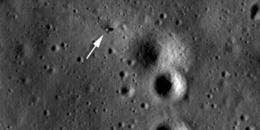
The Apollo 14 lunar module (LM Antares) and the Apollo Lunar Surface Experiment Package are visible in this image (note the astronaut tracks between the two artifacts). At the current altitude and lighting the descent stage is clearly visible with its angular shadow (right) and shadow cast by leg (near arrow tip). The LROC NAC image data has not been calibrated, the faint vertical stripes are a natural part of the image and will be removed later after the full suite of calibration data is collected during the commissioning phase. Credit: NASA/GSFC/Arizona State university

The imaging system on board NASA's Lunar Reconnaissance Orbiter (LRO) recently had its first of many opportunities to photograph the Apollo landing sites. The Lunar Reconnaissance Orbiter Camera (LROC) imaged five of the six Apollo sites with the narrow angle cameras (NACs) between July 11 and 15, within days of the 40th anniversary of the Apollo 11 mission.

The early images obtained by LROC, operated by Arizona State University Professor Mark Robinson, show the lunar module descent stages left behind by the departing astronauts. Their locations are made evident by their long shadows, which result from a low sun angle at the time of collection.

"In a three-day period we were able to image five of the six Apollo sites - the LROC team anxiously awaited each image," says LROC Principal Investigator Mark Robinson, professor in the School of Earth and Space Exploration in ASU's College of Liberal Arts and Sciences. "Of course we were very interested to get our first peek at the lunar module descent stages just for the thrill - and to see how well the cameras had come into focus."

For additional information about the LROC instrument and to view the first Apollo landing site images, visit: http://lroc.sese.asu.edu.

The orbiter's current elliptical orbit resulted in image resolutions from the NACs that were slightly different for each site but were all about four feet per pixel. Since the deck of the descent stage is about 14 feet in diameter, the Apollo relics themselves fill about four pixels. However, because the Sun was low to the horizon when the images were acquired, even subtle variations in topography create long shadows. Standing just over ten feet above the surface, each Apollo descent stage creates a distinct shadow that fills roughly 20 pixels.

"For the five landing site images photographed by LROC, the biggest variables are spacecraft altitude (ground scale) and time of day, which translates into signal strength," explains Robinson. "In the current collection of images the best discrimination of features is in the Apollo 14 scene even though the highest resolution picture covers the Apollo 16 site."

Compared to the other landing site images, the image of the Apollo 14 site revealed additional details. The Apollo Lunar Surface Experiment Package (ALSEP), a set of scientific instruments placed by the astronauts at the landing site, is discernable, as are the faint trails between the descent stage and ALSEP left by the astronauts' footprints.

Though it had been expected that LRO would be able to resolve the remnants of the Apollo missions, these first images came prior to the spacecraft reaching its final mapping orbit. As the orbit of LRO is lowered, LROC will receive many more opportunities to image the landing sites in the weeks to come. The resolution of future LROC images of these sites will improve by two to three times.

The timing of these images being captured is notable as it occurred only days before the 40-year anniversary of NASA's that first put humans on the . Though these pictures provide a reminder of one of humankind's greatest technological achievements, LRO's primary focus is paving the way for future exploration. By returning detailed lunar data the LRO mission will help NASA identify safe and compelling landing sites for future explorers, locate potential resources, describe the moon's radiation environment and demonstrate new technologies.

Source: Arizona State University (news : web)


print this article email this article download pdf blog this article bookmark this article     Stumble it Digg this share on Facebook retweet share on Reddit add to delicious
Rate this story - 4.9 /5 (9 votes)

Rank Filter

Move the slider to adjust rank threshold, so that you can hide some of the comments.


Display comments: newest first

  • Nik_2213 - Jul 17, 2009
    • Rank: 5 / 5 (5)
    Take THAT, all you Apollo-deniers !!
  • Ant - Jul 17, 2009
    • Rank: not rated yet
    I bet you can see the martian waving too.
  • yOnsa - Jul 17, 2009
    • Rank: 4 / 5 (4)
    at least they left that huge arrow behind or else i wouldn't be able to see anything
  • Ant - Jul 19, 2009
    • Rank: not rated yet
    hi nick
    The weirs thing about this angular shadow is that its on the wrong side. While all other shadows are on the left of the terrain this is on the right. A Studio glitch perhaps?

July 17, 2009 all stories

Comments: 4

4.9 /5 (9 votes)
  • Stumble this up

  • Digg this

  • share this

  • hide
  • Related Stories

  • Scientist to Work With NASA's Lunar Orbiter
    created Jan 25, 2005 | popularity not rated yet | comments 0
  • Digital archive casts new light on Apollo-era moon pictures
    created Aug 01, 2007 | popularity not rated yet | comments 0
  • Lunar Reconnaissance Orbiter's first moon images available
    created Jul 02, 2009 | popularity not rated yet | comments 0
  • Back to the Moon: Lunar Reconnaissance Orbiter Project
    created Apr 19, 2007 | popularity not rated yet | comments 0
  • Four Out of Six Apollos
    created Dec 24, 2008 | popularity not rated yet | comments 0


  • hide
  • Relevant PhysicsForums posts

  • Redshift as a distance indicator
    created 7 hours ago
  • Question about 2-body gravity
    created Nov 24, 2009
  • life on Mars
    created Nov 24, 2009
  • Semi-major axis from cartesian co-ordinates
    created Nov 23, 2009
  • More from Physics Forums - General Astronomy

Other News

Past regional cold and warm periods linked to natural climate drivers

Space & Earth / Earth Sciences

created 5 hours ago | popularity 5 / 5 (4) | comments 6

Intervals of regional warmth and cold in the past are linked to the El Niño phenomenon and the so-called "North Atlantic Oscillation" in the Northern hemisphere's jet stream, according to a team of climate scientists. These ...


Russia: no space for space tourists (AP)

Russia: no space for space tourists

Space & Earth / Space Exploration

created 13 hours ago | popularity 2.7 / 5 (3) | comments 2

(AP) -- A top Russian space official says there is no space for tourists wishing to fly to the International Space Station.


Astronauts surprised by holiday turkey dinners (AP)

Astronauts surprised by holiday turkey dinners

Space & Earth / Space Exploration

created 8 hours ago | popularity not rated yet | comments 0

(AP) -- Space shuttle Atlantis' astronauts thought they were going to give thanks with pantry leftovers Thursday as their mission drew to a close, but found turkey dinners awaiting them.


Gullies and Flow Features on Crater Wall

Gullies and Flow Features on Crater Wall

Space & Earth / Space Exploration

created 9 hours ago | popularity not rated yet | comments 0

(PhysOrg.com) -- This image from the High Resolution Imaging Science Experiment (HiRISE) camera on NASA's Mars Reconnaissance Orbiter shows a sample of the variety and complexity of processes that may occur ...


Burning coal worse for climate than clearing rain forests

Space & Earth / Environment

created 7 hours ago | popularity 3 / 5 (4) | comments 0

Deforestation has had a big influence on the increase of carbon dioxide (CO2) emissions in the past three centuries, but its impact is tapering off relatively. Nowadays, the burning of fossil fuels is a more crucial factor. ...