Professor hatches century-old eggs to study evolution
July 17, 2009 By Krishna Ramanujan Professor hatches century-old eggs to study evolution

Enlarge

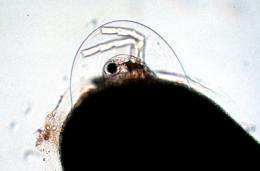
Daphnia neonate emerge from a dormant egg (Daphnia birth). Approximate size is 300 micrometers. Photomicrograph by P. Spaak

(PhysOrg.com) -- Suspending a life in time is a theme that normally finds itself in the pages of science fiction, but now such ideas have become a reality in the annals of science.

Cornell ecologist Nelson Hairston Jr. is a pioneer in a field known loosely as "resurrection ecology," in which researchers study the eggs of such creatures as zooplankton -- tiny, free-floating water animals -- that get buried in lake sediments and can remain viable for decades or even centuries. By hatching these eggs, Hairston and others can compare time-suspended hatchlings with their more contemporary counterparts to better understand how a species may have evolved in the meantime.

The researchers take from lake floors to extract the eggs; the deeper the egg lies in the core, the older it is. They then place the eggs in optimal hatching conditions, such as those found in spring in a temperate lake, and let nature take its course.

"We can resurrect them and discover what life was like in the past," said Hairston, who came to Cornell in 1985 and is a professor and chair of Cornell's Department of Ecology and . "Paleo-ecologists study microfossils, but you can't understand much physiologically or behaviorally" with that approach, he said.

Hairston first became interested in the possibilities of studying dormant eggs in the late 1970s, when he was an assistant professor of at the University of Rhode Island. There, he noticed that the little red crustaceans -- known as copepods -- in the pristine lake behind his Rhode Island home disappeared in the summer, only to return as larvae in the fall.
Professor hatches century-old eggs to study evolution

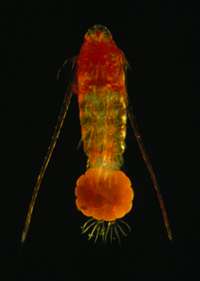
A female copepod carries a bright red egg sac at the base of her body. (Actual size is approximately 2 mm.) These eggs were likely hatched within a few days of this photomicrograph. Photomicrograph by Nelson Hairston Jr.

The observation prompted him to study why they disappear, research that revealed the copepods stay active under the ice in the winter, but they die out as their eggs lie dormant on the lake floor through the summer when the lake's fish are most active. When the fish become less active in the fall, larvae hatch from the eggs, and the copepods continue their life cycle.

This time suspension, where zooplankton pause their life cycles to avoid heavy predation or harsh seasonal and environmental conditions, also increases a species' local gene pool, with up to a century's worth of genetic material stored in a lake bed, Hairston said. When insects, nesting fish and boat anchors stir the mud, they can release old eggs that hatch and offer a wider variety of genetic material to the contemporary population.

In 1999 Hairston and colleagues published a paper in Nature that described how 40-year-old resurrected eggs could answer whether tiny crustaceans called Daphnia in central Europe's Lake Constance had evolved to survive rising levels of toxic cyanobacteria, known as blue-green algae. In the 1970s, phosphorus levels from pollution rose in the lake, increasing the numbers of cyanobacteria. The researchers hatched from the 1960s and found they could not survive the toxic lake conditions, but Daphnia from the 1970s had adapted and survived.

Hairston and colleagues have organized a resurrection ecology symposium in September 2009, in Herzberg, Switzerland, to bring together researchers in this growing new field.

Provided by Cornell University (news : web)


print this article email this article download pdf blog this article bookmark this article     Stumble it Digg this share on Facebook retweet share on Reddit add to delicious
Rate this story - 4.4 /5 (13 votes)


July 17, 2009 all stories

Comments: 0

4.4 /5 (13 votes)
  • Stumble this up

  • Digg this

  • share this

  • hide
  • Related Stories

  • Jurassic Park from a Swiss lake?
    created Mar 12, 2009 | popularity not rated yet | comments 0
  • Flies may reveal evolutionary step to live birth
    created Nov 25, 2008 | popularity not rated yet | comments 0
  • Deadly fish virus reaches Wisconsin lake
    created May 15, 2007 | popularity not rated yet | comments 0
  • Early bird doesn't always get worm, researcher finds
    created Mar 12, 2008 | popularity not rated yet | comments 0
  • Lake Vostok life to be studied
    created Jan 15, 2007 | popularity not rated yet | comments 0


  • hide
  • Relevant PhysicsForums posts

  • Selenocysteine in pH=7
    created 23 hours ago
  • What is the formula for calculating the speed of thought?
    created Nov 26, 2009
  • What does word "absorption" mean in the intestine?
    created Nov 26, 2009
  • What is transpulmonary pressure?
    created Nov 24, 2009
  • Is there a gay gene?
    created Nov 23, 2009
  • Super quick question about Starling forces?
    created Nov 22, 2009
  • More from Physics Forums - Biology

Other News

Indonesia rejects Bali plan for turtle sacrifices (AP)

Indonesia rejects Bali plan for turtle sacrifices

Biology / Ecology

created 1hour ago | popularity not rated yet | comments 0

(AP) -- Indonesia has rejected a push by the resort island of Bali for rare turtles to be legally slain in Hindu ceremonies, siding with conservationists of the protected reptiles against religious advocates, ...


Hammerhead shark

Wide heads give hammerheads exceptional stereo view

Biology / Plants & Animals

created 3 hours ago | popularity 4 / 5 (3) | comments 2

Hammerhead sharks are some of the Ocean's most distinctive residents. 'Everyone wants to understand why they have this strange head shape,' says Michelle McComb from Florida Atlantic University. One possible ...


Tough yet stiff deer antler is materials scientist's dream

Biology / Plants & Animals

created 4 hours ago | popularity not rated yet | comments 0

Prized for their impressive antlers, red deer have been caught in the hunters' sights for generations. But a deer's antlers are much more than decorative. They are lethal weapons that stags crash together when duelling. John ...


The six elephants in Sierra Leone were shot and "crudely butchered"

S.Leone elephants 'wiped out' by poachers: official

Biology / Ecology

created 22 hours ago | popularity 5 / 5 (5) | comments 6

Poachers "wiped out" the entire elephant herd in Sierra Leone's only wildlife park, wildlife managers said Thursday after police said they had arrested a gang of 10 poachers.


First-ever blueprint of a minimal cell is more complex than expected

First-ever blueprint of a minimal cell is more complex than expected

Biology / Cell & Microbiology

created 20 hours ago | popularity 5 / 5 (15) | comments 4

What are the bare essentials of life, the indispensable ingredients required to produce a cell that can survive on its own? Can we describe the molecular anatomy of a cell, and understand how an entire organism ...