Controlling the electronic surface properties of a material
July 17, 2009
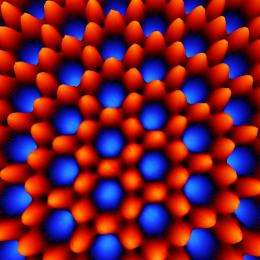
A two-dimensional “electronic metamaterial” is generated by supramolecular selfassembly on a metal surface. The periodic influence of the porous molecular network on the otherwise free-electron-like surface state results in the formation of an electronic band.
A recent breakthrough by researchers at the Swiss Nanoscience Institute sees for the first time the creation of thin films with controllable electronic properties. This discovery could have a large impact on future applications in sensors and computing. The international collaboration of researchers from the Universities of Basel and Heidelberg and the Paul Scherrer Institute (Switzerland) have published the work in the prestigious scientific journal Science.
It's commonly accepted that electrical resistance of a given material cannot be adjusted as is the case with, for example, density and color. However, Dr Meike Stöhr and her collaborators have now succeeded in developing a new method to selectively tune surface properties such as resistance.
The interdisciplinary team of physicists and chemists have developed a substance which, after heating on a copper surface, exhibits a two dimensional network with nanometer sized pores. The interaction of this network with the existing electron gas on the metal surface leads to the following effect: the electrons underneath the network are pushed into the pores to form small bunches of electrons called quantum dots.
By varying parameters such as the height and diameter of the pores the possibility arises to selectively tune the properties of the material. Further possibilities arise from the ability to fill the pores with different molecules. This allows direct access to the properties of the material which are dependent on the electronic structure, such as conductivity, reflectivity and surface catalysis properties. This will lead to the emergence of new materials with adjustable electronic properties.
The underlying physical mechanisms can best be understood by a comparison of the electron-gas with waves in water. Waves on a water surface are reflected by any obstacle they meet. If the obstacle on the surface in question resembles a honeycomb structure, standing waves are set up in each cell of the honeycomb. This then leads to a wave pattern representative of the honeycomb structure of the same size and shape. “Applying this analogy to the electron gas, we see that the interaction of the network structure with the electron gas on the metal surface confines the electrons giving rise to a characteristic electron wave structure of the new material.” says Stöhr.
These pore networks are good candidates for new meta-materials. These are man-made materials which, due to their period architecture, have specific optical and electronic properties not found in nature. These properties can be tuned by changing the properties of their component materials. In the case of pore networks, it is the electronic surface properties which can be tuned by careful selection of the nano-pores.
Source: Paul Scherrer Institut
-
Manipulation of single atoms provides fundamental insights
Sep 28, 2005 |
not rated yet |
0
-
A mysterious change in the wave properties of electrons
Sep 30, 2004 |
not rated yet |
0
-
Physicists discover surprising variation in superconductors
Jan 28, 2009 |
not rated yet |
0
-
Sheet of carbon atoms acts like a billiard table, physicists find
Sep 14, 2007 |
not rated yet |
0
-
Innovation in Nanoporous Chemistry
Sep 30, 2005 |
not rated yet |
0
-
Engineers build first sub-10-nm carbon nanotube transistor
Feb 01, 2012 |
4.9 / 5 (33) |
30
-
Something old, something new: Evolution and the structural divergence of duplicate genes
Jan 31, 2012 |
4.6 / 5 (7) |
1
-
The hidden nanoworld of ice crystals: Revealing the dynamic behavior of quasi-liquid layers
Jan 30, 2012 |
5 / 5 (4) |
1
-
Stock market network reveals investor clustering
Jan 27, 2012 |
3.9 / 5 (23) |
8
-
Of microchemistry and molecules: Electronic microfluidic device synthesizes biocompatible probes
Jan 26, 2012 |
5 / 5 (2) |
0
-
Anatomy of Fat man: implosion-critical bomb
1 hour ago
-
what makes two sounds similar???
2 hours ago
-
What would happen when a jet travelling at Mach 10 experiences engine failure
8 hours ago
-
Rust from my microwave ruined a nice bowl of soup and also my day
10 hours ago
-
gas leaks in space
14 hours ago
-
Weight required to balance a boom stand?
15 hours ago
- More from Physics Forums - General Physics
More news stories
Lab study raises questions over nano-particle impact
Tests involving chickens have raised questions about the impact on health from engineered nano-particles, the ultra-fine grains commonly used in drugs and processed foods, scientists said on Sunday.
Nanotechnology / Bio & Medicine
3 hours ago |
5 / 5 (4) |
0
New kind of solar cell could capture significantly more energy than current cells
New solar cells could increase the maximum efficiency of solar panels by over 25%, according to scientists from the University of Cambridge.
Feb 08, 2012 |
4.5 / 5 (13) |
14
|
Nanoshell whispering galleries improve thin solar panels
Visitors to Statuary Hall in the U.S. Capitol Building may have experienced a curious acoustic feature that allows a person to whisper softly at one side of the cavernous, half-domed room and for another on ...
Nanotechnology / Nanomaterials
Feb 07, 2012 |
4.4 / 5 (7) |
6
|
'Dark plasmons' transmit energy
Microscopic channels of gold nanoparticles have the ability to transmit electromagnetic energy that starts as light and propagates via "dark plasmons," according to researchers at Rice University.
Feb 09, 2012 |
4.8 / 5 (10) |
1
|
Revealing how a battery material works
Since its discovery 15 years ago, lithium iron phosphate (LiFePO4) has become one of the most promising materials for rechargeable batteries because of its stability, durability, safety and ability to deliver ...
Nanotechnology / Nanomaterials
Feb 08, 2012 |
5 / 5 (6) |
0
|
Overeating may double risk of memory loss
New research suggests that consuming between 2,100 and 6,000 calories per day may double the risk of memory loss, or mild cognitive impairment (MCI), among people age 70 and older. The study was released today and will be ...
Google might launch Drive for cloud storage soon
(PhysOrg.com) -- Google's next big move, according to the Wall Street Journal, is a cloud storage service called Drive. Hardly first to the plate, Google is simply catching up to introducing its cloud reposi ...
Scientists discover molecular secrets of 2,000-year-old Chinese herbal remedy
For roughly two thousand years, Chinese herbalists have treated Malaria using a root extract, commonly known as Chang Shan, from a type of hydrangea that grows in Tibet and Nepal. More recent studies suggest that halofuginone, ...
New method to examine batteries -- MRI from the inside
There is an ever-increasing need for advanced batteries for portable electronics, such as phones, cameras, and music players, but also to power electric vehicles and to facilitate the distribution and storage of energy derived ...
Injured boomers beware: Know when to see doctor
(AP) -- It happened to nurse Jane Byron years after an in-line skating fall, business owner Haralee Weintraub while doing "men's" push-ups, and avid cyclist Gene Wilberg while lifting a heavy box.
A mitosis mystery solved: How chromosomes align perfectly in a dividing cell
Although the process of mitotic cell division has been studied intensely for more than 50 years, Whitehead Institute researchers have only now solved the mystery of how cells correctly align their chromosomes during symmetric ...