Invasive mussels imperil western water system
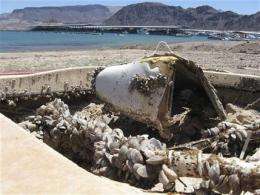
(AP) -- Two years after an invasive mussel was first discovered at Lake Mead, the population has firmly established itself and gone on a breeding binge, with numbers soaring into the trillions.
Despite efforts to stop their spread, scientists say it's only a matter of time before quagga mussels appear throughout the West's vast system of reservoirs and aqueducts, raising operation and maintenance costs by untold millions.
Water agencies and wildlife managers in California, Arizona, Nevada and Utah have put in place aggressive measures to try to prevent their spread, including mandatory decontamination or quarantine of boats traveling from infested areas or chlorinating some water inlets to try to kill off the mussels.
But as their counterparts in the northeast and Great Lakes region have found, eradicating the mussels is virtually impossible. The thumb-sized mollusks attach to almost anything and can clog drains and pipes, freeze up cooling systems, kill off native species and render power boats inoperable.
"Over time, maybe not this decade or the next, I would think eventually they'll be almost around the country," said Amy Benson, fishery biologist with the U.S. Geological Survey in Florida.
Quagga mussels, and their close cousin, zebra mussels, were introduced to the Great Lakes in the ballast of ships from eastern Europe and the Ukraine in the 1980s. Since their arrival at Lake Mead in 2007, their numbers have multiplied exponentially.
Populations of the mussels still are expanding in the East into the quadrillions, and there's no sign the growth is slowing, said Tom Nalepa, a research biologist with the National Oceanic and Atmospheric Administration in Michigan. But he said the population can't expand forever.
"The populations are going to stabilize at some point, and they're going to become adjusted to the system or the system is adjusted to them, but we're not at that point yet," Nalepa said. "We're still trying to figure out what the ultimate consequences are going to be."
In the West, the mussels have colonized the lower Colorado River that 27 million people rely on to irrigate crops, produce drinking water and operate businesses.
Lake Mead is just one of a string of huge reservoirs on the Colorado that store and divert water into aqueducts and pipelines feeding parts of California, Arizona and Nevada. Sharp shells now litter the lake's beaches, and boats docked in marinas can't leave without being decontaminated for fear a mussel might hitch a ride to another waterway.
The warmer weather in the West has allowed the quagga mussels to reproduce much more quickly than in the East. One adult female quagga can release up to a million eggs in a single year, and their microscopic larvae float freely downstream.
Water managers say the best way to prevent their spread is making sure boats traveling from one waterway to another are mussel-free. Lake Powell requires mandatory boat inspections, and California has trained dogs to sniff out the mussels at inspection points. Boats also can be quarantined at the California border if a single mussel is spotted on them.
"They can be prevented, and this is what people have to get into their heads," said Wen Baldwin, a National Park Service volunteer who confirmed the quagga mussels at Lake Mead. "Unfortunately there are some people who say, 'they are going to get here no matter what.' Maybe they will, but every year you hold them off, you're dollars ahead."
The Metropolitan Water District of Southern California expects to spend between $10 million and $15 million a year to address quagga mussel infestations in its 242-mile Colorado River aqueduct and reservoirs. The agency delivers water to 19 million people in Los Angeles and surrounding areas.
Ric DeLeon, the district's quagga mussel control coordinator, told U.S. lawmakers last year that the price tag for controlling the invasive species and their impact on business, the power industry, water companies and communities in the East is in the billions, and likely will soar in the West.
The increased costs are likely to drive up utility rates for consumers as systems are upgraded, divers spend more hours scraping mussels and researchers try to figure out just how the mussels behave and the impact they're making.
"Who is going to pay for that?" Baldwin said. "It ain't going to be Santa Claus; it's going to be the consumer."
At Hoover Dam, mussels first colonized intake towers and other structures. What started off as one or two mussels every square foot has increased to 55,000 mussels in the same space, said Leonard Willett, the lower Colorado River mussel coordinator for the U.S. Bureau of Reclamation.
The mussels also are in pipes that cool generators, compressors and transformers, which could disrupt operations.
One of the infestation's side effects has been that the mussels can affect water quality and clarity. That's a major concern at Lake Tahoe on the border of California and Nevada.
Some 6,300 boats have been inspected at the lake known for its pristine waters from May 1 to July 8. Of those, 470 were decontaminated, and 10 found to have mussels never were launched. Jeff Cowen, a spokesman for the Tahoe Regional Planning Agency, said an infestation of mussels at the lake would mean an economic loss of $22 million a year.
Recreation areas are focusing on educating boaters, using slogans such as "Don't move a mussel," "Stop aquatic hitchhikers," and "Drain, clean and dry." Bryan Moore, a biologist at Lake Mead, said most boaters are cooperative.
"They definitely don't want to be the person who spread it to another lake," he said.
---
On the Net:
U.S. Geological Survey Nonindigenous Aquatic Species: http://tinyurl.com/nbnwvh
©2009 The Associated Press. All rights reserved. This material may not be published, broadcast, rewritten or redistributed.


