Apollo 11 astronauts look beyond moon, toward Mars
July 20, 2009 By SETH BORENSTEIN , AP Science Writer
Apollo 11 astronauts look beyond moon, toward Mars (AP)

Enlarge

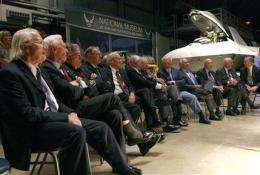
Apollo crewmen wait backstage before participating in a panel discussion during the National Aviation Hall of Fame Spirit of Flight Award at National Museum of the USAF, Friday, July 17, 2009 in Dayton, Ohio. (AP Photo/David Kohl)

(AP) -- The astronauts who first landed on the moon aren't dwelling on their small lunar steps. Instead, two of them on Sunday urged mankind to take a giant leap to Mars.

In one of their few joint public appearances, the crew of spoke on the eve of the 40th anniversary of man's first landing on the moon, but didn't get soggy with nostalgia. They instead spoke about the future and the more distant past.

On Monday, the three astronauts will get another chance to make the pitch for a Mars trip, this time to someone with a little more sway: President Barack Obama.

Sunday night, a packed crowd at the Smithsonian Institution's National Air and Space Museum - 7,000 people applied in a lottery for 485 seats - didn't get the intimate details of the Eagle's landing on the moon with little fuel left, or what the moon looked like, or what it felt like to be there.

They got second man on the moon Buzz Aldrin's pitch for Mars. He said the best way to honor the Apollo "is to follow in our footsteps; to boldly go again on a new mission of exploration."

First man on the moon only discussed Apollo 11 for about 11 seconds. He gave a professorial lecture titled "Goddard, governance and geophysics," looking at the inventions and discoveries that led to his historic "small step for a man" on July 20, 1969

Armstrong said the space race was "the ultimate peaceful competition: USA versus U.S.S.R. It did allow both sides to take the high road with the objectives of science and learning and exploration."

Apollo 11 command module pilot Michael Collins, who circled the moon alone while Armstrong and Aldrin walked on it, said the moon was not interesting, but Mars is.

"Sometimes I think I flew to the wrong place. Mars was always my favorite as a kid and it still is today," Collins said. "I'd like to see Mars become the focus, just as John F. Kennedy focused on the moon."

The man who founded and directed Mission Control Houston, Christopher Kraft Jr., also jumped on the go-somewhere-new, do-something-different bandwagon.

"What we need is new technology; we have not had that since Apollo," Kraft said as part of the lecture at the Smithsonian. "I say to Mr. Obama: Let's get on with it. Let's invest in the future."

As the men of NASA of the 1960s talked about new technology and new goals, the current NASA is still looking back at the moon.

NASA is still marching toward a goal of returning to the moon of Armstrong and Aldrin and this time putting a base there. The current plan is based on building new rockets that the former NASA administrator called "Apollo on steroids," with an alternative - a derivative of the space shuttle - floating through the space agency.

Although they didn't directly criticize NASA's current plans, Aldrin and Collins said the moon is old hat. Collins said he is afraid that NASA's exploration plans would be bogged down by a return visit to the moon.

Aldrin presented an elaborate slide detailing how to make a quick visit to the moon a stepping stone to visits to the Martian moon Phobos, Mars itself, and even some asteroids like Apophis that may someday hit Earth. Aldrin said he and Armstrong landed on the moon 66 years after the Wright brothers first flew an airplane. What he would like would be for humanity to land on Mars 66 years after his flight. That would be 2035.

And even though Armstrong didn't talk about the future in his 19-minute discourse, Aldrin dragged his commander onto the bandwagon anyway. "It was a great personal honor to walk on the moon, but as Neil once observed, there are still places to go beyond belief," he said. "Isn't it time to continue our journey outward, past the ?"

---

On the Net:

Aldrin's plans for Mars exploration: http://buzzaldrin.com/

National Air and Space Museum: http://www.nasm.si.edu/

©2009 The Associated Press. All rights reserved. This material may not be published, broadcast, rewritten or redistributed.


Rank 5 /5 (3 votes)
Related Stories
Relevant PhysicsForums posts
  • Titan's lack of impact craters
    createdFeb 09, 2012
  • Real pictures of black hole eating a star?
    createdFeb 08, 2012
  • Hypothetical way to travel faster than light, but not technically exceed lightspeed
    createdFeb 06, 2012
  • How do scientists monitor the Sun's activity?
    createdFeb 05, 2012
  • Search patterns in observational studies
    createdFeb 05, 2012
  • Derivation of Pogson's law
    createdFeb 03, 2012
  • More from Physics Forums - General Astronomy

More news stories

NASA sees wide-eyed cyclone Jasmine

Cyclone Jasmine's eye has opened wider on NASA satellite imagery, as it moves through the Southern Pacific Ocean.

Space & Earth / Earth Sciences

created 50 minutes ago | popularity not rated yet | comments 0

NASA sees Giovanna reach cyclone strength, threaten Madagascar

Tropical Storm 12S built up steam and became a cyclone on February 10, 2012 as NASA's Terra satellite passed overhead. Residents of east-central Madagascar should prepare for this cyclone to make landfall ...

Space & Earth / Earth Sciences

created 49 minutes ago | popularity not rated yet | comments 0

Humans may have helped the decline of African rainforests 3000 years ago

(PhysOrg.com) -- Large areas of rainforests in Central Africa mysteriously disappeared over three thousand years ago, to be replaced by savannas. The prevailing theory has been that the cause was a change ...

Space & Earth / Environment

created 12 hours ago | popularity 4.2 / 5 (6) | comments 10 | with audio podcast report

Could Venus be shifting gear?

(PhysOrg.com) -- ESA’s Venus Express spacecraft has discovered that our cloud-covered neighbour spins a little slower than previously measured. Peering through the dense atmosphere in the infrared, the ...

Space & Earth / Space Exploration

created 8 hours ago | popularity 5 / 5 (7) | comments 7 | with audio podcast

Clam fields found at deep, low-temperature Mariana vents

(PhysOrg.com) -- Scientists have marveled at the unusual life forms thriving at high temperature hydrothermal vents of the deep ocean.

Space & Earth / Earth Sciences

created 9 hours ago | popularity not rated yet | comments 0 | with audio podcast


Google users warned of threat to smartphone wallets

Users of Google smartphone wallets were being warned on Friday that there is a way to crack pass codes intended to thwart thieves from going on illicit shopping sprees.

CIA website offline, Anonymous takes credit

The website of the Central Intelligence Agency was unresponsive on Friday after the hacker group Anonymous claimed to have knocked it offline.

Complex wiring of the nervous system may rely on a just a handful of genes and proteins

Researchers at the Salk Institute have discovered a startling feature of early brain development that helps to explain how complex neuron wiring patterns are programmed using just a handful of critical genes. ...

Putting the squeeze on planets outside our solar system

(PhysOrg.com) -- Using high-powered lasers, scientists at Lawrence Livermore National Laboratory and collaborators discovered that molten magnesium silicate undergoes a phase change in the liquid state, abruptly ...

The power of estrogen -- male snakes attract other males

A new study has shown that boosting the estrogen levels of male garter snakes causes them to secrete the same pheromones that females use to attract suitors, and turned the males into just about the sexiest ...

New error-correcting codes guarantee the fastest possible rate of data transmission

Error-correcting codes are one of the triumphs of the digital age. They’re a way of encoding information so that it can be transmitted across a communication channel — such as an optical fiber o ...