Quantum memory and turbulence in ultra-cold atoms
July 20, 2009
Quantum memory and turbulence in ultra-cold atoms

Enlarge

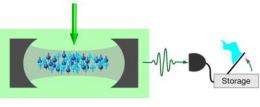
Scientists at MIT have figured out how to relay the successful storage of light in a a form of quantum memory based on a cold-atom gas. Credit: Image copyright American Physical Society [Illustration: Alan Stonebraker]

Scientists at MIT have figured out a key step toward the design of quantum information networks. The results are reported in the July 20th issue of Physical Review Letters and highlighted in APS's on-line journal Physics.

A quantum network - in which memory devices that store quantum states are interconnected with devices - is a prototype for designing a quantum internet. One path to making a quantum network is to map a light pulse onto nodes in a material system. Yet, it is one thing to catch a beam of light; it is more difficult to generate a signal that heralds that it has been successfully caught. Quantum systems follow Heisenberg's rule that observing an event may destroy it, so the system has to emit just the right kind of herald pulse so as not to erase the data.

Now, Haruka Tanji, Saikat Ghosh, Jonathan Simon, Benjamin Bloom, and Vladan Vuletic from MIT have demonstrated an atomic that heralds the successful storage of a in a cold atom gas. The atomic-ensemble memory can receive an arbitrary polarization state of an incoming photon, called a polarization qubit, announce successful storage of the qubit, and later regenerate another photon with the same polarization state. The herald signal only announces the fact the pulse has been captured, not details of the polarization, so the quantum information is preserved.

This capability will likely benefit scalable quantum networking, where it is crucial to know if operations have succeeded.


Quantum memory and turbulence in ultra-cold atoms
Enlarge

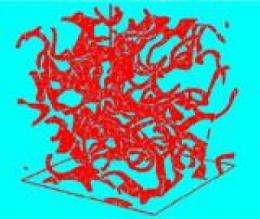
Scientists have imaged the vortices that form in the turbulent state of an ultra-cold atom gas. Credit: Image copyright American Physical Society [Illustration: Adapted from E. A. L. Henn et al. Phys. Rev. Lett. (to be published)]

Scientists in Brazil report the controllable formation of quantum turbulence in an ultra-cold atom gas. The results, which appear in the July 20 issue of and are highlighted in the APS journal Physics may make it easier to characterize quantum turbulence - and potentially even classical turbulence - because it is possible to tune many characteristics of the cold-atom gas.

Turbulence is considered a nuisance because it slows down boats and jars airplanes. But for hundreds of years, physicists have been fascinated with the notoriously difficult problem of how to describe this phenomenon, which involves the formation and disappearance of vortices - swirling regions in a gas or liquid- over many different length and time scales.

Turbulence can also occur in quantum fluids, such as ultra-cold atom gases and superfluid helium. In a quantum fluid, the motion of the vortices is quantized; and, because quantum fluids have zero viscosity, the vortices cannot easily disappear.

These properties make quantum turbulence more stable and easier to understand than classical turbulence. Now, Emanuel Henn and colleagues at the University of Sao Paulo in Brazil and the University of Florence in Italy have created quantum turbulence in a gas of ultra-cold rubidium atoms by shaking it up with a magnetic field. In this way, they are able to control the formation of vortices and generate many different kinds of turbulence to explore a number of questions relevant to both its quantum and classical forms.

Source: American Physical Society

4.8 /5 (4 votes)  

Rank 4.8 /5 (4 votes)
Related Stories
Relevant PhysicsForums posts
  • Magnet in a AC current solenoid
    created1 hour ago
  • Maxwell's equations outside electrodynamics?
    created2 hours ago
  • Force and Surface Charge on Sphere
    created8 hours ago
  • Trajectory Path from 2 Distance Sensors
    created9 hours ago
  • Conceptual issue with rolling sphere and friction.
    created12 hours ago
  • Conservation of momentum/energy
    created14 hours ago
  • More from Physics Forums - Classical Physics

More news stories

Putting the squeeze on planets outside our solar system

(PhysOrg.com) -- Using high-powered lasers, scientists at Lawrence Livermore National Laboratory and collaborators discovered that molten magnesium silicate undergoes a phase change in the liquid state, abruptly ...

Physics / Condensed Matter

created 10 hours ago | popularity 4.2 / 5 (6) | comments 0 | with audio podcast

Hovering not hard if you're top-heavy, researchers find

Top-heavy structures are more likely to maintain their balance while hovering in the air than are those that bear a lower center of gravity, researchers at New York University's Courant Institute of Mathematical Sciences ...

Physics / General Physics

created 11 hours ago | popularity 5 / 5 (1) | comments 1 | with audio podcast

SLAC, Stanford team focuses on high-energy electrons to treat cancer

Accelerator physicists at SLAC and cancer specialists from Stanford are working on a new technology that could dramatically reduce the time needed for cancer radiation treatments. The team ran an initial experiment ...

Physics / General Physics

created 14 hours ago | popularity 5 / 5 (1) | comments 0

Measurements from high-energy collisions lead to better understanding of why meson particles disappear

For several years, physicists at the Relativistic Heavy Ion Collider (RHIC) at Brookhaven National Laboratory (BNL), USA, have studied an unusual state of matter called the quark–gluon plasma, which they ...

Physics / General Physics

created 14 hours ago | popularity 4.5 / 5 (2) | comments 0

Explained: Sigma

It's a question that arises with virtually every major new finding in science or medicine: What makes a result reliable enough to be taken seriously? The answer has to do with statistical significance -- but ...

Physics / General Physics

created Feb 09, 2012 | popularity 5 / 5 (16) | comments 53


Anonymous knocks CIA website offline (Update)

The website of the Central Intelligence Agency was inaccessible on Friday after the hacker group Anonymous claimed to have knocked it offline.

Google users warned of threat to smartphone wallets

Users of Google smartphone wallets were being warned on Friday that there is a way to crack pass codes intended to thwart thieves from going on illicit shopping sprees.

New error-correcting codes guarantee the fastest possible rate of data transmission

Error-correcting codes are one of the triumphs of the digital age. They’re a way of encoding information so that it can be transmitted across a communication channel — such as an optical fiber o ...

Humans may have helped the decline of African rainforests 3000 years ago

(PhysOrg.com) -- Large areas of rainforests in Central Africa mysteriously disappeared over three thousand years ago, to be replaced by savannas. The prevailing theory has been that the cause was a change ...

Complex wiring of the nervous system may rely on a just a handful of genes and proteins

Researchers at the Salk Institute have discovered a startling feature of early brain development that helps to explain how complex neuron wiring patterns are programmed using just a handful of critical genes. ...

The power of estrogen -- male snakes attract other males

A new study has shown that boosting the estrogen levels of male garter snakes causes them to secrete the same pheromones that females use to attract suitors, and turned the males into just about the sexiest ...