Researchers discover genetic circuit that regulates behavior of stem cells
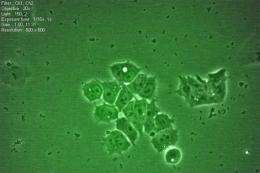
Jordi Garcia Ojalvo -- a lecturer at the Department of Physics and Nuclear Engineering of the Universitat Politčcnica de Catalunya’s School of Industrial and Aeronautical Engineering of Terrassa (ETSEIAT, Spain) -- has discovered the genetic circuit that controls the behavior of embryonic stem cells. The discovery was made in collaboration with University of Cambridge researchers. The process by which a stem cell is transformed into another type of cell is called differentiation, and the ability to change into other cell types is known as pluripotentiality.
Up until now it was generally believed in the international scientific community that embryonic stem cells are in a state of biochemical repose, static, awaiting a signal that causes them to differentiate, that gives them the initial trait which leads them to become bone, blood or skin cells, or any other type of cell of which an organism is composed. Jordi Garcia Ojalvo, one of the coordinators of the Nonlinear Dynamics, Nonlinear Optics and Lasers research group at the UPC’s Terrassa Campus, has discovered that this view is not correct, and that in fact the state of pluripotentiality in stem cells is anything but static.
Greater efficiency in generating new cells
In a paper published this July in the prestigious journal PLoS Biology, Jordi Garcia Ojalvo and the group headed by University of Cambridge researcher Alfonso Martínez Arias say that the pluripotentiality of embryonic stem cells is not static and that these cells are in fact constantly changing. Garcia-Ojalvo and Martínez-Arias also found that there is always a subset of stem cells that are on alert, ready to respond to the signals that trigger the process of transformation known as differentiation. This ensures that an embryo’s differentiation program is completed correctly and with the necessary speed.
The study—carried out using mouse embryonic stem cells but with results that are also valid for human stem cells—allowed the researchers to identify the genetic circuit that gives stem cells their pluripotent properties. Thanks to this discovery, it will now be possible to more effectively maintain embryonic stem cells in a pluripotent state in vitro and to more efficiently obtain differentiated cells—blood, bone, skin and other cells—from stem cells.
Chance plays a key role
For the UPC Terrassa and Cambridge researchers, the starting point on the road to their discovery was the hypothesis that chance plays an important role in the process. This is consistent with the fact that disorder plays a fundamental role in the functioning of living organisms. Cells are continually subject to random fluctuations. Based on this premise, Garcia-Ojalvo developed a mathematical model of the functioning of the proposed genetic circuit in the presence of disorder. Martínez-Arias then conducted experimental procedures to confirm these calculations in the lab.
Like athletes in constant motion
Garcia-Ojalvo uses a sports metaphor to explain the discovery: ‘Up until now we thought stem cells were static, like athletes about to start a 100-metre race, lined up waiting for the starting gun to go off to begin their sprint to the finish line. But we’ve discovered that this isn’t the way it works. In fact, stem cells are like athletes that are always running, in constant motion, back and forth. So when the signal to differentiate comes, the cells moving in the right direction are able to reach the finish line much faster than they would have if they’d been standing still. This makes sense because embryos have to develop very fast, and stem cells have very little time to change into whatever type of cell is needed at a particular time and in a particular position. What’s more, they have to do this in a very reliable and precise way so that malformations are not produced.’
Source: Universitat Politčcnica de Catalunya


