Ski Robot Could Decipher the Art of Skiing
July 20, 2009 By Lisa Zyga
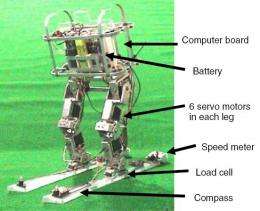
Researchers have developed a ski robot in an attempt to make precise measurements of skiing movements. Credit: T. Yoneyama, et al.
(PhysOrg.com) -- Watching an Olympic skier perform a downhill slalom, turning smoothly around the flags, makes the sport seem just as much an art as a science. Although advanced skiers know how to turn effectively, the exact physical mechanisms involved remain elusive, as there is no complete set of objective criteria to define joint motions, posture, and all the other motions that go into making the turn. To try to gain a better understanding of the kinematics of optimized skiing, researchers have recently built a ski robot that can simulate the movements of professional skiers, allowing for direct measurements of the variables involved.
The team of researchers, from Kanazawa University in Japan, has taken the first steps toward developing a robot experimental system to investigate the effects of joint motions on ski turns, and ultimately serve as a model to help skiers improve their own movements. Their research is published in a recent issue of Sports Engineering.
Generally, measuring the movements of skiers - specifically, the relationship between the joint angles and ski turn quality - has been very difficult. For instance, attempts at direct measurement face technical challenges and achieve only limited precision, and computer simulations - though more precise - must make many assumptions and are difficult to validate. On the other hand, the ski robot method has the advantage of providing precise measurements with controllable, consistent movements, as long as the robot can be designed to accurately simulate a human athlete.
“There have been several attempts at researching ski turns using a skiing robot,” Takeshi Yoneyama of Kanazawa University told PhysOrg.com. “But there have been few considerations on the conditions required to simulate human skiing with a robot. Our attempt is to clarify the considerations for developing a modeling system using a ski robot. We also wanted to express that we are approaching this subject to obtain some useful knowledge for human skiers.”
Although the researchers tried to model a real skier as closely as possible, they faced several challenges. Their robot consisted of two legs attached to skis, with a large “waist” that contained the computer and battery. They had to modify certain values, such as the ratio of the robot’s center of mass to its ski separation distance; a version of the robot with the correct human ratio was very prone to falling over. Despite (or because of) the differences in size, mass, and mass distribution, the robot was capable of performing several successful test runs on an 11-meter-long test slope covered in artificial grass with an inclination of 20°.
The robot had six servomotors in each leg to allow for six degrees of freedom, while its onboard computer controlled the sequences of the joint angles. The robot also had force sensors between each “foot” and ski, and an odometer at the rear of each ski, while a video camera at the base of the slope recorded the robot’s trajectory. The researchers could program various motions into the robot to investigate the relations among joint angles and turn trajectory. The researchers also programmed a motion plan based on the skiing style of world cup racer Gaku Hirasawa, who turns his waist to face inside the turn arc. Copying this technique made the robot’s turn faster and more stable.
Overall, the researchers found that the robot could enable them to separate and investigate the effects of each joint motion on skiing performance. Still, the robot was limited as a model due to its differences from a human being, and the researchers hope to improve the robot’s human-likeness in the future.
“Now we are attempting to realize the ski turn modeling on a real snow slope using the ski robot,” Yoneyama said, adding that he hopes to have results in the near future.
More information: T. Yoneyama, H. Kagawa, M. Unemoto, T. Iizuka, N.W. Scott. “A ski robot system for qualitative modeling of the carved turn.” Sports Engineering (2009) 11:131-141.
Copyright 2009 PhysOrg.com.
All rights reserved. This material may not be published, broadcast, rewritten or redistributed in whole or part without the express written permission of PhysOrg.com.
-
Ski Faster with Camera-less Fusion Motion Capture
Jul 01, 2008 |
not rated yet |
0
-
Skiers look at their back yard, not slopes
Dec 11, 2007 |
not rated yet |
0
-
Korea to sell programmable robot
Aug 21, 2006 |
not rated yet |
0
-
Scientists study robot-human interactions
Aug 30, 2006 |
not rated yet |
0
-
The robot that climbs in the pipe
Jun 23, 2008 |
not rated yet |
0
-
Engineers build first sub-10-nm carbon nanotube transistor
Feb 01, 2012 |
4.9 / 5 (30) |
30
-
Something old, something new: Evolution and the structural divergence of duplicate genes
Jan 31, 2012 |
4.6 / 5 (7) |
1
-
The hidden nanoworld of ice crystals: Revealing the dynamic behavior of quasi-liquid layers
Jan 30, 2012 |
5 / 5 (3) |
1
-
Stock market network reveals investor clustering
Jan 27, 2012 |
3.9 / 5 (23) |
8
-
Of microchemistry and molecules: Electronic microfluidic device synthesizes biocompatible probes
Jan 26, 2012 |
5 / 5 (1) |
0
-
feed hold button on CNC lathe
11 hours ago
-
Mechanics of Solids ( Final exam question) plz help!
12 hours ago
-
RFAC in Fortran
15 hours ago
-
dynamics 2/32
21 hours ago
-
dynamics
21 hours ago
-
Vibration Absorbtion Problem
Feb 08, 2012
- More from Physics Forums - General Engineering
More news stories
Apple to debut 'iPad 3' in March: report
Apple will unveil a new version of its market-ruling iPad table computer in March, according to a report in Dow Jones-owned technology blog All Things D.
Electronics / Consumer & Gadgets
6 hours ago |
2.5 / 5 (13) |
0
Barriers fall between TV, Internet
You say TV, I say Internet. Toe-mate-o, toe-mah-to.
Electronics / Consumer & Gadgets
2 hours ago |
not rated yet |
0
New Kindle Touch is an impressive e-reader
When it comes to reading digital books, tablets are all the rage. But there's a lot to like about simple e-readers, which over the past year have become both a lot cheaper and a lot less clunky.
Electronics / Consumer & Gadgets
5 hours ago |
5 / 5 (2) |
0
Review: Soulo converts iPad into karaoke machine
Karaoke lovers typically fall into two categories: Those who enjoy it, and those whose arms have to be twisted to get up and sing in public.
Electronics / Consumer & Gadgets
23 hours ago |
not rated yet |
0
Google rumored to have built Heads-Up-Display glasses prototype
(PhysOrg.com) -- 9to5Google is reporting that they have received a tip from someone they believe to be a reliable source saying that Google is working on a Heads-Up-Display (HUD) pair of eye-glasses. The per ...
Decoding the molecular machine behind E. coli and cholera
Scientists from Queen Mary, University of London have discovered the workings behind some of the bacteria that kill hundreds of thousands every year, possibly paving the way for new antibiotics that could treat infections ...
Deadly bird parasite evolves at exceptionally fast rate
A new study of a devastating bird disease that spread from poultry to house finches in the mid-1990s reveals that the bacteria responsible for the disease evolves at an exceptionally fast rate. What's more, ...
Flexible paper robots
(PhysOrg.com) -- These inexpensive robots can stretch, bend and twist under control, and lift objects up to 120 times their own weight. Being soft, they can apply gentle and even pressure, and adapt to varied ...
Tell me how you are -- and I know how long you will live
The way people rate their health determines their probability of survival in the following decades. Researchers from the Institute of Social and Preventive Medicine at the University of Zurich demonstrate that for ratings ...
New research reveals why fishermen keep fishing despite dwindling catches
Half of fishermen would not give up their livelihood in the face of drastically declining catches according to research led by the University of East Anglia (UEA).
Ultrasound study provides first direct evidence of effect of malaria on fetal growth
A study of almost 3,800 pregnancies has provided the most accurate and direct evidence to date that malaria infection reduces early foetal growth. Low birth weight is the most important risk factor for neonatal mortality ...
Jul 20, 2009
Rank: not rated yet
Jul 23, 2009
Rank: not rated yet
Jul 28, 2009
Rank: not rated yet
Jul 29, 2009
Rank: not rated yet
http://thekeyidea...ots.html
Jul 30, 2009
Rank: not rated yet
http://www.youtub...pz75Hwpk
It doesn't ski but it runs and tumbles. Well it does a forward flip.
Ethelred