'Invisibility cloak' could protect against earthquakes
July 20, 2009 'Invisibility cloak' could protect against earthquakes

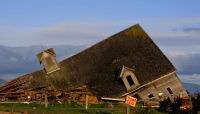
The 'invisibility cloak' could be applied to buildings by installing rings into foundations

(PhysOrg.com) -- Research at the University of Liverpool has shown it is possible to develop an 'invisibility cloak' to protect buildings from earthquakes.

The seismic waves produced by earthquakes include body waves which travel through the earth and surface waves which travel across it. The new technology controls the path of surface waves which are the most damaging and responsible for much of the destruction which follows earthquakes.

The technology involves the use of concentric rings of plastic which could be fitted to the Earth's surface to divert surface waves. By controlling the stiffness and elasticity of the rings, waves travelling through the 'cloak' pass smoothly into the material and are compressed into small fluctuations in pressure and density. The path of the surface waves can be made into an arc that directs the waves outside the protective cloak. The technique could be applied to buildings by installing the rings into foundations.

Sebastien Guenneau, from the University's Department of Mathematics, who developed the technology with Stefan Enoch and Mohamed Farhat from the Fresnel Institute (CNRS) in Marseilles, France, explained: "We are able to 'tune' the cloak to the differing frequencies of incoming waves which means we can divert waves of a variety of frequencies. For each small frequency range, there is a pair of rings which does most of the work and these move about a lot - bending up and down - when they are hit by a wave at their frequency.

"The waves are then directed outside the cloak where they return to their previous size. The cloak does not reflect waves - they continue to travel behind it with the same intensity. At this stage, therefore, we can only transfer the risk from one area to another, rather than eliminate it completely."

He added: "This work has enormous potential in offering protection for densely populated areas of the world at risk from earthquakes. The challenge now is to turn our theories into real applications that can save lives - small scale experiments are underway."

Seismic waves also include coupled pressure and shear body waves which are less destructive than surface waves. Sebastien Guenneau and Sasha Movchan at the University of Liverpool, together with Michele Brun at Cagliari University, have designed an 'elastic' cloak to protect against these particularseismic waves and the team is currently seeking a suitable material to accommodate the elastic parameters of the cloak.

The new research to protect against earthquakes is published in Applied Physics Letters and Physical Review Letters.

Source: University of Liverpool (news : web)


print this article email this article download pdf blog this article bookmark this article     Stumble it Digg this share on Facebook retweet share on Reddit add to delicious
Rate this story - 4.4 /5 (23 votes)

Rank Filter

Move the slider to adjust rank threshold, so that you can hide some of the comments.


Display comments: newest first

  • SincerelyTwo - Jul 20, 2009
    • Rank: 5 / 5 (1)
    Could this be applied to spacecraft to protect against all harmful radiation? etc?

    It would be amazing if we no longer had to use materials to absorb radiation but instead re-direct it all away entirely.
  • nkalanaga - Jul 20, 2009
    • Rank: not rated yet
    Would that qualify as a "deflector shield"?
  • Fazer - Jul 20, 2009
    • Rank: 5 / 5 (1)
    Could this be applied to spacecraft to protect against all harmful radiation?


    I am sure something like you say will eventually be developed, but for now, these cloaking schemes, both the ones for use with EM radiation, and this newer theoretical design for use with mechanical waves, are only suited for specific wavelengths.

    The possible uses are endless. How about thermal blankets? Or structures built into electronics that cause heat to flow only along desired pathways?

    After reading this article, I am wondering when the first lawsuit will be filed against a landlord using this technology for causing a "wave anomaly" to appear on his neighbor's land, utterly destroying everything on that plot beacuse the cloak inadvertantly concentrated the waves in that direction.
  • PinkElephant - Jul 20, 2009
    • Rank: not rated yet
    After reading this article, I am wondering when the first lawsuit will be filed against a landlord using this technology for causing a "wave anomaly" to appear on his neighbor's land, utterly destroying everything on that plot beacuse the cloak inadvertantly concentrated the waves in that direction.


    My thoughts exactly.

    As for,

    ...are only suited for specific wavelengths.


    That's the problem with the notion of shielding against cosmic radiation. These kinds of "invisibility cloaks" work only for long-wave radiation that is indeed best modeled as a wave. Short-wave radiation (like gamma rays, for example) is better modeled as particles, not to mention actual particles like cosmic rays. These things can't be practically deflected, as they travel too fast and huge energies are required to push them aside over such short distances; they also come from all directions, so no dipole-like field arrangement would be effective; unfortunately they can only be absorbed.
  • ArtflDgr - Jul 20, 2009
    • Rank: not rated yet
    there is a better way for earthquake waves on the surface that is less complex and serves the purpose better.
  • nkalanaga - Jul 20, 2009
    • Rank: not rated yet
    Sure - build earthquake proof buildings. But there comes a point where the cost of protecting the building from a large quake is prohibitive.

    One way to improve earthquake resistance would be to do away with vertical walls. A truncated pyramid can't easily fall, as the weight of the walls holds it together, and if the roof is on top of the walls, it can't fall into the building. But even that design would fail in a large enough quake.
  • ArtflDgr - Jul 26, 2009
    • Rank: not rated yet
    no.. what i mean is that in a wave that does damage the slopes are long and steep... but if you break those waves up, something that can be done much easier than some invisability cloak, then you get a lot of vibration instead of huge slopes. the point here is that its much easier to build for a lot of vibration but hard to build for a lot of sheer. the average energy is the same, but since its distributed and smaller than the size of the building, it becomes a lot of rumble. such structures can easily be built as empty columns or you can dual use them by filling them with water, and have radiant arms so that waves that hit them also get dispersed in other directions.

    a small down was hit hard by a tiny earthquake because the wave came in on the open size of a crescent valley.

July 20, 2009 all stories

Comments: 7

4.4 /5 (23 votes)
  • Stumble this up

  • Digg this

  • share this

  • hide
  • Related Stories

  • Tsunami Invisibility Cloak
    created Sep 26, 2008 | popularity not rated yet | comments 0
  • Scientists one more step closer to realising invisible technology
    created May 09, 2007 | popularity not rated yet | comments 0
  • Coastlines could be protected by 'invisibility cloak'
    created Oct 02, 2008 | popularity not rated yet | comments 0
  • 'Invisibility cloaks' could break sound barriers
    created Jan 09, 2008 | popularity not rated yet | comments 0
  • Researchers develop 2-D invisibility cloak
    created Dec 18, 2007 | popularity not rated yet | comments 0


  • hide
  • Relevant PhysicsForums posts

  • Vibration into Electricity?
    created 2 hours ago
  • Meniscus propulsion
    created 3 hours ago
  • Average velocity from multiple displacement/velocities
    created 5 hours ago
  • Stefan's Radiation Law with Boxes
    created 5 hours ago
  • More from Physics Forums - General Physics

Other News

Spin polarization achieved in room temperature silicon

Spin polarization achieved in room temperature silicon

Physics / General Physics

created 16 hours ago | popularity 4.8 / 5 (11) | comments 0

(PhysOrg.com) -- A group in The Netherlands has achieved a first: injection of spin-polarized electrons in silicon at room temperature. This has previously been observed only at extremely low temperatures, ...


Multiferroic compounds used to produce smaller and cheaper digital memories

Multiferroic compounds used to produce smaller and cheaper digital memories

Physics / Condensed Matter

created 10 hours ago | popularity 4.7 / 5 (3) | comments 0

(PhysOrg.com) -- Is it possible to make even more compact digital memories for portable electronic devices and which consume even less energy? A team of French researchers has recently demonstrated that it ...


Superconductor magnet heat shield being developed

Superconductor magnet spacecraft heat shield being developed

Physics / General Physics

created Nov 26, 2009 | popularity 5 / 5 (22) | comments 22

(PhysOrg.com) -- European space agencies and an aerospace giant are developing a new re-entry heat shield that will use superconductor magnets to generate a magnetic field strong enough to deflect the superhot ...


Restored machine to explore mysteries of Big Bang (AP)

Restored machine to explore mysteries of Big Bang

Physics / General Physics

created Nov 21, 2009 | popularity 4.6 / 5 (18) | comments 26

(AP) -- Scientists are preparing the world's largest atom smasher to explore the depths of matter after successfully restarting the $10 billion machine following more than a year of repairs.


Scientists react as they stand in front of a screen at CERN

First atoms reported smashed in Large Hadron Collider (Update)

Physics / General Physics

created Nov 23, 2009 | popularity 4.5 / 5 (31) | comments 22

Two circulating beams on Monday produced the first particle collisions in the world's biggest atom smasher, the Large Hadron Collider (LHC), three days after its restart, scientists announced.