Raindrops keep falling on your head -- but they burst first
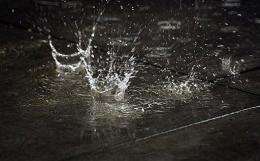
July 20, 2009 Raindrops fall near Waterloo Bridge in London, in 2008

Enlarge

Raindrops fall near Waterloo Bridge in London, in 2008. French scientists armed with ultra-fast video footage saya raindrop starts to fall as a sphere, but then flattens out

For generations, schoolchildren have been taught that raindrops start as micro-droplets that then gather together in clouds with their neighbours to become bigger droplets.

Complex interaction between these as they fall explains why raindrops come in such a remarkable range of sizes, goes this idea.

But French scientists armed with ultra-fast video footage say something else happens on the way down -- and this is why rainfall can range from fine droplets to chubby plops.

Initially, a raindrop starts to fall as a sphere, but then flattens out into a pancake shape.

Eventually, as the pancake widens and thins, the onrush of air causes it to hollow out, like an upturned bag.

The bag then inflates beyond the ability of the water's tension to hold things together and bursts into lots of smaller droplets.

The whole process takes only several thousands of a second.

But when the droplets hit the ground, the most numerous by far are very small, while large drops are comparatively few.

"Rainfall does indeed start through coalescence in the clouds but something quite different happens on the way down, and this explains the diversity of raindrop sizes," said Emmanuel Villermaux, who co-wrote the study with Benjamin Bossa of the Aix-Marseille University in southern France.

"Each drop breaks up individually, independently of its neighbours, on its way to earth."

Way back in 1904, scientists noted that raindrops came in different sizes.

The hypothesis was that droplets which bump into other droplets coalesce and become bigger, while smaller droplets are those that did not bump into as many other droplets.

But the new paper, published online in the journal , says the process is in fact much simpler than thought.

The findings could have practical applications in understanding rainfall patterns and in crop spraying, said Villermaux.

"Understanding how droplets will be distributed can be very important. Take pesticide spraying, for instance. With most sprayers in use today, all it takes is a slight breeze for half of the pesticide to end up in the neighbouring field," he said.

(c) 2009 AFP


print this article email this article download pdf blog this article bookmark this article     Stumble it Digg this share on Facebook retweet share on Reddit add to delicious
Rate this story - 4.8 /5 (9 votes)

Rank Filter

Move the slider to adjust rank threshold, so that you can hide some of the comments.


Display comments: newest first

  • PinkElephant - Jul 20, 2009
    • Rank: not rated yet
    Whoa. That just turned on its head the notion of a teardrop shape being naturally the most aerodynamic because it's what droplets supposedly look like while they fly through the air. Now they tell us the droplets look like pancakes, then like parachutes. ¡Ay, caramba!
  • paulthebassguy - Jul 20, 2009
    • Rank: not rated yet
    This makes sense. I can remember pouring a glass of water off a balcony on a high rise building a few years ago. About 10 floors down the water appeared to explode into tiny droplets, it was quite awesome to watch.
  • smiffy - Jul 21, 2009
    • Rank: not rated yet
    If this is true then it would seem to follow that after a certain size of raindrop has been developed then progression to bigger drops would depend on their being accompanied by an appropriate downdraught. For example the really large raindrops that you get in thunderstorms should be falling to ground in a downdraught of air.
  • El_Nose - Jul 21, 2009
    • Rank: not rated yet
    so it was just a stroke of PURE unadulterated luck that the tear drop shape even worked at all --- another one in the f'ups that made it big bag.

    -- We might be saying the same thing about Einstien in a few years
  • Slotin - Jul 25, 2009
    • Rank: not rated yet
    This behavior is known for years - reality doesn't exist just because it was videotaped..

    http://www.ems.ps...ain.html

July 20, 2009 all stories

Comments: 5

4.8 /5 (9 votes)
  • Stumble this up

  • Digg this

  • share this

  • hide
  • Related Stories

  • New instrument reveals raindrop formation in warm clouds
    created Dec 07, 2006 | popularity not rated yet | comments 0
  • Building a Better Virtual Raindrop
    created Jun 26, 2005 | popularity not rated yet | comments 0
  • Study may produce better weather forecasts
    created Aug 11, 2005 | popularity not rated yet | comments 0
  • Mathematicians defy gravity
    created Oct 03, 2007 | popularity not rated yet | comments 0
  • Dancing droplets
    created Nov 18, 2008 | popularity not rated yet | comments 0


  • hide
  • Relevant PhysicsForums posts

  • brewster's angle
    created 8 hours ago
  • ideal gas equation
    created 8 hours ago
  • electric charges experiment
    created 9 hours ago
  • What is wrong with this argument?
    created 12 hours ago
  • More from Physics Forums - General Physics

Other News

Spin polarization achieved in room temperature silicon

Physics / General Physics

created 1hour ago | popularity 4.5 / 5 (2) | comments 0

(PhysOrg.com) -- A group in The Netherlands has achieved a first: injection of spin-polarized electrons in silicon at room temperature. This has previously been observed only at extremely low temperatures, and the achievement ...


Superconductor magnet heat shield being developed

Superconductor magnet spacecraft heat shield being developed

Physics / General Physics

created Nov 26, 2009 | popularity 5 / 5 (20) | comments 18

(PhysOrg.com) -- European space agencies and an aerospace giant are developing a new re-entry heat shield that will use superconductor magnets to generate a magnetic field strong enough to deflect the superhot ...


Restored machine to explore mysteries of Big Bang (AP)

Restored machine to explore mysteries of Big Bang

Physics / General Physics

created Nov 21, 2009 | popularity 4.6 / 5 (18) | comments 26

(AP) -- Scientists are preparing the world's largest atom smasher to explore the depths of matter after successfully restarting the $10 billion machine following more than a year of repairs.


Scientists react as they stand in front of a screen at CERN

First atoms reported smashed in Large Hadron Collider (Update)

Physics / General Physics

created Nov 23, 2009 | popularity 4.5 / 5 (31) | comments 22

Two circulating beams on Monday produced the first particle collisions in the world's biggest atom smasher, the Large Hadron Collider (LHC), three days after its restart, scientists announced.


In the Brain, Seven Is A Magic Number

In the Brain, Seven Is A Magic Number

Physics / General Physics

created Nov 23, 2009 | popularity 4.5 / 5 (35) | comments 9

Having a tough time recalling a phone number someone spoke a few minutes ago or forgetting items from a mental grocery list is not a sign of mental decline; in fact, it's natural.