New research provides insight into ice sheet behavior
(PhysOrg.com) -- A new study published this week takes scientists a step further in their quest to understand how Antarctica's vast glaciers will contribute to future sea-level rise. Reporting in the journal Nature Geoscience, scientists from British Antarctic Survey (BAS) and University of Durham describe how a new 3-d map created from radar measurements reveals features in the landscape beneath a vast river of ice, ten times wider than the Rhine, in the West Antarctic Ice Sheet.
During 2007, two researchers spent months living and working on the Rutford Ice Stream in temperatures that dropped as low as -30°C. The ice stream moves towards Antarctica's coast by one metre every day. The science team towed radar equipment back and forth across the ice measuring its thickness, and building up a picture of the landscape beneath. A lubricating mixture of sediment and water beneath the ice assists as it flows towards the ocean, and is sculpted into a series of massive ridges the size of tower blocks and separated by deep furrows. These features ultimately control the flow of the ice stream.
Lead author British Antarctic Survey glaciologist Edward King says,
"It was really exciting to see this beautiful image of the landscape two kilometers below our feet emerge from the data. We are now sure that these amazing sediment formations are created by fast-flowing ice and we are much better placed to understand how ice streams behave and how they might change in the future."
Co-author Dr Chris Stokes from University of Durham has studied similar features in parts of northern Canada which were covered by glaciers 9000 years ago. He says,
"It's interesting to note that the features we see in Canada are the same as those under the Rutford Ice Stream. Until now we could only guess how they were formed. The next step will be to look closer at these features in Canada to see what happened as the glaciers disappeared."
British Antarctic Survey scientists have measured the movement and behaviour of the Rutford Ice Stream for the last 25 years. Technological developments in the past 13 years, including satellites, seismic studies and radar, has led to a much greater understanding of what lies beneath Antarctica's vast ice sheet. There is still much to learn, but the techniques developed for the study will greatly improve scientists' capability to measure how the ice sheet may change in the future.
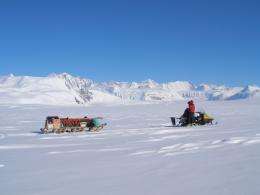
King and a field assistant spent two months in the 'deep field' over 1,000 kms from the nearby BAS Rothera Research Station. They lived under canvas and worked in temperatures often as low at -30°C. Weather permitting they drove their snowmobiles, fitted with radar equipment, 18 kms up the ice stream - doing this 35 times at 500 metre intervals - clocking up over 1200 kms in total.
WAIS contains 13% of all the ice on the Antarctic continent. Studying the flow of ice in Antarctica is important to understanding if the ice sheet is in balance. This means that the rate of snowfall (ice accumulated) equals the amount of ice discharged into the sea through glaciers and then ice bergs. The WAIS is not currently in balance.
Background information:
Ice streams - are like gigantic rivers of ice. They can be as much as a few hundred km long, tens of km wide, and they typically move by a metre or more every day. Almost all of the ice from the interior of the Antarctic Ice Sheet is drained towards the sea through these ice streams. As the ice enters the ocean, it forms large floating ice shelves. The ice streams can be considered to form the link between the ocean and the more slowly moving ice in the interior of the Antarctic continent. Understanding what controls the flow of ice streams is considered to be of key importance for predicting the future behaviour of the Antarctic ice sheet.
A glacier - is a 'river of ice' that is fed by the accumulation of snow. Glaciers drain ice from the mountains to lower levels, where the ice either melts, breaks away into the sea as icebergs, or feeds into an ice shelf.
Ice sheet - is the huge mass of ice, up to 4 km thick, that covers Antarctica's bedrock. It flows from the centre of the continent towards the coast where it feeds ice shelves.
Ice shelf - is the floating extension of the grounded ice sheet. It is composed of freshwater ice that originally fell as snow, either in situ or inland and brought to the ice shelf by glaciers. As they are already floating, any disintegration will have no impact on sea level. Sea level will rise only if the ice held back by the ice shelf flows more quickly onto the sea.
More information: Formation of mega-scale glacial lineations observed beneath a West Antarctic ice stream by E. C. King, R.C. Hindmarsh and C.R. Stokes is published online this week in the journal Nature Geoscience.
Source: British Antarctic Survey (british-antarctic-survey/" rel="news">news : web)


