Testing relativity in the lab
July 20, 2009
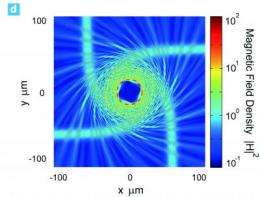
Through the optical-mechanical analogy, metamaterials and other advanced optical materials can be used to study such celestial phenomena as black holes, strange attractors and gravitational lenses. Here an air-GaInAsP metamaterial mimics a photon-sphere, one of the key black hole phenomena in its interactions with light. Credit: Xiang Zhang
Even Albert Einstein might have been impressed. His theory of general relativity, which describes how the gravity of a massive object, such as a star, can curve space and time, has been successfully used to predict such astronomical observations as the bending of starlight by the sun, small shifts in the orbit of the planet Mercury and the phenomenon known as gravitational lensing. Now, however, it may soon be possible to study the effects of general relativity in bench-top laboratory experiments.
Xiang Zhang, a faculty scientist with the U.S. Department of Energy's Lawrence Berkeley National Laboratory (Berkeley Lab) and professor at the University of California Berkeley, lead a study in which it was determined that the interactions of light and matter with spacetime, as predicted by general relativity, can be studied using the new breed of artificial optical materials that feature extraordinary abilities to bend light and other forms of electromagnetic radiation.
"We propose a link between the newly emerged field of artificial optical materials to that of celestial mechanics, thus opening a new possibility to investigate astronomical phenomena in a table-top laboratory setting," says Zhang. "We have introduced a new class of specially designed optical media that can mimic the periodic, quasi-periodic and chaotic motions observed in celestial objects that have been subjected to complex gravitational fields."
A paper describing this work is now available on-line in the journal Nature Physics. The paper is titled: "Mimicking Celestial Mechanics in Metamaterials." Co-authoring it with Zhang were his post-doctoral students Dentcho Genov and Shuang Zhang.
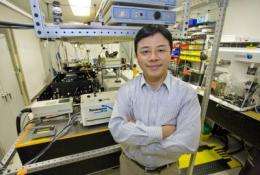
Xiang Zhang has been one of the pioneers in the creation of artificial optical materials and their applications to such phenomena as negative refraction, electromagnetic invisibility devices and microscopy with super-resolution. Credit: photo by Roy Kaltschmidt, Berkeley Lab Public Affairs
Zhang, a principal investigator with Berkeley Lab's Materials Sciences Division and director of UC Berkeley's Nano-scale Science and Engineering Center, has been one of the pioneers in the creation of artificial optical materials. Last year, he and his research group made headlines when they fashioned unique metamaterials - composites of metals and dielectrics - that were able to bend light backwards, a property known as a negative refraction that is unprecedented in nature. More recently, he and his group fashioned a "carpet cloak" from nanostructured silicon that concealed the presence of objects placed under it from optical detection. These efforts not only suggested that true invisibility materials are within reach, Zhang said, but also represented a major step towards transformation optics that would "open the door to manipulating light at will."
Now he and his research group have demonstrated that a new class of metamaterials called "continuous-index photon traps" or CIPTs can serve as broadband and radiation-free "perfect" optical cavities. As such, CIPTs can control, slow and trap light in a manner similar to such celestial phenomena as black holes, strange attractors and gravitational lenses. This equivalence between the motion of the stars in curved spacetime and propagation of the light in optical metamaterials engineered in a laboratory is referred to as the "optical-mechanical analogy."
Zhang says that such specially designed metamaterials can be valuable tools for studying the motion of massive celestial bodies in gravitational potentials under a controlled laboratory environment. Observations of such celestial phenomena by astronomers can sometimes take a century of waiting.
"If we twist our optical metamaterial space into new coordinates, the light that travels in straight lines in real space will be curved in the twisted space of our transformational optics," says Zhang. "This is very similar to what happens to starlight when it moves through a gravitational potential and experiences curved spacetime. This analogue between classic electromagnetism and general relativity, may enable us to use optical metamaterials to study relativity phenomena such as gravitational lens."
In their demonstration studies, the team showed a composite of air and the dielectric Gallium Indium Arsenide Phosphide (GaInAsP). This material provided operation at the infrared spectral range and featured a high refractive index with low absorptions.
In their paper, Zhang and his coauthors cite as a particularly intriguing prospect for applying artificial optical materials to the optical-mechanical analogy the study of the phenomenon known as chaos. The onset of chaos in dynamic systems is one of the most fascinating problems in science and is observed in areas as diverse as molecular motion, population dynamics and optics. In particular, a planet around a star can undergo chaotic motion if a perturbation, such as another large planet, is present. However, owing to the large spatial distances between the celestial bodies, and the long periods involved in the study of their dynamics, the direct observation of chaotic planetary motion has been a challenge. The use of the optical-mechanical analogy may enable such studies to be accomplished in a bench-top laboratory setting on demand.
"Unlike astronomers, we will not have to wait 100 years to get experimental results," Zhang says.
-
Invisibility Cloak Blurs Line Between Magic and Science (w/Video)
May 01, 2009 |
not rated yet |
0
-
Invisibility cloak now within sight: scientists (Update 2)
Aug 11, 2008 |
not rated yet |
0
-
Practical Cloaking Devices On The Horizon?
Aug 10, 2008 |
not rated yet |
0
-
New research field promises radical advances in optical technologies
Oct 16, 2008 |
not rated yet |
0
-
Negative Index Materials: From Theory to Reality
Jun 06, 2006 |
not rated yet |
0
-
Engineers build first sub-10-nm carbon nanotube transistor
Feb 01, 2012 |
4.9 / 5 (30) |
30
-
Something old, something new: Evolution and the structural divergence of duplicate genes
Jan 31, 2012 |
4.6 / 5 (7) |
1
-
The hidden nanoworld of ice crystals: Revealing the dynamic behavior of quasi-liquid layers
Jan 30, 2012 |
5 / 5 (3) |
1
-
Stock market network reveals investor clustering
Jan 27, 2012 |
3.9 / 5 (23) |
8
-
Of microchemistry and molecules: Electronic microfluidic device synthesizes biocompatible probes
Jan 26, 2012 |
5 / 5 (1) |
0
-
electrostatic induction in a conductor should be immpossible
1 hour ago
-
Help! Physics Momentum/Impulse problem!
4 hours ago
-
Gauss' law cubes, how to prove
5 hours ago
-
A grandfather pulls his granddaughter, whose mass is 20.5 kg
7 hours ago
-
what is significance of torque
7 hours ago
-
Difference between volume displaced fluid and volume of the object
8 hours ago
- More from Physics Forums - General Physics
More news stories
Explained: Sigma
It's a question that arises with virtually every major new finding in science or medicine: What makes a result reliable enough to be taken seriously? The answer has to do with statistical significance -- but ...
21 hours ago |
5 / 5 (12) |
30
Borexino Collaboration succeeds in spotting pep neutrinos emitted from the sun
(PhysOrg.com) -- To learn more about how the sun works, scientists study particles that are emitted from it into space due to thermonuclear reactions that occur inside; by applying known physics principles, ...
Physics research suggests new pathways for cancer progression
Observing that certain cancer cells may exhibit greater flexibility than normal cells, some scientists believe that this capability promotes rapid tumor growth. Now computer simulations developed by Boston University Biomedical ...
18 hours ago |
5 / 5 (1) |
0
Quantum physicist explains $100K offer for proof scaled-up quantum computing is impossible
(PhysOrg.com) -- MIT researcher Scott Aaronson has certainly riled the physics community with his offer this past Friday, of $100,000 to anyone who can prove that scaled-up quantum computing is impossible. ...
Physicists 'record' magnetic breakthrough
An international team of scientists has demonstrated a revolutionary new way of magnetic recording which will allow information to be processed hundreds of times faster than by current hard drive technology.
Feb 07, 2012 |
4.5 / 5 (39) |
14
|
FDA-approved drug rapidly clears amyloid from the brain, reverses Alzheimer's symptoms in mice
Neuroscientists at Case Western Reserve University School of Medicine have made a dramatic breakthrough in their efforts to find a cure for Alzheimer's disease. The researchers' findings, published in the journal Science, show t ...
'Dark plasmons' transmit energy
Microscopic channels of gold nanoparticles have the ability to transmit electromagnetic energy that starts as light and propagates via "dark plasmons," according to researchers at Rice University.
Hydrogen from acidic water: Researchers develop potential low cost alternative to platinum for splitting water
A technique for creating a new molecule that structurally and chemically replicates the active part of the widely used industrial catalyst molybdenite has been developed by researchers with the Lawrence Berkeley ...
Ultraviolet protection molecule in plants yields its secrets
Lying around in the sun all day is hazardous not just for humans but also for plants, which have no means of escape. Ultraviolet (UV) radiation from the sun can damage proteins and DNA inside cells, leading ...
Soraa LED light may dim 50-watt halogen rivals
(PhysOrg.com) -- Soraa, a Fremont, California company founded in 2008, this week launched its first product, a light that uses LEDS (light emitting diodes). The "Soraa LED MR16 lamp" is the "perfect" replacement ...
Anyone can learn to be more inventive, cognitive researcher says
There will always be a wild and unpredictable quality to creativity and invention, says Anthony McCaffrey, a cognitive psychology researcher at the University of Massachusetts Amherst, because an "Aha moment" is rare and ...

Jul 20, 2009
Rank: 5 / 5 (1)
Jul 20, 2009
Rank: 5 / 5 (1)
Jul 20, 2009
Rank: 1 / 5 (1)
Jul 20, 2009
Rank: 2 / 5 (4)
http://www.scifor...=1727687
These analogies helps us to predict various boundary phenomena in more intuitive way.
Jul 25, 2009
Rank: 3.7 / 5 (3)
Jul 25, 2009
Rank: 1.3 / 5 (15)
http://tinyurl.com/kl62tn
So I don't steal my ideas from anybody - I can say, this publication was predicted by AWT or it was even motivated by AWT, instead... ;-)
Jul 25, 2009
Rank: 1.3 / 5 (14)
Can you at least attempt for it?
Jul 25, 2009
Rank: 1.5 / 5 (2)
I suggest another title.
Mimicking relativity in a lab.
Jul 25, 2009
Rank: 1.3 / 5 (15)
The modelling of vacuum by solid state metamaterial foam works for light of very narrow range of wavelength only. Real vacuum adopts its behavior to energy density nearly exactly - so we cannot see rainbow behind gravitational lens, for example.
Jul 25, 2009
Rank: 3 / 5 (1)
I am very interested to know that.
Jul 26, 2009
Rank: 1 / 5 (14)
http://www.wired....sts-make
So that the metamaterial behavior of vacuum isn't surprising at all for scientists, who are informed about subject. Just the malicious people, who want to prohibit publicity from such understanding are labeling my posts be minimal number of points possible repeatedly. They want to keep "their" science mysterious and secret like Holy Church in medieval era to keep their information monopoly.
Jul 26, 2009
Rank: 5 / 5 (2)
If somebody ranks a question made with 3/5 by a user named Alizee who ranks all Slotin sayings with 5, then I conclude
Slotin=Alizee
Jul 26, 2009
Rank: 1 / 5 (4)
http://aetherwave...ory.html
But some people will not be convinced by any evidence, in the same way, like many people (~66% of Americans, for example) doesn't believe in evolution even after 150 years after Darwin's death. From this perspective some 33% would be a huge success of every scientific theory, not saying about non-scientific one.
The lack of communication skills is both advantage, both disadvantage for AWT. In fact it filters out the layer of people, who are influenced by eloquence and cajolement...
What I really don't want is to become 2nd Brian Greene, because my person is supposed to remain quite irelevant here. AWT is here for fresh understanding of residual connections missing for mainstream physics and for learning people in independent thinking - not for establishing of another level of scientific religion, like string theory.
And AWT isn't brigth at all - it's quite silly idea - the only problem of human creatures is, the most silly ideas are checked at the very end, when all more thorough and clever models fail. What do you expect from Occam's razor criterion, after all?
Jul 26, 2009
Rank: 1 / 5 (3)
Jul 26, 2009
Rank: 1 / 5 (2)
You see, you are very gifted to not making friends.
Occam's razor?
Why does space(time) bend?
Because light always goes in a straight line.
The latter is is an assumption that may or may not be true. Maybe that is where Einstein went wrong.
Einstein was besides a mathematician and a physicist a great communicator and entertainer, and not only that. You need these skills to become famous.
Jul 26, 2009
Rank: 1 / 5 (2)
They are also right as Paul said in one of his letters something you should read.
Though I speak with the tongues of men and of angels and have not love. I am become as sounding brass or a tinkling cymbal. And though I have the gift of prophecy, and understand all mysteries, and all knowledge, and though I have all faith so that I could remove mountains, and have not love, I am nothing.
Jul 28, 2009
Rank: 1.3 / 5 (15)
For me sounds a bit funny, if person like you, who is labeling others like psychiatrist without asking mentors people, how to get friends..;-) The fact, you mistyped the name of my alleged disorder is symptomatic. This is simply very dull behavior .
Jul 28, 2009
Rank: 1.3 / 5 (15)
Jul 28, 2009
Rank: 1 / 5 (2)
It just means that English is not my native language. I learned psychiatry in Spanish which is also not my native language. That is where the typo came from.
http://es.wikiped...onalidad
Jul 28, 2009
Rank: 1.3 / 5 (16)
A hint: http://aetherwave...tum.html
Jul 28, 2009
Rank: 1.3 / 5 (15)
Jul 28, 2009
Rank: 1 / 5 (1)
But hey I feel that through that razor, just maybe Einstein went too far to put an end to Euclidian space.
I suddenly have an idea though how things stick together (another 2 cents theory on the limit of my knowledge)
I will make a nice animation to explain and when ready I might post it.
Jul 28, 2009
Rank: 1.3 / 5 (15)
Jul 28, 2009
Rank: 1 / 5 (1)
Jul 29, 2009
Rank: 1.3 / 5 (15)