Smart clothes for better healthcare (w/ Video)
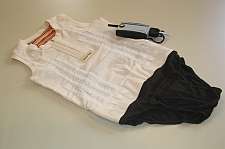
(PhysOrg.com) -- Comfortable smart clothes that monitor the wearer’s heart, breathing and body temperature promise to revolutionise healthcare by reducing hospital visits and allowing patients to lead more active lives.
Unlike many remote health monitoring systems that rely on sensors strapped to users’ arms or chests connected by wires to bulky equipment, a European team has embedded sensing devices directly into textiles, creating garments that are not only smart but also comfortable and practical to wear. Data from the biosignals collected by the clothes is then sent via a mobile connection to caregivers, allowing doctors to check up on their patients and warning if their health deteriorates.
“Remote monitoring is ideally suited to patients suffering from chronic diseases or recovering from an incident, such as a heart attack, who would otherwise have to spend longer in hospital or visit their doctor more frequently for checkups,” explains Theodore Vontetsianos, the head of the e-Health Unit at Sotiria General Chest Diseases Hospital in Athens, Greece.
Vontetsianos helped oversee the EU-funded HealthWear project in which a series of clinical trials were carried out to validate the remote health monitoring technology, developed by a consortium of smart fabric manufacturers, software developers, telecommunications providers and healthcare professionals.
“By embedding the sensors in a vest that patients feel comfortable wearing, and requiring only a mobile phone-sized device to gather and transmit the information, the system empowers patients to be more active and independent while letting caregivers check on them at anytime or in any place as necessary,” Vontetsianos says.
Whereas other remote monitoring systems require different sensors linked to different transmission devices, the HealthWear system collects all the information from the sensors into a single device called a Portable Patient Unit (PPU).
The embedded sensors include a six-lead electrocardiograph (ECG), respiration movement, pulse rate and skin temperature monitors, in addition to an external oximeter to measure blood oxygen saturation and a 3D accelerometer inside the PPU to measure body position. The data are then transmitted via a secure GPRS mobile connection to a central server.
“The information is stored on a patient’s electronic health record and can be accessed via a secure TCP/IP internet connection by doctors and caregivers, in either near real-time or off-line mode,” explains Alexis Milsis, a research engineer at the Sotiria e-Health Unit.
Transparent and easy to use
Crucially, the technology is transparent and simple to use for both patients and healthcare professionals. Patients only have to wear the vest and keep the attached PPU’s batteries charged, just as they would recharge their mobile phone. In fact, in the future the HeatlhWear team envisions a normal mobile phone doubling up as a PPU.
“The technology needs to be transparent to users if they are going to be comfortable with it. They don’t want to be surrounded by cables and different devices that they have to plug in. This is especially important since the patients being monitored are usually elderly,” Milsis says.
Caregivers, meanwhile, can easily access patients’ data, allowing them to visualise the patients’ progress accurately over time and even monitor their data in real time. This feature allows doctors to perform remote checkups by speaking with the patient via a videophone and instructing them to perform different exercises while they monitor their ECG and oximetry readings.
“The contact with their doctor builds up a strong feeling of safety for the patient, and it is also much more convenient than having to make a trip to the hospital,” Votentsianos says.
One of the project trials conducted by the Sotiria Hospital team showed not only that patients feel comfortable using the technology, but that the system improves quality of care and patient comfort.
A doctor always by the patient’s side
Thanks to the HealthWear system, a group of 24 people suffering from chronic obstructive pulmonary disease were able to be discharged from hospital after an average of just 3.6 days compared with 6.8 days for a control group. Just one patient using the HealthWear system had to be readmitted, compared to three from the control group, and, most significantly, patients using the smart clothes made just two outpatient visits compared with 32 from the control group.
As one patient involved in the trial noted: “What a patient wants is someone to be next to him… this is the best remedy.”
For healthcare providers, fewer visits and less hospitalisation time should translate into substantial efficiency gains and significant cost savings.
“As with all new technology, the costs of implementing the HealthWear system are high if it is done on a small scale, but the system and its components could readily be mass produced and widely deployed. That would bring down the implementation costs substantially and result in considerable savings for private and public health providers,” Milsis says.
With that goal in mind, the project partners are actively seeking investors and business partners to roll out a commercial version of the system. The Sotiria Hospital e-Health Unit has also embarked on a new EU-funded project, NEXES, in which the smart clothes will enable doctors to monitor their patients’ compliance with prescribed exercise programmes and check for cases of sleep apnea.
The HealthWear project received funding under the EU’s eTEN programme for market validation and implementation.
More information: www.health-wear.eu/
Provided by ICT Results


