Prehistoric Cold Case Hints of Interspecies Homicide
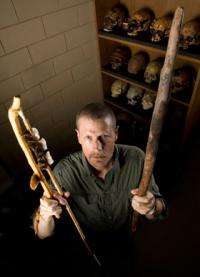
(PhysOrg.com) -- The wound that ultimately killed a Neandertal man between 50,000 and 75,000 years was most likely caused by a thrown spear, the kind modern humans used but Neandertals did not, according to Duke University-led research.
"What we've got is a rib injury, with any number of scenarios that could explain it," said Steven Churchill, an associate professor of evolutionary anthropology at Duke. "We're not suggesting there was a blitzkrieg, with modern humans marching across the land and executing the Neandertals. I want to say that loud and clear."
But Churchill's analysis indicates the wound was from a thrown spear, and it appears that modern humans had a thrown-weapons technology and Neandertals didn't. "We think the best explanation for this injury is a projectile weapon, and given who had those and who didn't that implies at least one act of inter-species aggression."
Churchill is the first author of a new report now posted online in the Journal of Human Evolution on the long-ago incident in what is now Iraq. He and four other investigators used a specially calibrated crossbow, copies of ancient stone points and numerous animal carcasses to make their deductions.
Neandertals, stoutly-built and human-like, lived at the same time and in the same areas as some modern humans before going extinct. Anthropologists have been puzzling over Neandertal's fate for many years, proposing that perhaps they inter-bred with modern humans, failed to compete for food or resources, or were possibly hunted to extinction by the humans.
While narrowing the range of possible causes for the Iraqi Neandertal's wound, and raising the possibility of an encounter between humans and a now-extinct close cousin, the research does not definitively conclude who did it, or why.
The victim was one of nine Neandertals discovered between 1953 and 1960 in a cave in northeastern Iraq's Zagros Mountains. Now called "Shanidar 3," he was a 40- to 50-year-old male with signs of arthritis and a sharp, deep slice in his left ninth rib.
The wounded Neandertal's rib had apparently started healing before he died. Comparing the wound to medical records from the American Civil War, a time before modern antibiotics, suggested to the researchers that he died within weeks of the injury, perhaps due to associated lung damage from a stabbing or piercing wound.
"People have been speculating about that rib injury for going on 50 years now," Churchill said. "Some said it was interpersonal violence. Others said it could have been an accident. Did it involve only Neandertals? Now we, for the first time, have brought some experimental evidence to bear on these questions."
While scientists have been unable to precisely date the remains, Shanidar 3 could have lived and died as recently as 50,000 years ago. If so, he could have encountered modern humans who were just returning to the area then after a 30,000-year hiatus.
Archaeological evidence also suggests that by 50,000 years ago humans, but not their Neandertal cousins, had developed projectile hunting weapons, Churchill said. They used spear throwers, detachable handles that connected with darts and spears to effectively lengthen a hurler's arm and give the missiles a power boost.
As human weapons technology advanced, Neandertals continued using long thrusting spears in hunting, which they probably tried -- for personal safety -- to keep between themselves and their prey instead of hurling them, Churchill added.
Both Neandertals and humans were also armed with stone knives. And both species had developed techniques for making sharp stone points.
Looking back at this Paleolithic cold case, the study's authors evaluated all the possible causes of the rib wound with the aid of contemporary tools.
The injury is "consistent with a number of scenarios, including wounding from a long-range projectile (dart) weapon, knife stab, self-inflicted accidental injury and accidental stabbing by a hunting partner," the report said.
Drawing from studies aimed at improving police and prison guard protection, the researchers concluded that the downward sweep of a knife could have the correct trajectory to produce Shanidar 3's rib injury. "Knife attacks generally involve a relatively higher kinetic energy," the report said. However, "whatever created that puncture was carrying fairly low kinetic energy at a low momentum," said Churchill. "That's consistent with a spear-thrower delivered spear."
The investigators rigged up a special crossbow to fire stone-age projectiles, using calibration marks on the crossbow to tell them how much force they were delivering with each launch.
Those tests revealed the delivered energy needed to create similar wounds in the ribs of pig carcasses, which the researchers used as an approximation of a Neandertal's body.
The researchers also used measurements from a 2003 study to estimate the impact of using a thrusted rather than thrown spear, the kind of jabbing that Neandertals are thought to have employed. That produced higher kinetic energies and caused more massive rib damage than Shanidar 3 sustained.
Another clue was the angle of the wound. Whatever nicked his rib entered the Neandertal's body at about 45 degrees downward angle. That's consistent with the "ballistic trajectory" of a thrown weapon, assuming that Shanidar 3 -- who was about 5 feet, 6 inches tall -- was standing, Churchill said.
Shanidar 3 is one of two known Neandertal skeletons bearing evidence of a possible stone tool injury. The other remains, found in France, had an almost-healed head wound. That individual is known to have lived "at a time of overlap with modern humans we call the Cro-Magnon," Churchill said.
Source: Duke University (news : web)


