California's Channel Islands hold evidence of Clovis-age comets
July 20, 2009
California's Channel Islands hold evidence of Clovis-age comets

Enlarge

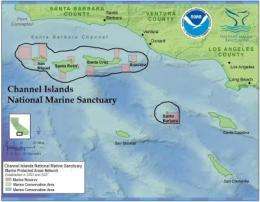
This map shows California's Channel Islands with the islands of the previously combined islands of Santarosae encircled at the top. Credit: Courtesy NOAA and UC Santa Barbara

A 17-member team has found what may be the smoking gun of a much-debated proposal that a cosmic impact about 12,900 years ago ripped through North America and drove multiple species into extinction.

In a paper appearing online ahead of regular publication in the , University of Oregon archaeologist Douglas J. Kennett and colleagues from nine institutions and three private research companies report the presence of shock-synthesized hexagonal diamonds in 12,900-year-old sediments on the Northern Channel Islands off the southern California coast.

These tiny diamonds and diamond clusters were buried deeply below four meters of sediment. They date to the end of Clovis -- a Paleoindian culture long thought to be North America's first human inhabitants. The nano-sized diamonds were pulled from Arlington Canyon on the island of Santa Rosa that had once been joined with three other Northern Channel Islands in a landmass known as Santarosae.

The diamonds were found in association with soot, which forms in extremely hot fires, and they suggest associated regional wildfires, based on nearby environmental records.

Such soot and diamonds are rare in the geological record. They were found in sediment dating to massive impacts 65 million years ago in a layer widely known as the K-T Boundary. The thin layer of iridium-and-quartz-rich sediment dates to the transition of the Cretaceous and Tertiary periods, which mark the end of the Mesozoic Era and the beginning of the Cenozoic Era.

"The type of diamond we have found -- Lonsdaleite -- is a shock-synthesized mineral defined by its hexagonal crystalline structure. It forms under very high temperatures and pressures consistent with a cosmic impact," Kennett said. "These diamonds have only been found thus far in meteorites and impact craters on Earth and appear to be the strongest indicator yet of a significant cosmic impact [during Clovis]."
California's Channel Islands hold evidence of Clovis-age comets
Enlarge

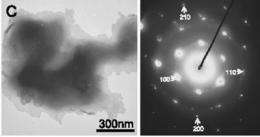
This transmission electron microscopy close-up shows a single lonsdaleite crystal, left, and associated diffraction pattern. Credit: University of Oregon

The age of this event also matches the extinction of the pygmy mammoth on the Northern Channel Islands, as well as numerous other North American mammals, including the horse, which Europeans later reintroduced. In all, an estimated 35 mammal and 19 bird genera became extinct near the end of the Pleistocene with some of them occurring very close in time to the proposed cosmic impact, first reported in October 2007 in PNAS.

In the Jan. 2, 2009, issue of the journal Science, a team led by Kennett reported the discovery of billions of nanometer-sized diamonds concentrated in sediments -- weighing from about 10 to 2,700 parts per billion -- in six North American locations.

"This site, this layer with hexagonal diamonds, is also associated with other types of diamonds and with dramatic environmental changes and wildfires," said James Kennett, paleoceanographer and professor emeritus in the Department of Earth Science at the University of California, Santa Barbara.

"There was a major event 12,900 years ago," he said. "It is hard to explain this assemblage of materials without a cosmic impact event and associated extensive wildfires. This hypothesis fits with the abrupt cooling of the atmosphere as shown in the record of ocean drilling of the Santa Barbara Channel. The cooling resulted when dust from the high-pressure, high-temperature, multiple impacts was lofted into the atmosphere, causing a dramatic drop in solar radiation."

The hexagonal diamonds from Arlington Canyon were analyzed at the UO's Lorry I. Lokey Laboratories, a world-class nanotechnology facility built deep in bedrock to allow for sensitive microscopy and other high-tech analyses of materials. The analyses were done in collaboration with FEI, a Hillsboro, Ore., company that distributes the high-resolution Titan microscope used to characterize the hexagonal diamonds in this study.

Transmission electron microscopy and scanning electron microscopes were used in the extensive analyses of the sediment that contained clusters of Lonsdaleite ranging in size from 20 to 1,800 nanometers. These diamonds were inside or attached to carbon particles found in the sediments.

These findings are inconsistent with the alternative and already hotly debated theory that overhunting by Clovis people led to the rapid extinction of large mammals at the end of the ice age, the research team argues in the PNAS paper. An alternative theory has held that climate change was to blame for these mass extinctions. The cosmic-event theory suggests that rapid climate change at this time was possibly triggered by a series of small and widely dispersed comet strikes across much of North America.

Source: University of Oregon (news : web)

4.9 /5 (14 votes)  

Filter


Move the slider to adjust rank threshold, so that you can hide some of the comments.


Display comments: newest first

RayCherry
Jul 21, 2009

Rank: 2 / 5 (1)
How fortunate were we in 1908? What will be left is us in twelve thousand years? Do you think the Clovis people had Internet, solar power, inter-planetary transport? What is the difference between you, and a sitting duck? When ducks think that a gun might be pointing at them, they fly to someplace else.

http://www.physor...533.html

All together now: "Quack!"
Nik_2213
Jul 21, 2009

Rank: not rated yet
Is there any indication of impact location ? IIRC, a 'tunguska' might not penetrate the Pacific waters, making a search hard.

Um, given that a lot of Clovis-era settlement was coastal, this could have wiped those off the map...
marjon
Jul 21, 2009

Rank: not rated yet
Is there any indication of impact location ? IIRC, a 'tunguska' might not penetrate the Pacific waters, making a search hard.


Um, given that a lot of Clovis-era settlement was coastal, this could have wiped those off the map...


One theory was an ice sheet impact in Canada leaving little geological evidence.
Ronan
Jul 21, 2009

Rank: 4 / 5 (1)
"These findings are inconsistent with the alternative and already hotly debated theory that overhunting by Clovis people led to the rapid extinction of large mammals at the end of the ice age, the research team argues in the PNAS paper. An alternative theory has held that climate change was to blame for these mass extinctions. The cosmic-event theory suggests that rapid climate change at this time was possibly triggered by a series of small and widely dispersed comet strikes across much of North America."

Admittedly, I haven't looked into this particular subject very deeply, so I'm likely talking through my hat, but why are these all mutually exclusive? Why not a triple-whammy for the poor megafauna of that time? A shifting climate plus tool-using, spear-throwing, hungry humans PLUS a gigantic set of impact events across the Canadian shield would be more than enough to accomplish the various extinctions.
nkalanaga
Jul 21, 2009

Rank: 3 / 5 (1)
Most mass extinctions seem to involve multiple causes, so you're probably right. Any one of them would have causes extinctions, but they would have affected fewer species or taken longer.

Just the climate change at the end of the last Ice Age wouldn't have been likely to cause a mass extinction, because most of the species affected had survived previous interglacial periods.

Humans could have caused it, but it wouldn't be likely that we overhunted the same species, across the continent, at the same time. The extinction would have occurred at different times in different regions.
Rank 4.9 /5 (14 votes)
Relevant PhysicsForums posts
  • Discrepancy between oxygen and carbon-dioxide levels
    createdFeb 09, 2012
  • where gems are found in the world
    createdFeb 09, 2012
  • Wind Waves in Reservoir ~ Wind run-up and Wind set-up
    createdFeb 08, 2012
  • Balance of oxygen in the atmosphere
    createdFeb 01, 2012
  • The case for a methanol-based economy
    createdJan 30, 2012
  • Weather in a rotating cylinder
    createdJan 25, 2012
  • More from Physics Forums - Earth

More news stories

Humans may have helped the decline of African rainforests 3000 years ago

(PhysOrg.com) -- Large areas of rainforests in Central Africa mysteriously disappeared over three thousand years ago, to be replaced by savannas. The prevailing theory has been that the cause was a change ...

Space & Earth / Environment

created 16 hours ago | popularity 4.2 / 5 (9) | comments 11 | with audio podcast report

Could Venus be shifting gear?

(PhysOrg.com) -- ESA’s Venus Express spacecraft has discovered that our cloud-covered neighbour spins a little slower than previously measured. Peering through the dense atmosphere in the infrared, the ...

Space & Earth / Space Exploration

created 12 hours ago | popularity 5 / 5 (7) | comments 7 | with audio podcast

NASA sees wide-eyed cyclone Jasmine

Cyclone Jasmine's eye has opened wider on NASA satellite imagery, as it moves through the Southern Pacific Ocean.

Space & Earth / Earth Sciences

created 4 hours ago | popularity 2 / 5 (1) | comments 1

NASA sees Giovanna reach cyclone strength, threaten Madagascar

Tropical Storm 12S built up steam and became a cyclone on February 10, 2012 as NASA's Terra satellite passed overhead. Residents of east-central Madagascar should prepare for this cyclone to make landfall ...

Space & Earth / Earth Sciences

created 4 hours ago | popularity not rated yet | comments 0

Mars Science Laboratory computer issue resolved

(PhysOrg.com) -- Engineers have found the root cause of a computer reset that occurred two months ago on NASA's Mars Science Laboratory and have determined how to correct it.

Space & Earth / Space Exploration

created 13 hours ago | popularity 4.7 / 5 (6) | comments 3 | with audio podcast


Google users warned of threat to smartphone wallets

Users of Google smartphone wallets were being warned on Friday that there is a way to crack pass codes intended to thwart thieves from going on illicit shopping sprees.

Anonymous knocks CIA website offline (Update)

The website of the Central Intelligence Agency was inaccessible on Friday after the hacker group Anonymous claimed to have knocked it offline.

Complex wiring of the nervous system may rely on a just a handful of genes and proteins

Researchers at the Salk Institute have discovered a startling feature of early brain development that helps to explain how complex neuron wiring patterns are programmed using just a handful of critical genes. ...

New error-correcting codes guarantee the fastest possible rate of data transmission

Error-correcting codes are one of the triumphs of the digital age. They’re a way of encoding information so that it can be transmitted across a communication channel — such as an optical fiber o ...

The power of estrogen -- male snakes attract other males

A new study has shown that boosting the estrogen levels of male garter snakes causes them to secrete the same pheromones that females use to attract suitors, and turned the males into just about the sexiest ...

Putting the squeeze on planets outside our solar system

(PhysOrg.com) -- Using high-powered lasers, scientists at Lawrence Livermore National Laboratory and collaborators discovered that molten magnesium silicate undergoes a phase change in the liquid state, abruptly ...