Tension in axons is essential for synaptic signaling, researchers report
July 20, 2009
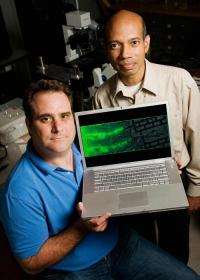
University of Illinois doctoral student Scott Siechen (left), mechanical science and engineering professor Taher Saif and their colleagues found that tension in axons is required for proper neuron signaling. Credit: Photo by L. Brian Stauffer, U. of I. News Bureau.
Every time a neuron sends a signal - to move a muscle or form a memory, for example - tiny membrane-bound compartments, called vesicles, dump neurotransmitters into the synapse between the cells. Researchers report that this process, which is fundamental to the workings of the nervous system, relies on a simple mechanical reality: Tension in the axon of the presynaptic neuron is required.
Without this tension, the researchers found, the vesicles that must haul their chemical cargo to the synapse for neuronal signaling would instead disperse.
The new findings appear this week in the Proceedings of the National Academy of Sciences.
"There is no controversy here," said University of Illinois mechanical science and engineering professor Taher Saif, who conducted the study with biology professor Akira Chiba, now at the University of Miami. Chiba's former doctoral student Scott Siechen and Saif's former doctoral student Shengyuan Yang also contributed significantly to the study. "We're not saying that you don't need chemical or electrical signals for the neurons to fire. All we're saying is that you also need tension in the axons."
The discovery was made almost by accident, Saif said. In a study of fruit fly embryos, Siechen wanted to know whether severing the growing end of an axon would prevent it from reaching its target, a nearby muscle cell.
After severing the axon, he watched the growing tip of the axon, called the growth cone, continue to grow toward and touch the muscle cell. But when he stained it, he noticed that the vesicles in the axon tip were dispersed, not clustered together near the synapse as they normally are.
He then repeated the experiment, but used a micropipette to pull on the severed end of the axon before staining it. This time the vesicles appeared at high density near the synapse.
This indicated that tension in the severed axon was somehow directing the vesicles to collect near the synapse, Saif said.
"The axon is physically cut off, chemically cut off, electrically cut off from the rest of the cell," he said. "So it appears that tension is all that was needed to keep the vesicles in place. But the question is, what keeps the vesicles there?"
Saif hypothesized that the axons in the embryo must be under tension. Otherwise - like a guitar string that is too loose to tune - it would not readily respond to changes in tension.
Using nanoscale probes developed in Saif's laboratory to gently deform an intact axon, the researchers found that the resting tension in a typical axon is about 1 nanonewton. (One newton has been described as the force required to hold a standard-sized apple against the pull of gravity; a nanonewton is one-billionth of that force.) Saif's hypothesis was thus proved true.
The researchers next turned their attention to the structure of the axon terminal, the region that lies closest to the synapse. This region contains many proteins, including actin, which is found in virtually all cell types and is known for maintaining cell shape and generating tension. Under the right conditions, individual actin molecules link together into ropelike filaments. Another protein, myosin, acts as a motor that connects the fibers and causes them to slide in relation to one another. This sliding can increase or decrease tension in the cell.
Other researchers have suggested that actin in axon terminals acts as a kind of scaffold that holds the vesicles near the synapse, Saif said. If that is true, he said, then tension also plays a significant role in the process. It appears that actin cannot properly scaffold the vesicles without sufficient tension in the axon terminal. Further research is needed to identify the exact mechanism that allows this to work, he said.
"This study shows that tension in neurons might be one of the parameters so far overlooked in the quest for understanding learning and memory," Saif said. "We know from studies done elsewhere that tension in neurons creates folds in the brain, and it may be that a lack of tension in the neuron or a lack of the neuron's ability to generate tension is linked with memory loss or other neurological disorders."
Source: University of Illinois at Urbana-Champaign (news : web)
-
What makes an axon an axon?
Nov 10, 2008 |
not rated yet |
0
-
Motor protein plays key role in connecting neurons
Jan 22, 2007 |
not rated yet |
0
-
Autopilot guides proteins in brain
Apr 21, 2009 |
not rated yet |
0
-
Multiple axons and actions with PSD-95
Dec 15, 2008 |
not rated yet |
0
-
Molecular motor works by detecting minute changes in force
Jul 09, 2008 |
not rated yet |
0
-
Engineers build first sub-10-nm carbon nanotube transistor
Feb 01, 2012 |
4.9 / 5 (33) |
30
-
Something old, something new: Evolution and the structural divergence of duplicate genes
Jan 31, 2012 |
4.6 / 5 (7) |
1
-
The hidden nanoworld of ice crystals: Revealing the dynamic behavior of quasi-liquid layers
Jan 30, 2012 |
5 / 5 (4) |
1
-
Stock market network reveals investor clustering
Jan 27, 2012 |
3.9 / 5 (23) |
8
-
Of microchemistry and molecules: Electronic microfluidic device synthesizes biocompatible probes
Jan 26, 2012 |
5 / 5 (2) |
0
-
Is Everyday Technology Killing Us?
Feb 08, 2012
-
Exercise and weight loss
Feb 08, 2012
-
Why do we have head aches? Our brains can't feel anything.
Feb 07, 2012
-
"The end of diseases" by David Agus, interview from Daily Show with Jon Stewart
Feb 04, 2012
-
Oncolytic adenovirus
Feb 04, 2012
-
Nutrition label stuffs and diets
Feb 02, 2012
- More from Physics Forums - Medical Sciences
More news stories
Overeating may double risk of memory loss
New research suggests that consuming between 2,100 and 6,000 calories per day may double the risk of memory loss, or mild cognitive impairment (MCI), among people age 70 and older. The study was released today and will be ...
Medicine & Health / Neuroscience
3 hours ago |
5 / 5 (2) |
0
|
Starve a virus, feed a cure? Findings show how some cells protect themselves against HIV
A protein that protects some of our immune cells from the most common and virulent form of HIV works by starving the virus of the molecular building blocks that it needs to replicate, according to research published online ...
6 hours ago |
5 / 5 (1) |
0
|
Declining health-care productivity in England: Who says so?
Reports that the National Health Service in England has been declining in productivity in the last decade appear to have been accepted as fact. However, a Viewpoint published Online First by The Lancet disputes this. The Vi ...
1 hour ago |
not rated yet |
0
Injured boomers beware: Know when to see doctor
(AP) -- It happened to nurse Jane Byron years after an in-line skating fall, business owner Haralee Weintraub while doing "men's" push-ups, and avid cyclist Gene Wilberg while lifting a heavy box.
8 hours ago |
5 / 5 (1) |
0
FDA-approved drug rapidly clears amyloid from the brain, reverses Alzheimer's symptoms in mice
Neuroscientists at Case Western Reserve University School of Medicine have made a dramatic breakthrough in their efforts to find a cure for Alzheimer's disease. The researchers' findings, published in the journal Science, show t ...
Medicine & Health / Neuroscience
Feb 09, 2012 |
4.9 / 5 (58) |
17
|
Scientists discover molecular secrets of 2,000-year-old Chinese herbal remedy
For roughly two thousand years, Chinese herbalists have treated Malaria using a root extract, commonly known as Chang Shan, from a type of hydrangea that grows in Tibet and Nepal. More recent studies suggest that halofuginone, ...
New method to examine batteries -- MRI from the inside
There is an ever-increasing need for advanced batteries for portable electronics, such as phones, cameras, and music players, but also to power electric vehicles and to facilitate the distribution and storage of energy derived ...
A mitosis mystery solved: How chromosomes align perfectly in a dividing cell
Although the process of mitotic cell division has been studied intensely for more than 50 years, Whitehead Institute researchers have only now solved the mystery of how cells correctly align their chromosomes during symmetric ...
Lab study raises questions over nano-particle impact
Tests involving chickens have raised questions about the impact on health from engineered nano-particles, the ultra-fine grains commonly used in drugs and processed foods, scientists said on Sunday.
Google might launch Drive for cloud storage soon
(PhysOrg.com) -- Google's next big move, according to the Wall Street Journal, is a cloud storage service called Drive. Hardly first to the plate, Google is simply catching up to introducing its cloud reposi ...
Researchers find extensive RNA editing in human transcriptome
In a new study published online in Nature Biotechnology, researchers from BGI, the world's largest genomics organization, reported the evidence of extensive RNA editing in a human cell line by analysis of RNA-seq data, demons ...
Jul 21, 2009
Rank: not rated yet
Jul 22, 2009
Rank: not rated yet