NOAA chief says new ocean uses creating conflicts
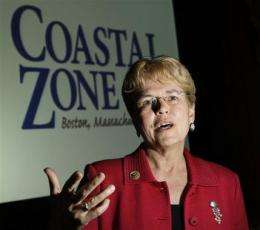
(AP) -- New pressures on the nation's oceans, from wind turbines to fish farms, are increasingly sparking conflicts with more traditional activities such as shipping and recreational boating and show the need for better planning, the head of the agency overseeing federal ocean research services said Monday.
National Oceanic and Atmospheric Administration chief Jane Lubchenco said the nation should take cues from Massachusetts, the first state to create a comprehensive planning map for its ocean waters.
While a similar map for the nation would be more daunting - state waters extend out just 3 miles compared to 200 nautical miles for federal waters - Lubchenco said it's important to begin the process.
"We are seeing more and more conflicts between the emerging uses and the old uses," including fishing, she said in an interview with The Associated Press.
One new use noted by Lubchenco is offshore liquefied natural gas facilities. A plan to build an offshore LNG berth in Mount Hope Bay near Massachusetts and Rhode Island has been criticized by residents and elected officials, including Rep. James McGovern, D-Mass., who said LNG tankers would pose a hazard to commercial and recreational boat traffic.
The LNG company has defended the plan as safe, saying it proposed the offshore berth to ease fears of tankers approaching more densely populated areas.
The National Oceanic and Atmospheric Administration oversees a range of federal research agencies, from the National Marine Fisheries Service to the National Weather Service, that provide weather forecasts, climate monitoring, coastal restoration and other services. Part of its mission is to conserve and manage coastal and marine resources.
Lubchenco, the NOAA's administrator, said the nation needs to adopt "a more holistic, thoughtful approach" when it comes to ocean planning, not just to minimize conflicts but to acknowledge there are legitimate new uses for ocean waters.
"Across the board we are seeing much more intense use of oceans in almost every single dimension," she said, noting at the same time that "oceans in general are becoming seriously depleted and degraded because we have not been the best at our stewardship responsibilities."
Lubchenco sits on a special Ocean Policy Task Force created by President Barack Obama to develop a "framework for effective coastal and marine spatial planning."
That framework should include an "ecosystem-based approach that addresses conservation, economic activity, user conflict and sustainable use," according to a June 12 presidential memo.
"Marine spatial planning" refers to the process of determining which kind of activity should be allowed in which parts of the oceans, including which portions of the oceans should have single or multiple uses, while still protecting fragile marine ecosystems.
Lubchenco said better planning, with the help of extensive public hearing and comment, could help minimize conflicts in the future, particularly as developers seek to place wind farms or tidal energy projects in deeper waters farther from shore.
In Massachusetts, the 130-turbine Cape Wind project, the nation's first proposed offshore wind farm, has prompted a backlash from critics who have vigorously protested the siting of the project in federal waters off Nantucket Sound, where people own expensive homes looking out to sea and recreational boating is popular.
Last year, state lawmakers approved the Massachusetts Oceans Act in part to create a document to cover a myriad of ocean activities while drawing lines around areas considered too environmentally sensitive for development.
A draft version of the map unveiled earlier this month would limit large-scale offshore wind farms to two small areas close to Martha's Vineyard and allow smaller community-based wind projects in other portions of state waters. It would virtually bar any development off the Cape Cod National Seashore, 40 miles of beaches, marshes and ponds home to diverse species.
Lubchenco said the Massachusetts map should be an inspiration for other states and for the nation, although she conceded drafting a similar map out to the 200-mile limit for all national coastal waters would be an enormous task.
The goal of the task force is to get the discussion started and to help move the country away from more piecemeal regulations, she added.
"The goal is to have some reasonable expectations so people can plan," she said. "Exactly what that's going to look like we don't really know."
©2009 The Associated Press. All rights reserved. This material may not be published, broadcast, rewritten or redistributed.


