Brain develops motor memory for prosthetics, study finds
July 21, 2009
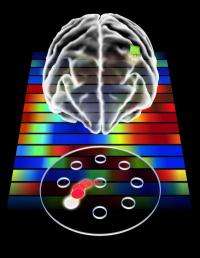
Signals from the brain's motor cortex were translated by a "decoder" into deliberate movements of a computer cursor. The task involved moving the cursor from a central starting point to a nearby target. UC Berkeley researchers have learned that the brain is capable of developing a motor memory of the task, much like it masters other physical skills such as riding a bike or playing tennis, but with the added distinction that the control is of a device separate from one's own body. Credit: Illustration by John Blanchard
"Practice makes perfect" is the maxim drummed into students struggling to learn a new motor skill - be it riding a bike or developing a killer backhand in tennis. Stunning new research now reveals that the brain can also achieve this motor memory with a prosthetic device, providing hope that physically disabled people can one day master control of artificial limbs with greater ease.
In this study, to be published July 21 in the open-access journal PLoS Biology, macaque monkeys using brain signals learned how to move a computer cursor to various targets. What the researchers learned was that the brain could develop a mental map of a solution to achieve the task with high proficiency, and that it adhered to that neural pattern without deviation, much like a driver sticks to a given route commuting to work.
The study, conducted by scientists at the University of California, Berkeley, addresses a fundamental question about whether the brain can establish a stable, neural map of a motor task to make control of an artificial limb more intuitive.
"When your own body performs motor tasks repeatedly, the movements become almost automatic," said study principal investigator Jose Carmena, a UC Berkeley assistant professor with joint appointments in the Department of Electrical Engineering and Computer Sciences, the Helen Wills Neuroscience Institute, and the Program in Cognitive Science. "The profound part of our study is that this is all happening with something that is not part of one's own body. We have demonstrated that the brain is able to form a motor memory to control a disembodied device in a way that mirrors how it controls its own body. That has never been shown before."
Researchers in the field of brain-machine interfaces, including Carmena, have made significant strides in recent years in the effort to improve the lives of people with physical disabilities. An April 2009 survey by the Christopher and Dana Reeve Foundation found that nearly 1.3 million people in the United States suffer from some form of paralysis caused by spinal cord injury. When other causes of restricted movement are considered, such as stroke, multiple sclerosis and cerebral palsy, the number of Americans affected jumps to 5.6 million, the survey found.
Already, researchers have demonstrated that rodents, non-human primates and humans are able to control robotic devices or computer cursors in real time using only brain signals. But what had not been clear before was whether such a skill had been consolidated as a motor memory. The new study suggests that the brain is capable of creating a stable, mental representation of a disembodied device so that it can be controlled with little effort.
To demonstrate this, Carmena and Karunesh Ganguly, a post-doctoral fellow in Carmena's laboratory, used a mathematical model, or "decoder," that remained static during the length of the study, and they paired it with a stable group of neurons in the brain. The decoder, analogous to a simplified spinal cord, translated the signals from the brain's motor cortex into movement of the cursor.
It took about four to five days of practice for the monkeys to master precise control of the cursor. Once they did, they completed the task easily and quickly for the next two weeks.
As the tasks were being completed, the researches were able to monitor the changes in activity of individual neurons involved in controlling the cursor. They could tell which cells were firing when the cursor moved in specific directions. The researchers noticed that when the animals became proficient at the task, the neural patterns involved in the "solution" stabilized.
"The solution adopted is what the brain returned to repeatedly," said Carmena.
That stability is one of three major features scientists associate with motor memory, and it is all too familiar to music teachers and athletic coaches who try to help their students "unlearn" improper form or techniques, as once a motor memory has been consolidated, it can be difficult to change.
Other characteristics of motor memory include the ability for it to be rapidly recalled upon demand and its resistance to interference when new skills are learned. All three elements were demonstrated in the UC Berkeley study.
In the weeks after they achieved proficiency, the primates exhibited rapid recall by immediately completing their learned task on the first try. "They did it from the get-go; there was no need to retrain them," said Carmena.
Real-life examples of resistance to interference, the third feature of motor memory, include people who return to an automatic transmission car after learning how to drive stick-shift. In the study, the researchers presented a new decoder - marked by a different colored cursor - two weeks after the monkeys showed mastery of the first decoder.
As the monkeys were mastering the new decoder, the researchers would suddenly switch back to the original decoder and saw that the monkeys could immediately perform the task without missing a beat. The monkeys could easily switch back and forth between the two decoders, showing a level of neural plasticity never before associated with the control of a prosthetic device, the researchers said.
"This is a study that says that maybe one day, we can really think of the ultimate neuroprosthetic device that humans can use to perform many different tasks in a more natural way," said Carmena.
Yet, the researchers acknowledged that prosthetic devices will not match what millions of years of evolution have accomplished to enable animal brains to control body movement. The complexity of wiring one's brain to properly control the body is made clear whenever one watches an infant's haphazard attempts to find its own hands and feet.
"Nevertheless, beyond its clinical applications, which are very clear, this line of research sheds light on how the brain assembles and organizes neurons, and how it forms a motor memory to control the prosthetic device," Carmena said. "These are important, fundamental questions about how the brain learns in general."
-
Mind over matter: Monkey feeds itself using its brain
May 28, 2008 |
not rated yet |
0
-
Scientists restore movement to paralyzed limbs through artificial brain-muscle connections
Oct 15, 2008 |
not rated yet |
0
-
Tiny electronic chip, interacting with the brain, modifies pathways for controlling movement
Oct 24, 2006 |
not rated yet |
0
-
Motor skill learning may be enhanced by mild brain stimulation
Jan 19, 2009 |
not rated yet |
0
-
Does the brain control muscles or movements?
May 07, 2008 |
not rated yet |
0
-
Engineers build first sub-10-nm carbon nanotube transistor
Feb 01, 2012 |
4.9 / 5 (31) |
30
-
Something old, something new: Evolution and the structural divergence of duplicate genes
Jan 31, 2012 |
4.6 / 5 (7) |
1
-
The hidden nanoworld of ice crystals: Revealing the dynamic behavior of quasi-liquid layers
Jan 30, 2012 |
5 / 5 (3) |
1
-
Stock market network reveals investor clustering
Jan 27, 2012 |
3.9 / 5 (23) |
8
-
Of microchemistry and molecules: Electronic microfluidic device synthesizes biocompatible probes
Jan 26, 2012 |
5 / 5 (1) |
0
-
Is Everyday Technology Killing Us?
Feb 08, 2012
-
Exercise and weight loss
Feb 08, 2012
-
Why do we have head aches? Our brains can't feel anything.
Feb 07, 2012
-
"The end of diseases" by David Agus, interview from Daily Show with Jon Stewart
Feb 04, 2012
-
Oncolytic adenovirus
Feb 04, 2012
-
Nutrition label stuffs and diets
Feb 02, 2012
- More from Physics Forums - Medical Sciences
More news stories
Complex wiring of the nervous system may rely on a just a handful of genes and proteins
Researchers at the Salk Institute have discovered a startling feature of early brain development that helps to explain how complex neuron wiring patterns are programmed using just a handful of critical genes. ...
2 hours ago |
5 / 5 (4) |
0
|
Human cognitive performance suffers following natural disasters, researchers find
Not surprisingly, victims of a natural disaster can experience stress and anxiety, but a new study indicates that it might also cause them to make more errors - some serious - in their daily lives. In their upcoming Human Fa ...
Medicine & Health / Psychology & Psychiatry
4 hours ago |
4 / 5 (1) |
0
Both maternal and paternal age linked to autism
Older maternal and paternal age are jointly associated with having a child with autism, according to a recently published study led by researchers at The University of Texas Health Science Center at Houston (UTHealth).
Medicine & Health / Psychology & Psychiatry
7 hours ago |
5 / 5 (1) |
0
|
New understanding of DNA repair could eventually lead to cancer therapy
A research group in the Faculty of Medicine & Dentistry at the University of Alberta is hoping its latest discovery could one day be used to develop new therapies that target certain types of cancers.
6 hours ago |
4.8 / 5 (4) |
0
|
Curry spice component may help slow prostate tumor growth
Curcumin, an active component of the Indian curry spice turmeric, may help slow down tumor growth in castration-resistant prostate cancer patients on androgen deprivation therapy (ADT), a study from researchers ...
8 hours ago |
4.6 / 5 (5) |
0
|
Google users warned of threat to smartphone wallets
Users of Google smartphone wallets were being warned on Friday that there is a way to crack pass codes intended to thwart thieves from going on illicit shopping sprees.
Anonymous knocks CIA website offline (Update)
The website of the Central Intelligence Agency was inaccessible on Friday after the hacker group Anonymous claimed to have knocked it offline.
NASA sees wide-eyed cyclone Jasmine
Cyclone Jasmine's eye has opened wider on NASA satellite imagery, as it moves through the Southern Pacific Ocean.
NASA sees Giovanna reach cyclone strength, threaten Madagascar
Tropical Storm 12S built up steam and became a cyclone on February 10, 2012 as NASA's Terra satellite passed overhead. Residents of east-central Madagascar should prepare for this cyclone to make landfall ...
Putting the squeeze on planets outside our solar system
(PhysOrg.com) -- Using high-powered lasers, scientists at Lawrence Livermore National Laboratory and collaborators discovered that molten magnesium silicate undergoes a phase change in the liquid state, abruptly ...
The power of estrogen -- male snakes attract other males
A new study has shown that boosting the estrogen levels of male garter snakes causes them to secrete the same pheromones that females use to attract suitors, and turned the males into just about the sexiest ...
Jul 21, 2009
Rank: not rated yet
And I wonder how exactly the signals that the decoders work with are selected. Do they custom-tailor them to each specific brain, by monitoring and re-using signals that are observed during previous experiments, like moving the cursor with a joystick? If so, how can they possibly come up with a second set of signals for the same task?
Or are the signals understood by the device some generic set, one-size-fits-all, not specific to the particular brain? If so, it is noteworthy that the brain is capable of learning and incorporating that device... I'd be very curious to read about the details of the process, probably even deserves its own article.
Oh and one last thing - I really don't agree with the paragraph before the closing one. Never say never. I am sure eventually there will be prosthetics that even surpass our natural bodies, even if it requires implantation at an extremely early stage in the development, so that the brain can learn to control its artificial body parts all along with the natural ones.
Jul 21, 2009
Rank: not rated yet
http://www.plosbi....1000152
I know now that the first case is true - they custom-tailored the original decoders to the brain using signals recorded during a similar task performed with the monkey's physical hand. It is still curious how different the second decoder was from the first though and how it was produced.
I can't wait to get one implant like these in my own head.