DNA of ancient lost barley could help modern crops cope with water stress
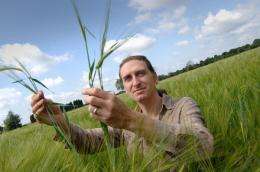
(PhysOrg.com) -- Researchers at the University of Warwick have recovered significant DNA information from a lost form of ancient barley that triumphed for over 3000 years seeing off: 5 changes in civilisation, water shortages and a much more popular form of barley that produces more grains. This discovery offers a real insight into the couture of ancient farming and could assist the development of new varieties of crops to face today's climate change challenges.
The researchers, led by Dr Robin Allaby from the University of Warwick's plant research arm Warwick HRI, examined Archaeobotanical remains of ancient barley at Qasr Ibrim in Egypt's Upper Nile. This is a site that was occupied for over 3000 years by 5 successive cultures: Napatan, Roman, Meoitic, Christian and Islamic.
The first surprise for the researchers was that throughout that period every culture seemed to be growing a two rowed form of barley. While natural wild barley tends to be two rowed most farmers prefer to grow a much higher yield 6 row version which produces up to 3 times as many grains. That 6 row version has grown for over 8000 years and that was certainly grown in the lower Nile over the same period as Qasr Ibrim was occupied. It was thought that despite the fact that the rest of Egypt used 6 row barley that the farmers of Qasr Ibrim were perhaps deliberately choosing to import 2 rowed barley but the researchers could not understand why that would be so.
The plant scientists were pleased to find that the very dry conditions at Qasr Ibrim meant that they were able to extract a great deal of DNA information from barley samples from the site that dated back 2900 years. This was far better than would normally be expected from barley samples of that age. This led to the researchers to a second and much bigger surprise. They found that the DNA evidence showed that the two rowed barley at the site wasn't the normal wild two eared barley but a mutation of the more normally cultivated six rowed barley that had changed into a two ear form that had continued to be cultivated for around three millennia.
Dr Robin Allaby said:
"The consistency of the two-row phenotype throughout all the strata spanning three millennia indicates that the reason for the reappearance of the two row form is more likely to be genetic, not environmental. Consequently, the two-row condition has probably resulted from a gain of a function mutation at another point in the plants DNA that has also reasserted the two-row condition from a six-row ancestor"
"There may have been a natural selection pressure that strongly favoured the two-row condition. One such possible cause we are currently investigating is water stress. Qasr Ibrim is located in the upper Nile which is very arid relative to the lower Nile where six-row remains are found, and studies have shown that two-row can survive water stress better than six-row"
He concluded that:
"This finding has two important implications. Such strong selection pressure is likely to have affected many genes in terms of adaptation. Archaeogenetic study of the DNA of such previously lost ancient crops could confirm the nature of the selection pressure and be very valuable in the development of new varieties of crops to help with today's climate change challenges. Secondly this crop's rediscovery adds to our respect for the methods and thinking of ancient farmers. These ancient cultures utilized crops best suited to their environmental situation for centuries, rather than the much more popular six rowed barley they used a successful low grain number yield crop which could cope far better with water stress."
The research paper entitled "Archaeogenetic Evidence of Ancient Nubian Barley Evolution from Six to Two-Row Indicates Local Adaptation" has just been published in PLoS One.
Source: University of Warwick (news : web)


