Heart disease: Research off the beating patch
July 21, 2009
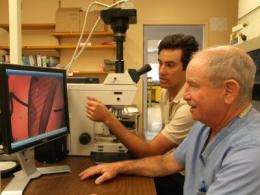
Research group leader Steven Goldman, MD, (right) and pre-doctoral Fellow Jordan Lancaster look at the microscopic image of a synthetic fiber mesh with beating heart muscle cells. Credit: University of Arizona
It is an amazing sight: What looks like a tiny beating heart is actually a piece of synthetic, gauze-like mesh, barely the size of a fingernail, floating in a Petri dish. And yet it keeps squeezing away, nice and rhythmically.
Researchers at The University of Arizona's Sarver Heart Center and the Southern Arizona Veterans Administration Health Care System (SAVAHCS) have come a step closer to repairing hearts damaged by a heart attack or weakened by chronic heart failure.
"We have developed a delivery system that allows us to introduce living, healthy heart muscle cells into damaged areas of the heart in a way that is much more efficient than the conventionally practiced method of injecting cells into heart tissue," says study leader Steven Goldman, MD.
Unlike most existing approaches, in which cardiac cells with no supporting structure are injected into heart tissue, Goldman's group uses a patch (Theregen Inc. San Francisco) made from microscopically thin fibers that serve as a scaffold to which the cells can adhere.
The group's latest achievements have attracted the attention of the American Heart Association, who picked the research as one of the most noteworthy achievements of this year's Cardiovascular Sciences Annual Conference in Las Vegas, Nev.
"Ultimately, we hope to use our system in patients with chronic heart failure and, possibly, to prevent heart failure in patients who had a heart attack," says Jordan Lancaster, BS, a pre-doctoral fellow in Dr. Goldman's lab who will present the research at the meeting on July 21, 2009.
Dr. Goldman and his team discovered that when they "seed" a vicryl mesh patch with a sufficiently large number of heart muscle cells (2.5 million or more), the cells start behaving just like their counterparts in the real organ: They contract synchronously at about 70 beats per minute even without any outside stimulation.
"Our work shows that we can put living cells onto a biodegradable, 3-dimensional scaffold in a way that not only allows them to survive, but to spontaneously beat in a coordinated fashion," says Lancaster.
In addition to demonstrating the feasibility of using a synthetic mesh as a means to deliver living heart cells into a diseased heart, the group has already shown that the patch improves left ventricular function and blood flow when implanted into damaged heart muscle in a rat model of myocardial infarction.
Dr. Goldman believes that the construct developed in his lab provides a better vehicle to introduce cells into damaged heart muscle than conventional cell transplantation techniques, in which cells are injected directly into the heart.
"I think the main reason for the disappointing results people have seen with those clinical trials is that the cells end up in an environment that is not optimal for them to thrive in. Scar tissue offers poor blood supply and weak structural support for new cells to attach, survive and grow. Our patch offers just what cardiac muscle cells need: structural support, increased blood supply and chemicals secreted by the supporting cells on the patch that help the heart muscle cells grow and function."
-
Heart derived stem cells develop into heart muscle
Apr 23, 2008 |
not rated yet |
0
-
Stem cells to repair damaged heart muscle
Jun 22, 2007 |
not rated yet |
0
-
Scientists achieve repair of injured heart muscle in lab tests of stem cells
Nov 25, 2008 |
not rated yet |
0
-
Can stem cells heal damaged hearts? No easy answers, but some signs of hope
Oct 08, 2008 |
not rated yet |
0
-
Human derived stem cells can repair rat hearts damaged by heart attack
Aug 26, 2007 |
not rated yet |
0
-
Engineers build first sub-10-nm carbon nanotube transistor
Feb 01, 2012 |
4.9 / 5 (33) |
30
-
Something old, something new: Evolution and the structural divergence of duplicate genes
Jan 31, 2012 |
4.6 / 5 (7) |
1
-
The hidden nanoworld of ice crystals: Revealing the dynamic behavior of quasi-liquid layers
Jan 30, 2012 |
5 / 5 (4) |
1
-
Stock market network reveals investor clustering
Jan 27, 2012 |
3.9 / 5 (23) |
8
-
Of microchemistry and molecules: Electronic microfluidic device synthesizes biocompatible probes
Jan 26, 2012 |
5 / 5 (2) |
0
-
Is Everyday Technology Killing Us?
Feb 08, 2012
-
Exercise and weight loss
Feb 08, 2012
-
Why do we have head aches? Our brains can't feel anything.
Feb 07, 2012
-
"The end of diseases" by David Agus, interview from Daily Show with Jon Stewart
Feb 04, 2012
-
Oncolytic adenovirus
Feb 04, 2012
-
Nutrition label stuffs and diets
Feb 02, 2012
- More from Physics Forums - Medical Sciences
More news stories
Overeating may double risk of memory loss
New research suggests that consuming between 2,100 and 6,000 calories per day may double the risk of memory loss, or mild cognitive impairment (MCI), among people age 70 and older. The study was released today and will be ...
Medicine & Health / Neuroscience
5 minutes ago |
not rated yet |
0
|
Injured boomers beware: Know when to see doctor
(AP) -- It happened to nurse Jane Byron years after an in-line skating fall, business owner Haralee Weintraub while doing "men's" push-ups, and avid cyclist Gene Wilberg while lifting a heavy box.
5 hours ago |
5 / 5 (1) |
0
Starve a virus, feed a cure? Findings show how some cells protect themselves against HIV
A protein that protects some of our immune cells from the most common and virulent form of HIV works by starving the virus of the molecular building blocks that it needs to replicate, according to research published online ...
3 hours ago |
5 / 5 (1) |
0
|
FDA-approved drug rapidly clears amyloid from the brain, reverses Alzheimer's symptoms in mice
Neuroscientists at Case Western Reserve University School of Medicine have made a dramatic breakthrough in their efforts to find a cure for Alzheimer's disease. The researchers' findings, published in the journal Science, show t ...
Medicine & Health / Neuroscience
Feb 09, 2012 |
4.9 / 5 (56) |
15
|
Green tea found to reduce disability in the elderly
(Medical Xpress) -- A lot of research has been done over the past several years looking into the health benefits of green tea. As a result, scientists have found that regular consumption of the beverage leads ...
Google might launch Drive for cloud storage soon
(PhysOrg.com) -- Google's next big move, according to the Wall Street Journal, is a cloud storage service called Drive. Hardly first to the plate, Google is simply catching up to introducing its cloud reposi ...
Scientists discover molecular secrets of 2,000-year-old Chinese herbal remedy
For roughly two thousand years, Chinese herbalists have treated Malaria using a root extract, commonly known as Chang Shan, from a type of hydrangea that grows in Tibet and Nepal. More recent studies suggest that halofuginone, ...
New method to examine batteries -- MRI from the inside
There is an ever-increasing need for advanced batteries for portable electronics, such as phones, cameras, and music players, but also to power electric vehicles and to facilitate the distribution and storage of energy derived ...
Lab study raises questions over nano-particle impact
Tests involving chickens have raised questions about the impact on health from engineered nano-particles, the ultra-fine grains commonly used in drugs and processed foods, scientists said on Sunday.
A mitosis mystery solved: How chromosomes align perfectly in a dividing cell
Although the process of mitotic cell division has been studied intensely for more than 50 years, Whitehead Institute researchers have only now solved the mystery of how cells correctly align their chromosomes during symmetric ...
Researchers find extensive RNA editing in human transcriptome
In a new study published online in Nature Biotechnology, researchers from BGI, the world's largest genomics organization, reported the evidence of extensive RNA editing in a human cell line by analysis of RNA-seq data, demons ...