Human Movement Plays Critical Role in Disease Transmission
July 21, 2009 Human Movement Plays Critical Role in Disease Transmission

Enlarge

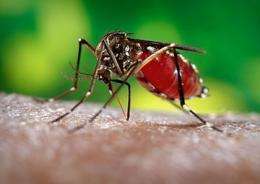
This mosquito, the Aedes aegypti, transmits dengue, considered the world's worst insect virus. (James Gathany, CDC photo)

To control mosquito-borne diseases like dengue, researchers need to look at the behavior of people, not just the insect that transmits the disease, according to new research by Steven Stoddard of the University of California, Davis, and intercollegiate colleagues. The study, published July 21 in the open-access journal PLoS Neglected Tropical Diseases, exhibits work by an international, multidisciplinary team of vector biologists, sociologists and virologists studying dengue in Iquitos, Peru.

Understanding the behavior of the host and vector can lead to better surveillance and intervention and improved disease prevention, said Stoddard. The incidence rate of dengue in Iquitos has varied from around five percent to over 30 percent after serotype introductions, according to Stoddard. There is no vaccine and no cure for dengue, which is transmitted by the tiger-striped, day-biting mosquito, Aedes aegypti.

To track individual human movement, the research team uses satellite-based (GPS) and culturally-sensitive interviews that were developed by the team.

"We do not necessarily expect to be able to identify actual places or individuals where the risk is greatest because the of the vector and the behavior of the hosts are too transient," Stoddard said. "We do hope, however, to arrive at a much better understanding of the mechanics of transmission—like why epidemics occur even when vector abundances are low—and of the types of places and types of individuals at greatest risk."

The researchers developed a conceptual model showing that the relevance of human movement at a particular scale depends on vector behavior. Focusing on Aedes aegypti, they illustrated how vector-biting behavior combined with fine-scale movements of individual humans engaged in daily routines can influence transmission. They also outlined several considerations for designing epidemiological studies to encourage studies of individual human movement.

"We hope to arrive at a better notion of the spatial scale on which dengue transmission occurs and from an operational standpoint, at what scale to focus interventions," Stoddard said. Another aim is to encourage researchers of other mosquito-borne diseases, such as malaria, "to do a more incisive examination of individual movements."

More information: Stoddard ST, Morrison AC, Vazquez-Prokopec GM, Paz Soldan V, Kochel TJ, et al. (2009) The Role of Human Movement in the Transmission of Vector-Borne Pathogens. PLoS Negl Trop Dis 3(7): e481. doi:10.1371/journal.pntd.0000481

Source: Public Library of Science (news : web)


print this article email this article download pdf blog this article bookmark this article     Stumble it Digg this share on Facebook retweet share on Reddit add to delicious
Rate this story - not rated yet


July 21, 2009 all stories

Comments: 0

not rated yet
  • Stumble this up

  • Digg this

  • share this

  • hide
  • Related Stories

  • Local climate influences dengue transmission
    created Feb 17, 2009 | popularity not rated yet | comments 0
  • Researchers determine how mosquitoes survive dengue virus infection
    created Feb 13, 2009 | popularity not rated yet | comments 0
  • Humans, not climate, driving increased dengue risk in Australia
    created May 05, 2009 | popularity not rated yet | comments 0
  • A novel finding in how chikungunya virus has spread to new vectors and locations
    created Dec 07, 2007 | popularity not rated yet | comments 0
  • Potential for malaria transmission higher than previously thought
    created Feb 20, 2007 | popularity not rated yet | comments 0


  • hide
  • Relevant PhysicsForums posts

Other News

Scientists report first effective medical therapy for rare stomach disorder

Medicine & Health / Cancer

created 56 minutes ago | popularity not rated yet | comments 0

A drug used to treat colorectal cancer also can reverse a rare stomach disorder and should be considered first-line therapy for the disease, researchers at Vanderbilt University Medical Center report this week.


Jail

Preventing Spread of HIV in Jails: Best Window of Opportunity Early in Incarceration

Medicine & Health / HIV & AIDS

created 36 minutes ago | popularity not rated yet | comments 0

(PhysOrg.com) -- With World AIDS Day less than a week away, two new studies from Yale School of Medicine show that jail inmates, one of the highest risk groups for AIDS, are far more likely to be tested for ...


Implant-based cancer vaccine is first to eliminate tumors in mice

Medicine & Health / Cancer

created 1hour ago | popularity 5 / 5 (1) | comments 0

A cancer vaccine carried into the body on a carefully engineered, fingernail-sized implant is the first to successfully eliminate tumors in mammals, scientists report this week in the journal Science Translational Medicine.


CDC: Swine flu vaccine safe; no big problems seen

Medicine & Health / Medications

created 1hour ago | popularity not rated yet | comments 0

(AP) -- U.S. health officials say there's no evidence that the swine flu vaccine is causing any serious side effects.


Feeding the clock

Feeding the clock: Cycles of feeding and fasting drive circadian gene expression in the liver

Medicine & Health / Research

created 4 hours ago | popularity 4 / 5 (1) | comments 0

When you eat may be just as vital to your health as what you eat, found researchers at the Salk Institute for Biological Studies. Their experiments in mice revealed that the daily waxing and waning of thousands ...