International research team seeks to unravel flatworm regeneration
July 21, 2009 International research team seeks to unravel flatworm regeneration

Enlarge

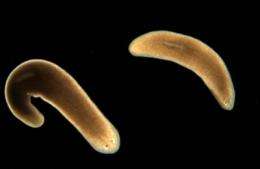
Flatworms are masters of regeneration and an ideal model organism for researchers to investigate stem cells and their regulation. Photo/Copyright: A. Sánchez Alvarado/Copyright: HHMI

Planarian flatworms are only a few millimeters up to a few centimeters in length, live in freshwater and are the object of intense research, because they possess the extraordinary ability to regenerate lost tissue with the help of their stem cells (neoblasts) and even grow an entirely new worm out of minute amputated body parts.

Now researchers from the Max Delbrück Center in Berlin, Germany together with researchers in the US and Canada present the first comprehensive catalogue of small RNAs of planaria, elements that regulate . They also have identified small RNAs which may play a role in regeneration and stem cell function, Nikolaus Rajewsky from the MDC points out (PNAS, Early Edition).

Research suggests that the regeneration of the flatworm involves hundreds of genes. But how are these genes regulated? With the latest technologies researchers search for molecules which regulate genes, such as the small RNAs and especially microRNAs (miRNAs).

Of the hundreds of known planarian species the team of researchers from Germany, the US and Canada chose Schmidtea mediterranea. Full 30 percent of the cells of this species consists of stem cells, making it a unique model system to investigate the function of stem cells.

Many planaria genes resemble those of humans, and also many genes specifically linked to planarian stem cell biology and regeneration are conserved in humans. Understanding planarian regeneration therefore promises to yield important insights into human regeneration and stem cell biology, the researchers are convinced.

The researchers looked for small RNAs in stem cells as well as in the whole planarian organism. They discovered 60 new microRNA genes and could demonstrate that ten microRNAs are specifically linked to stem cell biology and may therefore play a role in . A few of these microRNAs also exist in humans.

Furthermore, the researchers discovered millions of piRNAs. This is a group of just recently discovered small molecules which are important for the stability of the genome. The researchers could demonstrate that piRNAs are highly represented in the planarian stem cells and likely function in a similar way as in mammals.

Because stem cells are potentially immortal, they need to strictly control their genome integrity during transmission to future generations, and particulary to protect it against the uncontrolled propagation of mobile genetic elements, transposons. PiRNAs have been shown to selectively silence transposons in the fly and mouse genomes. Due to their analysis the researchers assume that piRNAs have a similar function in the planarian . Further studies are needed to investigate this.

Source: Helmholtz Association of German Research Centres (news : web)


print this article email this article download pdf blog this article bookmark this article     Stumble it Digg this share on Facebook retweet share on Reddit add to delicious
Rate this story - not rated yet


July 21, 2009 all stories

Comments: 0

not rated yet
  • Stumble this up

  • Digg this

  • share this

  • hide
  • Related Stories


  • hide
  • Relevant PhysicsForums posts

  • Selenocysteine in pH=7
    created 10 hours ago
  • What is the formula for calculating the speed of thought?
    created 16 hours ago
  • What does word "absorption" mean in the intestine?
    created 16 hours ago
  • What is transpulmonary pressure?
    created Nov 24, 2009
  • More from Physics Forums - Biology

Other News

First-ever blueprint of a minimal cell is more complex than expected

First-ever blueprint of a minimal cell is more complex than expected

Biology / Cell & Microbiology

created 8 hours ago | popularity 5 / 5 (10) | comments 0

What are the bare essentials of life, the indispensable ingredients required to produce a cell that can survive on its own? Can we describe the molecular anatomy of a cell, and understand how an entire organism ...


The six elephants in Sierra Leone were shot and "crudely butchered"

S.Leone elephants 'wiped out' by poachers: official

Biology / Ecology

created 10 hours ago | popularity 5 / 5 (4) | comments 5

Poachers "wiped out" the entire elephant herd in Sierra Leone's only wildlife park, wildlife managers said Thursday after police said they had arrested a gang of 10 poachers.


Ecological speciation by sexual selection on good genes: Is speciation adaptive?

Biology / Ecology

created 8 hours ago | popularity 5 / 5 (1) | comments 0

Darwin suggested that the action of natural selection can produce new species, but 150 years after the publication of his famous book, 'On the Origin of Species', debate still continues on the mechanisms of speciation. New ...


Knockouts in human cells point to pathogenic targets

Knockouts in human cells point to pathogenic targets

Biology / Cell & Microbiology

created 11 hours ago | popularity not rated yet | comments 0

(PhysOrg.com) -- Whitehead researchers have developed a new approach for genetics in human cells and used this technique to identify specific genes and proteins required for pathogens.


Whiteflies sabotage alarm system of plant in distress

Whiteflies sabotage alarm system of plant in distress

Biology / Plants & Animals

created 12 hours ago | popularity 5 / 5 (1) | comments 0

(PhysOrg.com) -- When spider mites attack a bean plant, the plant responds by producing odours which attract predatory mites. These predatory mites then exterminate the spider mite population, thus acting ...