Ancient Humans Left Evidence from the Party that Ended 4,000 Years Ago
July 21, 2009 Ancient Humans Left Evidence from the Party that Ended 4,000 Years Ago

Enlarge

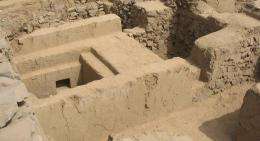
Gourd and squash artifacts were recovered from the sunken pit and platform in the Fox Temple at the Buena Vista site in central Peru.

(PhysOrg.com) -- The party was over more than 4,000 years ago, but the remnants still remain in the gourds and squashes that served as dishware. For the first time, University of Missouri researchers have studied the residues from gourds and squash artifacts that date back to 2200 B.C. and recovered starch grains from manioc, potato, chili pepper, arrowroot and algarrobo. The starches provide clues about the foods consumed at feasts and document the earliest evidence of the consumption of algarrobo and arrowroot in Peru.

"Archaeological starch grain research allows us to gain a better understanding of how ancient humans used plants, the types of food they ate, and how that food was prepared," said Neil Duncan, doctoral student of anthropology in the MU College of Arts and Science and lead author of the study that was published in the Proceedings of the National Academy of Science (PNAS) this week.

"This is the first study to analyze residue from bottle gourd or squash artifacts. Squash and bottle gourds had a variety of uses 4,000 years ago, including being used as dishes, net floats and symbolic containers. Residue analysis can help determine the specific use."

In the study, researchers recovered starch grains from squash and gourd artifacts by a method that currently is used to recover from and ceramics. First, the artifact was placed in a special water bath to loosen and remove adhering residue. Then the artifact's interior surface was lightly brushed to remove any remaining residue. The residues were collected, and starch grains were isolated from each of these sediments.
Ancient Humans Left Evidence from the Party that Ended 4,000 Years Ago
Enlarge

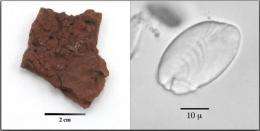
Archaeological starch granules recovered from gourd and squash artifacts from Buena Vista.

"The starch residues of edible plants found on the artifacts and the special archaeological context from which these artifacts were recovered suggest that the artifacts were used in a ritual setting for the serving and production of food," Duncan said. "The method used in this study could be used in other areas and time periods in which gourds and squash rinds are preserved."

Scientists believe the Buena Vista site, where the starch grains were recovered, served as a small ceremonial center in the central Chillon Valley. The social and ritual use of food is not well understood during this time period in Peru, but this research will enhance the potential for understanding, Duncan said.

The study, "Gourd and squash artifacts yield starch grains of feasting foods from preceramic Peru," is coauthored by Duncan; Deborah Pearsall, professor of anthropology; and Robert Benfer, emeritus professor of anthropology.

Provided by University of Missouri


print this article email this article download pdf blog this article bookmark this article     Stumble it Digg this share on Facebook retweet share on Reddit add to delicious
Rate this story - 4.3 /5 (9 votes)

Rank Filter

Move the slider to adjust rank threshold, so that you can hide some of the comments.


Display comments: newest first

  • Soylent - Jul 21, 2009
    • Rank: 5 / 5 (3)
    Must have been some party if they're still talking about it 4000 years later.

July 21, 2009 all stories

Comments: 1

4.3 /5 (9 votes)
  • Stumble this up

  • Digg this

  • share this

  • hide
  • Related Stories

  • Evidence from dirty teeth: Ancient Peruvians ate well
    created Dec 01, 2008 | popularity not rated yet | comments 0
  • Practice of farming reaches back farther than thought
    created Feb 20, 2007 | popularity not rated yet | comments 0
  • Corn's roots dig deeper into South America
    created Mar 24, 2008 | popularity not rated yet | comments 0
  • Earliest evidence of peanut, cotton, squash farming
    created Jul 24, 2007 | popularity not rated yet | comments 0
  • Gourds brought to the Americas from Asia
    created Dec 13, 2005 | popularity not rated yet | comments 0


  • hide
  • Relevant PhysicsForums posts

  • Selenocysteine in pH=7
    created 9 hours ago
  • What is the formula for calculating the speed of thought?
    created 14 hours ago
  • What does word "absorption" mean in the intestine?
    created 14 hours ago
  • What is transpulmonary pressure?
    created Nov 24, 2009
  • More from Physics Forums - Biology

Other News

The skyline of Tokyo in Japan, where scientists have criticised the new government for plans to slash research budgets

Japan scientists attack govt research cut plans

Other Sciences / Other

created 3 hours ago | popularity 5 / 5 (1) | comments 0

Top Japanese scientists, including four Nobel laureates, have criticised the new government for plans to slash research budgets, warning the country will loose its high-tech edge.


Message gone viral? Blame it on altruistic, yet image-conscious Internet  'e-mavens'

Message gone viral? Blame it on altruistic, yet image-conscious Internet 'e-mavens'

Other Sciences / Economics

created 10 hours ago | popularity 3.5 / 5 (2) | comments 0

(PhysOrg.com) -- Why do some online ad campaigns go viral while other online marketing messages gather "cyber-dust" on the information superhighway? The key may lie in the motivation of Internet users to email ...


Researcher: Faint writing seen on Shroud of Turin (AP)

Researcher: Faint writing seen on Shroud of Turin (Update)

Other Sciences / Archaeology & Fossils

created Nov 20, 2009 | popularity 2.4 / 5 (30) | comments 42

(AP) -- A Vatican researcher has rekindled the age-old debate over the Shroud of Turin, saying that faint writing on the linen proves it was the burial cloth of Jesus. Experts say the historian may be reading ...


Explained: The Discrete Fourier Transform

Explained: The Discrete Fourier Transform

Other Sciences / Mathematics

created Nov 25, 2009 | popularity 4.3 / 5 (26) | comments 8

(PhysOrg.com) -- In 1811, Joseph Fourier, the 43-year-old prefect of the French district of Isčre, entered a competition in heat research sponsored by the French Academy of Sciences. The paper he submitted ...


Climate change could boost incidence of civil war in Africa

Other Sciences / Social Sciences

created Nov 23, 2009 | popularity 2.4 / 5 (16) | comments 9

Climate change could increase the likelihood of civil war in sub-Saharan Africa by over 50 percent within the next two decades, according to a new study led by a team of researchers at University of California, Berkeley, ...