How do you sneeze in a spacesuit? Very carefully
July 21, 2009 By MIKE SCHNEIDER , Associated Press Writer Astronauts answer YouTube questions from space (AP)

Enlarge

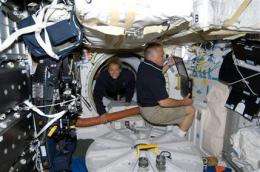
In this 19 July 2009 photo provided by NASA shows Canadian Space Agency astronaut Julie Payette float onto the mid deck of the space shuttle Endeavour, where she joins astronaut Dave Wolf, who makes an entry on a laptop computer. The two STS-127 mission specialists are part of a seven member shuttle crew currently visiting the International Space Station, which is now docked with the shuttle. (AP Photo/NASA)

(AP) -- When it comes to sneezing in a spacesuit during a spacewalk in the void of space, it is best to aim well.

That is the advice lead spacewalker David Wolf gave Tuesday to Dawn from Indianapolis, who along with more than a dozen others had questions they had posted on YouTube answered by some of the crew of space shuttle Endeavour.

"I've done it quite a few times, most recently yesterday," said Wolf, who led the mission's second spacewalk Monday and was set to go on a third spacewalk Wednesday. "You learn in training, and I don't know how to say this, aim well. It can mess up your view and there is no way to clear it."

The YouTube questioners, mostly children and teenagers, had posted their questions well before last week's launch of Endeavour on a 16-day mission to the international space station. Their posts were played one at a time for commander Mark Polansky, pilot Doug Hurley, Canadian astronaut Julie Payette and Wolf, who took turns answering the questions live, more than 200 miles above Earth.

Other questioners asked the astronauts what they missed most in space (friends and family), what they did in their spare time (look out the window) and what would happen if the shuttle or space station flew into a black hole (don't know). There are currently 13 crew members at the space station - seven visiting from the shuttle and six living at the station.

The YouTube questions were the latest effort by NASA to embrace social media. Polansky has a Twitter account with more than 37,500 followers, and since the mission began last Wednesday, Polansky has tweeted regularly with the help of workers at the Johnson Space Center who actually post his messages.

Last May, under the moniker Astro-Mike, Astronaut Mike Massimino became the first person to tweet from space during space shuttle Atlantis' repair mission to the Hubble Space Telescope.

While Wolf and astronaut Christopher Cassidy prepared for Wednesday's spacewalk, other crew members used robotic arms Tuesday to move a storage pallet holding equipment for three experiments from the belly of the docked space shuttle Endeavour to the outside of the orbiting outpost's Japanese-made lab.

Endeavour's seven astronauts had some rare off-duty hours Tuesday afternoon, when they had the opportunity to do nothing but look out the window.

---

On the Net:

NASA: http://www.nasa.gov/mission_pages/shuttle/main/index.html

Mark Polansky's Twitter page: http://twitter.com/Astro_127

©2009 The Associated Press. All rights reserved. This material may not be published, broadcast, rewritten or redistributed.


Rate this story - 5 /5 (2 votes)


July 21, 2009 all stories

Comments: 0

5 /5 (2 votes)

  • hide
  • Related Stories

  • Astronauts Move Japanese Exposed Section to Station
    created Jul 21, 2009 | popularity not rated yet | comments 0
  • More storms threaten Monday shuttle launch attempt
    created Jul 13, 2009 | popularity not rated yet | comments 0
  • NASA assigns STS-127, Expedition 19 crews
    created Feb 12, 2008 | popularity not rated yet | comments 0
  • Endeavour Astronauts Attach Japanese Module to Station
    created Mar 14, 2008 | popularity not rated yet | comments 0
  • Endeavour 'Go' for Launch on June 13
    created Jun 03, 2009 | popularity not rated yet | comments 0


  • hide
  • Relevant PhysicsForums posts

  • Spreading Life in the Universe
    created 16 hours ago
  • Force of Gravity in terms of Density
    created Feb 08, 2010
  • what is the relation between gravity and light?
    created Feb 08, 2010
  • Does the Thermoelectric effect apply in sun?
    created Feb 07, 2010
  • More from Physics Forums - General Astronomy

Other News

India announces long-range nuclear-capable missile test

Space & Earth / Space Exploration

created 27 minutes ago | popularity 5 / 5 (1) | comments 0

India will test a nuclear-capable missile with a range of over 5,000 kilometres (3,000 miles) within a year, its top military scientist said Wednesday, risking a rise in regional tensions.


Space shuttle Endeavour pulls in at space station (AP)

Space shuttle Endeavour pulls in at space station

Space & Earth / Space Exploration

created 5 hours ago | popularity 5 / 5 (1) | comments 0

(AP) -- Shuttle Endeavour arrived to a warm welcome at the International Space Station early Wednesday, delivering a new room and observation deck that will come close to completing construction 200 miles ...


Climate 'Tipping Points' May Arrive Without Warning, Says Top Forecaster

Space & Earth / Environment

created 15 hours ago | popularity 3.5 / 5 (11) | comments 10 | with audio podcast

(PhysOrg.com) -- A new University of California, Davis, study by a top ecological forecaster says it is harder than experts thought to predict when sudden shifts in Earth's natural systems will occur -- a worrisome finding ...


38 percent of world's surface in danger of desertification

38 percent of world's surface in danger of desertification

Space & Earth / Environment

created 12 hours ago | popularity 2 / 5 (4) | comments 6

A team of Spanish researchers has measured the degradation of the planet's soil using the Life Cycle Assessment (LCA), a scientific methodology that analyses the environmental impact of human activities, and ...


A new 3-D map of the interstellar gas within 300 parsecs from the sun

A new 3D map of the interstellar gas within 300 parsecs from the Sun

Space & Earth / Astronomy

created 18 hours ago | popularity 5 / 5 (6) | comments 0 | with audio podcast

(PhysOrg.com) -- Astronomy & Astrophysics is publishing new 3D maps of the interstellar gas in the local area around our Sun. A French-American team of astronomers presents new absorption measurements toward ...