Longest Solar Eclipse of the 21st Century
July 21, 2009 by Dr. Tony Phillips Longest Solar Eclipse of the 21st Century

Enlarge

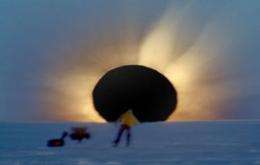
A totally eclipsed sunrise in Antarctica. Credit and Copyright: Fred Bruenjes of moonglow.net.

One one-thousand, 2 one-thousand, 3 one-thousand, 4 one-thousand... Continue counting and don't stop until you reach 399 one-thousand.

Did that feel like a long time? Six minutes and 39 seconds to be exact. That's the duration of this week's total solar eclipse--the longest of the 21st century.

The event begins at the crack of dawn on Wednesday, July 22nd, in the Gulf of Khambhat just east of . Morning fishermen will experience a sunrise like nothing they've ever seen before. Rising out of the waves in place of the usual sun will be an inky-black hole surrounded by pale streamers splayed across the sky. Sea birds will stop squawking, unsure if the day is beginning or not, as a strange shadow pushes back the dawn and stirs up a breeze of unaccustomed chill.

Most solar eclipses produce this sort of surreal experience for a few minutes at most. The eclipse of July 22, 2009, however, will last as long as 6 minutes and 39 seconds in some places, not far short of the 7 and a half minute theoretical maximum. It won't be surpassed in duration until the eclipse of June 13, 2132.

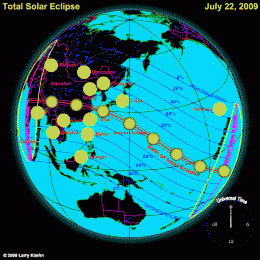
From the Gulf of Khambhat, the Moon's shadow will race east across India, , and the Ryukyu Islands of Japan. Click on the image to launch an animated map:
Longest Solar Eclipse of the 21st Century
Enlarge

Clicking on this image will launch an animated global map of the July 22nd eclipse. Regional animations of India and China are also available. Credit: Larry Koehn of ShadowAndSubstance.com.

The path of totality cuts across many large cities. The shadow will linger over Shanghai, the largest city in China, for six full minutes, giving 20 million residents a lengthy and stunning view of the sun's ghostly corona. Other large cities in the path of totality include Surat, Vadodara, Bhopal, Varanasi, Chengdu, Chongqing, Wuhan, Hefei, Hangzhou. The population of each numbers in the millions, making this possibly the best-observed in human history.

The eclipse is extra-long because of a lucky coincidence, made possible by the elliptical shape of planetary orbits. On July 22nd, Earth happens to be near its farthest point from the sun. A small sun means the Moon can cover it longer. At the same time, the Moon will be near its closest point to Earth. A large Moon covers the sun longer, lengthening the eclipse even more.

The leisurely pace of the eclipse could have a transformative effect on witnesses. Total eclipses have been known to turn ordinary folk into life-long "eclipse-chasers" willing to spend thousands of dollars and travel tens of thousands of miles to feel the Moon's cool shadow and behold the sun's pale atmosphere just one more time. A few extra minutes of wonder will intensify this effect to an unknown degree.

Live webcasts of the eclipse--not the next best thing to being there, but the only substitute available to many readers--may be found at the website of the San Francisco Exploratorium.

Let the counting begin.

Source: Science@NASA, by Dr. Tony Phillips


print this article email this article download pdf blog this article bookmark this article     Stumble it Digg this share on Facebook retweet share on Reddit add to delicious
Rate this story - 4.8 /5 (5 votes)


July 21, 2009 all stories

Comments: 0

4.8 /5 (5 votes)
  • Stumble this up

  • Digg this

  • share this

  • hide
  • Related Stories

  • Partial Solar Eclipse visible from the UK on the morning of 1st August
    created Jul 25, 2008 | popularity not rated yet | comments 0
  • Get Ready For Total Lunar Eclipse Wednesday Night
    created Feb 19, 2008 | popularity not rated yet | comments 0
  • See Total Solar Eclipse Tomorrow in a Different Light
    created Mar 28, 2006 | popularity not rated yet | comments 0
  • Cloud obscures annular eclipse
    created Oct 03, 2005 | popularity not rated yet | comments 0
  • A Solar Eclipse on the Moon
    created Apr 21, 2005 | popularity not rated yet | comments 0


  • hide
  • Relevant PhysicsForums posts

  • Redshift as a distance indicator
    created 2 hours ago
  • Question about 2-body gravity
    created Nov 24, 2009
  • life on Mars
    created Nov 24, 2009
  • Semi-major axis from cartesian co-ordinates
    created Nov 23, 2009
  • More from Physics Forums - General Astronomy

Other News

Astronauts surprised by holiday turkey dinners (AP)

Astronauts surprised by holiday turkey dinners

Space & Earth / Space Exploration

created 2 hours ago | popularity not rated yet | comments 0

(AP) -- Space shuttle Atlantis' astronauts thought they were going to give thanks with pantry leftovers Thursday as their mission drew to a close, but found turkey dinners awaiting them.


Gullies and Flow Features on Crater Wall

Gullies and Flow Features on Crater Wall

Space & Earth / Space Exploration

created 3 hours ago | popularity not rated yet | comments 0

(PhysOrg.com) -- This image from the High Resolution Imaging Science Experiment (HiRISE) camera on NASA's Mars Reconnaissance Orbiter shows a sample of the variety and complexity of processes that may occur ...


Russia: no space for space tourists (AP)

Russia: no space for space tourists

Space & Earth / Space Exploration

created 7 hours ago | popularity 2.7 / 5 (3) | comments 2

(AP) -- A top Russian space official says there is no space for tourists wishing to fly to the International Space Station.


Monster Waves on the Sun are Real

Monster Waves on the Sun are Real (w/ Video)

Space & Earth / Astronomy

created 19 hours ago | popularity 4.9 / 5 (15) | comments 2

Sometimes you really can believe your eyes. That's what NASA's STEREO (Solar Terrestrial Relations Observatory) spacecraft are telling researchers about a controversial phenomenon on the sun known as the "solar ...


Burning coal worse for climate than clearing rain forests

Space & Earth / Environment

created 1hour ago | popularity 3.7 / 5 (3) | comments 0

Deforestation has had a big influence on the increase of carbon dioxide (CO2) emissions in the past three centuries, but its impact is tapering off relatively. Nowadays, the burning of fossil fuels is a more crucial factor. ...