Mars breakthrough: Scientists uncover red planet's hot and steamy secrets
July 21, 2009 Mars breakthrough: Scientists uncover red planet's hot and steamy secrets

Enlarge

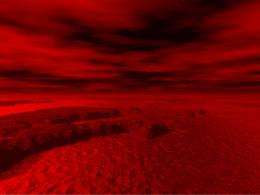
Molten surface on Mars. Image by Craig O'Neill

(PhysOrg.com) -- An analysis of Martian meteorites has led scientists to believe that Mars was molten for up to 100 million years after it formed, thwarting the evolution of early life on the planet.

The research, just published in the prestigious international journal Nature Geoscience, has shown that the red planet remained excessively hot - with temperatures in excess of 1000 degrees Celsius - for 100 million years following its formation.

The team of international scientists from the USA, Belgium, and Australia, and spearheaded by workers at NASA's Johnson Space Center, studied the radioactive clocks ticking away in a particularly rare and ancient type of Martian meteorite called a Nakhlite (named after Nakhla in Egypt where the first one was found).

They have made the most precise measurements yet on rare isotopes of exotic elements such as Hafnium, Lutetium, and Neodymium. These isotopes allow scientists to date ancient events deep in Mars' earliest history.

"We were able to reconstruct the timescale for Mars' earliest evolution," says Macquarie University planetary scientist Dr Craig O'Neill, the only Australian scientist on the study.

Contrary to the popular belief that it only took a few thousand years for to cool and solidify from an initially molten ball, their study suggests that there was a thick steam atmosphere on Mars very early in the planet's history that kept the surface a magma ocean for 100 million years - and essentially sterile the whole time.

"The conditions for life wouldn't have existed, unless you could really handle the heat," O'Neill said. "The toughest extremophile bacteria on Earth can withstand up to 130 degrees Celsius, so that makes it very difficult to see how life could have evolved under the conditions on primeval Mars.

Subsequently, the solidified magma ocean would have overturned in a lava lamp-like fashion, says O'Neill. The resulting forces and volcanism from this process may have formed the early Martian crust, and the scars of the ordeal might still be seen on surface today. Evidence for water has been found on Mars, but life may have been possible only after the steam started to rain out of the atmosphere.

The study was made possible by some of the most accurate measurements yet on radioactive isotope systems.

"Our measurements are up to 20 times more accurate than previous studies, so we've really been able to nail the timescale," he said. "The magma ocean eventually froze and overturned - which would have been probably the most violent event the planet ever saw - but we now know this took much longer than most people think it takes magma oceans to cool."

Provided by Macquarie University


Rate this story - 4.5 /5 (20 votes)

Rank Filter

Move the slider to adjust rank threshold, so that you can hide some of the comments.


Display comments: newest first

  • yyz - Jul 22, 2009
    • Rank: not rated yet
    So it would seem that life may still have had a chance to form on Mars, just not as early as might have been thought. Quite an interesting study of early Mars.
  • Damon_Hastings - Jul 22, 2009
    • Rank: not rated yet
    Yeah, this says nothing about the likelihood of life on Mars. Mars is 4.6 billion years old, so a 100 million year "late start" is more or less irrelevant. What's amusing is that the article actually bothers to consider what it would take for life to have existed on Mars during its first 100 million years. Maybe they're hoping that some readers will be tricked into thinking 100 million years is a significant length of time for Mars.
  • notaphysicist - Aug 28, 2009
    • Rank: not rated yet
    Or Earth, since our planet must have gone through a series of similar processes.

July 21, 2009 all stories

Comments: 3

4.5 /5 (20 votes)

  • hide
  • Related Stories

  • Mars' Molten Past
    created Nov 21, 2007 | popularity not rated yet | comments 0
  • Clay Studies Alter View of Early Mars Environment
    created Jul 18, 2007 | popularity not rated yet | comments 0
  • Revising Earth's early history
    created Dec 22, 2005 | popularity not rated yet | comments 0
  • Drilling on Mars to find evidence of ancient organisms: a second genesis of life?
    created Sep 15, 2005 | popularity not rated yet | comments 0
  • Mars rocks could provide vital clue to how life began on Earth
    created Dec 12, 2006 | popularity not rated yet | comments 0


  • hide
  • Relevant PhysicsForums posts

  • Spreading Life in the Universe
    created 15 hours ago
  • Force of Gravity in terms of Density
    created Feb 08, 2010
  • what is the relation between gravity and light?
    created Feb 08, 2010
  • Does the Thermoelectric effect apply in sun?
    created Feb 07, 2010
  • More from Physics Forums - General Astronomy

Other News

Space shuttle Endeavour pulls in at space station (AP)

Space shuttle Endeavour pulls in at space station

Space & Earth / Space Exploration

created 4 hours ago | popularity not rated yet | comments 0

(AP) -- Shuttle Endeavour arrived to a warm welcome at the International Space Station early Wednesday, delivering a new room and observation deck that will come close to completing construction 200 miles ...


Climate 'Tipping Points' May Arrive Without Warning, Says Top Forecaster

Space & Earth / Environment

created 14 hours ago | popularity 3 / 5 (8) | comments 10 | with audio podcast

(PhysOrg.com) -- A new University of California, Davis, study by a top ecological forecaster says it is harder than experts thought to predict when sudden shifts in Earth's natural systems will occur -- a worrisome finding ...


38 percent of world's surface in danger of desertification

38 percent of world's surface in danger of desertification

Space & Earth / Environment

created 11 hours ago | popularity 2 / 5 (4) | comments 5

A team of Spanish researchers has measured the degradation of the planet's soil using the Life Cycle Assessment (LCA), a scientific methodology that analyses the environmental impact of human activities, and ...


A new 3-D map of the interstellar gas within 300 parsecs from the sun

A new 3D map of the interstellar gas within 300 parsecs from the Sun

Space & Earth / Astronomy

created 17 hours ago | popularity 5 / 5 (5) | comments 0 | with audio podcast

(PhysOrg.com) -- Astronomy & Astrophysics is publishing new 3D maps of the interstellar gas in the local area around our Sun. A French-American team of astronomers presents new absorption measurements toward ...


URI researcher calls for global effort to monitor marine pollutants

Space & Earth / Environment

created 15 hours ago | popularity 3 / 5 (2) | comments 1

A University of Rhode Island researcher who studies chemical pollutants in the marine environment has called on colleagues around the world to establish a global monitoring network to verify that the chemicals banned by the ...