Building a Better Battery
July 21, 2009 By Caroline Barnhill
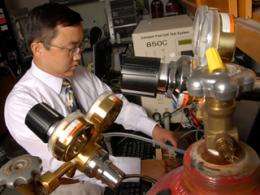
Xiangwu Zhang joined the NC State faculty in 2006.
Amid corporate restructuring plans, car czars and a waning economy, the struggling automotive industry is tasked with providing more efficient and economical options for car buyers. While foreign markets have been quick to move into hybrid and electric vehicle space, the United States has been slower to adapt.
That’s where NC State comes in.
“We need technology that allows this country’s manufacturers to produce better hybrid and electric vehicles to keep up with overseas markets,” explained Dr. Xiangwu Zhang, assistant professor of textile engineering, chemistry and science in the College of Textiles at North Carolina State University.
The U.S. Department of Energy agreed, recently awarding Dr. Zhang and colleagues at NC State’s Future Renewable Electric Energy Delivery and Management (FREEDM) Systems Center more than $1 million in grant money to continue researching ways to improve the batteries that help power plug-in hybrid electric vehicles. Fellow researchers on the project include Drs. Alex Huang, the FREEDM Systems Center director, Peter S. Fedkiw and Saad A. Khan, all of the College of Engineering at NC State.
Current batteries used in hybrid and electric vehicles are large, expensive and not entirely practical for those looking for high-power vehicles, or for people driving them on longer trips.
Zhang and his team are using a technique called electrospinning to combine lithium alloy and carbon into new composite nanofiber anodes, which have the ability to produce more energy while costing less and tolerating abuse better than existing batteries. The batteries are also lighter, producing more power in a smaller package - ideal for use in vehicles.
Nanofiber anodes can be easily produced in large numbers, which could help reduce the demand for imported petroleum, decrease emissions of air pollutants and greenhouse gases, and enable the U.S. transportation industry to sustain a strong position in the global marketplace.
“This goes beyond just building a better battery,” Zhang said. “We’re talking about industrial innovation that will change the way of life for future generations.”
Sharing Zhang’s vision is a team of four NC State graduate students who developed a business plan for Zhang’s research through the Jenkins MBA program’s Technology Entrepreneurship Commercialization (TEC) program in the College of Management. Their business plan is currently being put into action through the formation of a start-up company, Tec-Cel.
A mentor on the project, Al Bender, now serves as the fledging company’s CEO. The company was incorporated in May, and is currently working to raise venture capital.
Members of the student team included Jason Marlow, who received his MBA in May 2009, and engineering graduate students Richard Wolf, Jason Marlow and Marie Kerlau. All were part-time graduate students, three with full-time positions at technology companies in Research Triangle Park.
The students continue their involvement in what is now operating as a virtual company.
“The idea of creating a company and building something from scratch... is very interesting to me," said Marlow, who has a full-time position with Red Hat operations. "Going through the TEC program and learning how to analyze markets and the technologies, talking with people and figuring out what products might sell at what price - I felt that this was a holistic approach for learning how to start and run a business.”
“NC State has successfully transformed its culture of innovation into a culture of entrepreneurship," added Billy Houghteling, director of NC State’s Office of Technology Transfer. "Tec-Cel is just one example of how students who've receive hands-on entrepreneurial training can make a difference by leading a company through development, inception and impact.
"The number of opportunities for students to engage in entrepreneurial activities at NC State is amazing," he said. "These students are creative, eager and excited by the technological and business challenges that NC State provides.”
-
NC State Unveils New DARPA Urban Challenge Driverless Vehicle
Nov 16, 2006 |
not rated yet |
0
-
NC State Nuclear Reactor Program Celebrates Scientific Breakthrough
Oct 22, 2007 |
not rated yet |
0
-
Federal government taps NC State experts to explain nanotech risks
May 12, 2008 |
not rated yet |
0
-
Researchers seek ways to make lithium-ion batteries work longer, safer
Jan 17, 2006 |
not rated yet |
0
-
New Super-Efficient Plug-in Hybrid Unveiled
May 18, 2006 |
not rated yet |
0
-
Fast photon control brings quantum photonic technologies closer
1 minute ago |
not rated yet |
0
-
Engineers build first sub-10-nm carbon nanotube transistor
Feb 01, 2012 |
4.9 / 5 (33) |
30
-
Something old, something new: Evolution and the structural divergence of duplicate genes
Jan 31, 2012 |
4.6 / 5 (7) |
1
-
The hidden nanoworld of ice crystals: Revealing the dynamic behavior of quasi-liquid layers
Jan 30, 2012 |
5 / 5 (5) |
1
-
Stock market network reveals investor clustering
Jan 27, 2012 |
3.9 / 5 (23) |
8
-
How to tilt a object
13 hours ago
-
How to calculate total compressibility in liquid porous solid system
18 hours ago
-
Need help reading 3-D
Feb 11, 2012
-
A way to send and receive wireless data
Feb 11, 2012
-
Calling function with no input argument
Feb 10, 2012
-
Force free body diagram problem on gym equipment
Feb 10, 2012
- More from Physics Forums - General Engineering
More news stories
Ethanol mandate not the best option
Many people are willing to pay a premium for ethanol, but not enough to justify the government mandate for the corn-based fuel, a Michigan State University economist argues.
Technology / Energy & Green Tech
51 minutes ago |
not rated yet |
0
Teaching teens safety in the virtual world
A new cyber safety program on the dangers of social networking is being developed by Flinders University, in light of an alarming report which shows children as young as 12 are meeting internet strangers in ...
29 minutes ago |
not rated yet |
0
Darpa to develop mobile millimeter-wave backhaul networks
Providing high-bandwidth communications for troops in remote forward operating locations is not only critical but also challenging because a reliable infrastructure optimized for remote geographic areas does ...
43 minutes ago |
not rated yet |
0
Building a 'blind-friendly' Internet
Rakesh Babu demonstrates how a blind person uses the Internet.
1 hour ago |
not rated yet |
0
Microsoft India retail site down after 'cyber attack'
Microsoft said Monday it was investigating an attack by hackers on its Indian retail website, reportedly carried out by a Chinese group called the "Evil Shadow Team."
3 hours ago |
not rated yet |
0
Transforming galaxies
(PhysOrg.com) -- Many of the Universe's galaxies are like our own, displaying beautiful spiral arms wrapping around a bright nucleus. Examples in this stunning image, taken with the Wide Field Camera 3 on ...
'Smart' microcapsules in a single step
(PhysOrg.com) -- A new, single-step method of fabricating microcapsules, which have potential commercial applications in industries including medicine, agriculture and diagnostics, has been developed by researchers ...
A continent ablaze in auroral and manmade light
The North American continent is literally set ablaze in a confluence of Auroral and Manmade light captured in spectacular new videos snapped by the astronauts serving aboard the International Space Station ...
Nanostructured electrodes for rechargeable sodium-Ion batteries
Highly efficient 3V cathodes for rechargeable sodium-ion batteries have been developed by users from Argonne National Laboratory's Materials Science, Chemical Sciences & Engineering, and X-ray Sciences Divisions, ...
New tumor suppressor gene identified
A recent study published in Clinical Cancer Research suggests that the protein hVps37A suppresses tumor growth in ovarian cancer. The work, which was funded by the Austrian Science Fund FWF, shows, for th ...
A lost world? How zooarchaeology can inform biodiversity conservation
A new study of tropical forests will provide a 50,000-year perspective on how animal biodiversity has changed, explored through an archaeological investigation of animal bones.