Ancient Maya Practiced Forest Conservation -- 3,000 Years Ago
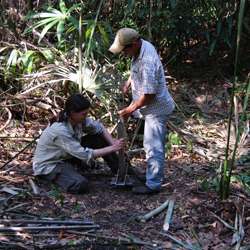
(PhysOrg.com) -- As published in the July issue of the Journal of Archaeological Science, paleoethnobotanist David Lentz of the University of Cincinnati has concluded that not only did the Maya people practice forest management, but when they abandoned their forest conservation practices it was to the detriment of the entire Maya culture.
“From our research we have learned that the Maya were deliberately conserving forest resources,” says David Lentz, a professor of biological sciences at the University of Cincinnati and executive director of the Cincinnati Center for Field Studies. “Their deliberate conservation practices can be observed in the wood they used for construction and this observation is reinforced by the pollen record.”
The UC team is the first North American team allowed to work at the Tikal site core in northern Guatemala in more than 40 years. The UC team is unique in other ways as well. Whereas previous archaeological excavations reflected an interest in culture history, particularly of the elites, researchers’ interests are different in the 21st century.
“Forty years ago the emphasis was on what king built what palace, who slew whom and who is portrayed on what stelae. It’s all about the rulers and their exploits,” says Lentz. “They didn’t look at the economy, agricultural practices, forest management or how the people and the culture functioned.”
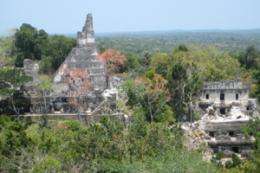
And what the UC team has learned by studying these processes is that the Maya, at least initially, were practicing good forestry management.
“They were not allowed to cut down what we’re calling the ‘sacred groves,’” says Lentz. “Then that changed during the Late Classic period with Jasaw Chan K’awiil — one of the greatest figures of prehistory. The Tikal Maya had been beaten up and had fallen to second-rate status prior to his ascendancy. Jasaw Chan K’awiil led an army to the heartland of a competing city, Calakmul, captured their ruler, bound him, brought him back and sacrificed him — and it totally reversed their fortunes in a very dramatic way.”
After that, the Maya rebuilt the city of Tikal in a way never seen before. They begin building huge temples that required considerable resources, especially large, straight trees whose wood could withstand the weight of tons of stone. Their choices were limited to two types of trees only.
“So, unfortunately, Jasaw Chan K’awiil tapped into their sacred groves to do this,” says Lentz. The stands of virgin timber were more than 200 years old in some areas. After building a few of the temples, the Maya ran out of timber from the Manilkara zapota (sapodilla) tree, so they switched to an inferior tree —Haematoxylon campechianum, logwood or inkwood — which is found in swamps.
“Sapodilla is soft when you first cut it, so it can be carved into beautiful, intricate shapes. Yet when it dries, it is as hard as iron,” Lentz explains. “Logwood, on the other hand, is like iron to start with and stays that way.”
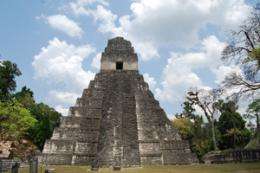
Logwood often is very crooked and grows to much lesser heights — so the archways in the temples built with logwood were far less ornate. Temples 1 through 4 are quite large, with temple 4 having the largest lintels, the beams over the doorways. Temples 5 and 6 (built in the middle — the temples are not numbered in order of construction) are much smaller.
“For the last temple (temple 3), they went back to sapodilla — why?” says Lentz. “Perhaps they had replanted after their sacred groves had been cleared of their timber. After 40 years you get a tree big enough with which to build. Also, at that point, things were beginning to go downhill for the Maya. Perhaps they reasoned that the gods didn’t like the new style of temple and they needed to return to the construction style of earlier, and more prosperous, times.”
So what led to the downfall of the Maya? Whether it was the gods’ displeasure or not, the answer came from the heavens.
“When you clear all the forests, it changes the hydrologic cycle,” says Lentz. “The world is like a flat surface with all the trees acting as sponges on it. The trees absorb the water. Without the trees, there is no buffer to stop the water from runoff. That causes soil erosion, which then chokes the rivers and streams. With no trees, you lose water retention in the soil or aquifers so the ground dries up and then there is less transpiration, so therefore less rainfall as well.”
In addition to using the trees as timber, the Maya also burned the trees, adding carbon to the air in the form of carbon dioxide. Trees remove carbon dioxide from the air and return oxygen in its place, thus cleaning and purifying the air.
“Forests provide many benefits to society,” says Lentz. “The Maya forests provided timber, fuel, food, fiber and medicine in addition to the ecosystem services of cleansing the air and water. Just as forests provided essential resources for the ancient Maya, the same is true for our civilization today.”
A UC research team, which will again include archaeologist Vern Scarborough and geographer Nick Dunning, will be returning to Tikal in February 2010. Some of the key questions that remain are how did the Maya control their water resources, when did the deforestation occur, what trees were used when, did the Maya plant large orchards and where were the sacred groves.
“We’re saying in the end they were unsuccessful,” says Lentz. “But they kept it going for several hundreds of years — so they must have done some things right.”
Provided by University of Cincinnati (news : web)


