SKorean moves to turn science fiction into fact
July 22, 2009 by Simon Martin
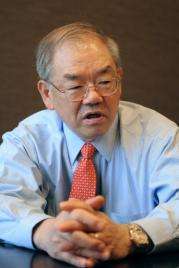
Suh Nam-Pyo, president of the Korea Advanced Institute of Science and Technology

Enlarge

Suh Nam-Pyo, president of the Korea Advanced Institute of Science and Technology, South Korea's top technology university, which is leading a drive for creativity over conformity to equip the economy for the 21st century

A computer screen that folds up like a pocket handkerchief, a harbour that goes out to a ship and a road which recharges electric vehicles -- it sounds like the stuff of science fiction.

These projects and others are well under way at South Korea's top technology university, which is leading a drive for creativity over conformity to equip the economy for the 21st century.

The state-financed Korea Advanced Institute of Science and Technology (KAIST) was set up in 1971 as raced to industrialise its way out of post-war poverty.

Since then, the country has become the world's biggest shipbuilder and an international force in electronics, telecommunications, autos and steel.

Now, says KAIST president Suh Nam-Pyo, it's time to move on.

"Korea can no longer develop its economy by following what everyone else has done already, because it is at the leading edge of a number of these traditional industries," he told AFP in a recent interview.

"I think Korea needs to have a very different kind of education where we produce more people who can think, who can lead by conceiving solutions to problems that humanity has to solve in the 21st century."

The intensely competitive education system, geared to getting students through crucial college entrance exams and into prestigious universities, is seen as part of the problem.

Parents spent 20.9 trillion won (16.4 billion dollars) on private education last year to supplement the state system, but Suh said results are questionable.

"They are not really providing education as such, they teach people how to take exams," he said. And many of the exams consist of multiple choice questions.

"So students don't really get to practise how to define what the problem is, how to reason and how to drive solutions."

For the system to change, Suh said, universities must change.

"Based on that philosophy we eliminated written (entrance) exams altogether," he said, outlining some of the changes which have made him a much-discussed campus reformer.

In another departure from tradition, professors who fail to make the grade are denied tenure. Students who underperform lose their right to free tuition.

In a bid to become one of the world's 10 leading science and technology universities, KAIST by next year will teach classes exclusively in English.

"One of our goals is to produce graduates who can become global leaders in science and technology. Nowadays, unless one is fluent in English it's hard to function in a global setting," said Suh.

Suh, 73, was an assistant director at the US National Science Foundation from 1984-88 and headed the department of mechanical engineering at the Massachusetts Institute of Technology from 1991-2001. He came to KAIST in July 2006.

He believes there are some areas in which KAIST can compete even with MIT.

"EEWS -- energy, environment, water and sustainability -- is the area where we think we need to be good," Suh said. The online electric vehicle is one example.

KAIST decided that lithium ion batteries are not the best way forward because of cost, weight and finite lithium resources on land.

Its "recharging road" involves burying power strips just under the surface. Vehicles suck up power from the strips via a magnetic device on their chassis as they pass over them, without coming into direct contact.

The system would allow smaller batteries or extended range for .

A prototype at KAIST's campus at Daejeon, 140 km (90 miles) south of Seoul, already powers a bus service.

KAIST has also received a sizeable government grant to develop its mobile harbour, designed to cut the huge costs involved when big container ships queue up to berth at deep-water ports.

"Why should ships come into harbour? Why not have a harbour go out to the ships?" said Suh.

Mobile harbours -- automated vessels with a shallow draught -- would pull alongside big ships in open waters to offload containers and ferry them closer to their final destination.

An automated system creates a stable platform and a special loading system eliminates the need for cranes. One design could handle 1,250 containers at a time, another 250.

Suh sees potential for the harbour in Africa, Malaysia, the Middle East and in the shallow Yellow Sea between Korea and China.

Both projects are going ahead fast, he said. During the economic downturn, "we want to see if we can create new technologies and new industries...good research and development does not have to take years."

As for the flexible laptop, the idea came from an undergraduate student. KAIST solicits ideas and gives prizes in return.

"The message for students is that everybody has the right to think creatively," he said. "Creativity is what we are trying to instil in our students."

(c) 2009 AFP

4.6 /5 (10 votes)  

Filter


Move the slider to adjust rank threshold, so that you can hide some of the comments.


Display comments: newest first

RayCherry
Jul 22, 2009

Rank: 5 / 5 (1)
No Comment :)
AMMBD
Jul 22, 2009

Rank: 5 / 5 (3)
"I think Korea needs to have a very different kind of education where we produce more people who can think, who can lead by conceiving solutions to problems that humanity has to solve in the 21st century."

It's not just Korea. ALL countries need to make those changes if we are ever to begin solving humanity's long standing problems AND spreading out into space.

Evolve or die.
RJ32
Jul 22, 2009

Rank: 4 / 5 (1)
Teaching what was doesn't create what can be. My own personal experience is that inovation has been either defeated or sequestered by the conservatives in education, business and government who's only purpose is to preserve the status quo. Traditional banking will NOT support inovation. That is why venture capitol does the job and once it has been shown to be provitable, the big money people step in and take the business public, reaping profit from other people's work.
Valentiinro
Jul 22, 2009

Rank: 3.7 / 5 (3)
"a road which recharges electric vehicles"
Two words: Bumper Cars.
thales
Jul 22, 2009

Rank: 3 / 5 (2)
Another demonstration of the success of open, democratic policies, especially when compared side by side with North Korea's closed, isolationist policies. You can see the difference from space.
Scryer
Jul 22, 2009

Rank: 5 / 5 (1)
Regardless if scientists like it or not, more than 70% of all science fiction can become a reality.

It's a matter of time really.

Without even reading this article I knew all this stuff and more then even what is implied here, is possible.
nkalanaga
Jul 22, 2009

Rank: not rated yet
Recharging roads: Given the state of American roads, it wouldn't work. Every time the pavement cracks, the wires would break! As far as the theory, inductance charging has been demonstrated before, and the "linear induction motor" is a common device today.

Mobile harbors: They used to be called "lighters", small craft that ferried cargo to and from larger ones. The old ones didn't have container cranes, but the idea has been around for centuries.
trantor
Jul 23, 2009

Rank: 5 / 5 (1)
what about wireless electricity? Some news about it last year.

it could recharge cars and robots in our cities.
Scryer
Jul 26, 2009

Rank: not rated yet
The only problem with wireless electricity, is apparently, that it has a relatively lower efficiency rate to traditional wires.

However, once scientist realize that energy is everywhere and that it can be harvested or generated from anything, wireless technology will be in the background. Hopefully someone will be developing it.
Rank 4.6 /5 (10 votes)
Related Stories
Relevant PhysicsForums posts
  • How to tilt a object
    created3 hours ago
  • How to calculate total compressibility in liquid porous solid system
    created8 hours ago
  • Need help reading 3-D
    createdFeb 11, 2012
  • A way to send and receive wireless data
    createdFeb 11, 2012
  • Calling function with no input argument
    createdFeb 10, 2012
  • Force free body diagram problem on gym equipment
    createdFeb 10, 2012
  • More from Physics Forums - General Engineering

More news stories

Google might launch Drive for cloud storage soon

(PhysOrg.com) -- Google's next big move, according to the Wall Street Journal, is a cloud storage service called Drive. Hardly first to the plate, Google is simply catching up to introducing its cloud reposi ...

Technology / Internet

created 17 hours ago | popularity 4.8 / 5 (5) | comments 5 | with audio podcast report

Iran blocks email, restricts net access: reports

Iran has further restricted access to the Internet and blocked popular email services for the past few days, in a move a top lawmaker said could "cost the regime dearly," media reports said on Sunday.

Technology / Internet

created 10 hours ago | popularity 5 / 5 (2) | comments 5

Walney offshore wind farm is world's biggest (for now)

(PhysOrg.com) -- The Walney wind farm on the Irish Sea--characterized by high tides, waves and windy weather--officially opened this week. The farm is treated in the press as a very big deal as the Walney ...

Technology / Energy & Green Tech

created Feb 11, 2012 | popularity 4.1 / 5 (14) | comments 56 | with audio podcast weblog

Love a click away in Indonesia's Twitter Republic

He was a geeky kid from Yogyakarta, she a glamorous city girl in Jakarta. In a country with one of the world's most vibrant social networking scenes they fell in love on Twitter.

Technology / Internet

created 18 hours ago | popularity 4 / 5 (1) | comments 0

Navy to begin tests on electromagnetic railgun prototype launcher

The Office of Naval Research (ONR)'s Electromagnetic (EM) Railgun program will take an important step forward in the coming weeks when the first industry railgun prototype launcher is tested at a facility ...

Technology / Engineering

created Feb 06, 2012 | popularity 4.6 / 5 (20) | comments 95 | with audio podcast


Scientists discover molecular secrets of 2,000-year-old Chinese herbal remedy

For roughly two thousand years, Chinese herbalists have treated Malaria using a root extract, commonly known as Chang Shan, from a type of hydrangea that grows in Tibet and Nepal. More recent studies suggest that halofuginone, ...

New method to examine batteries -- MRI from the inside

There is an ever-increasing need for advanced batteries for portable electronics, such as phones, cameras, and music players, but also to power electric vehicles and to facilitate the distribution and storage of energy derived ...

A mitosis mystery solved: How chromosomes align perfectly in a dividing cell

Although the process of mitotic cell division has been studied intensely for more than 50 years, Whitehead Institute researchers have only now solved the mystery of how cells correctly align their chromosomes during symmetric ...

Lab study raises questions over nano-particle impact

Tests involving chickens have raised questions about the impact on health from engineered nano-particles, the ultra-fine grains commonly used in drugs and processed foods, scientists said on Sunday.

Starve a virus, feed a cure? Findings show how some cells protect themselves against HIV

A protein that protects some of our immune cells from the most common and virulent form of HIV works by starving the virus of the molecular building blocks that it needs to replicate, according to research published online ...

Researchers find extensive RNA editing in human transcriptome

In a new study published online in Nature Biotechnology, researchers from BGI, the world's largest genomics organization, reported the evidence of extensive RNA editing in a human cell line by analysis of RNA-seq data, demons ...