Massive quake moves NZealand closer to Australia
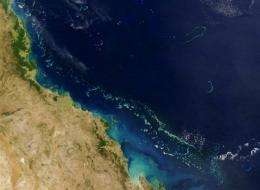
July 22, 2009 by David Brooks The Great Barrier Reef off Australia's eastern coast

Enlarge

The Great Barrier Reef off Australia's eastern coast. A massive 7.8 magnitude earthquake last week has moved the south of New Zealand closer to Australia, scientists said

A massive 7.8 magnitude earthquake last week has moved the south of New Zealand closer to Australia, scientists said Wednesday.

With the countries separated by the 2,250-kilometre-wide (1,400-mile-wide) Tasman Sea, the 30 centimetre (12 inch) closing of the gap in New Zealand's southwest won't make much difference.

But scientist Ken Gledhill of GNS Science said the shift illustrated the huge force of the tremor, the biggest in the world so far this year.

"Basically, New Zealand just got a little bit bigger is another way to think about it," he told AFP.

While the southwest of the South Island moved about 30 centimetres closer to Australia, the east coast of the island moved only one centimetre westwards, he said.

The biggest in New Zealand in 78 years caused only slight damage to buildings and property when it struck the remote southwest Fiordland region of the South Island last Thursday.

A small tsunami was generated by the earthquake, with a tide gauge on the West Coast of New Zealand recording a wave of one metre.

"For a very large earthquake, although it was very widely felt, there were very few areas that were severely shaken," Gledhill said.

Aerial inspection of the forested fiords near the quake's epicentre showed few land slips or other signs of damage.

This was partly because the type of rupture at the boundaries of the Australian and Pacific plates meant the energy from the quake was largely directed westwards towards the sea rather than inland towards the nearest towns.

The type of quake, known as a subduction thrust rupture, also meant the quake produced lower frequency shaking, felt as a rolling motion, rather than sharp jolts which would have caused more damage.

New Zealand frequently suffers earthquakes because it marks the meeting point of the Australian and Pacific continental plates.

Gledhill said the latest quake may have brought forward a major quake on the offshore section of the Alpine fault, off the coast of Fiordland in the Tasman Sea.

"There could easily be another large earthquake in another part of that region. We can't predict that obviously."

The latest quake was the biggest since February 2, 1931 when a 7.8 quake killed at least 256 people in the North Island city of Napier.

The biggest quake recorded here measured 8.2 and caused major damage in 1855 in the fledgling European settlement that later became the capital Wellington.

The latest quake was unusual in striking right on the boundary of the Australian and Pacific plates and will be important in researching earthquake hazards, Gledhill said.

(c) 2009 AFP


print this article email this article download pdf blog this article bookmark this article     Stumble it Digg this share on Facebook retweet share on Reddit add to delicious
Rate this story - 4.7 /5 (10 votes)

Rank Filter

Move the slider to adjust rank threshold, so that you can hide some of the comments.


Display comments: newest first

  • nuge - Jul 22, 2009
    • Rank: 3 / 5 (2)
    So the kiwis are closer to us now? Damn!
  • Velanarris - Jul 22, 2009
    • Rank: not rated yet
    Just wait, I'm banking on bigger quakes in the area north in the very near future. Possibly within the week of the solar eclipse.
  • paulthebassguy - Jul 23, 2009
    • Rank: not rated yet
    I hope that this will mean it will cost less to fly to Australia
  • poi - Jul 23, 2009
    • Rank: not rated yet
    "Basically, New Zealand just got a little bit bigger is another way to think about it," he told AFP.

    While the southwest of the South Island moved about 30 centimetres closer to Australia, the east coast of the island moved only one centimetre westwards, he said.

    Is this even legally possible?
    we know accession but this doesn't seem fit.
    torrens system won't allow it since property delimitations are governed by the imaginary latitudes and longitudes. it's not enough that we can trace the origin of the land mass (maybe your tree was in it) but that property divisions remain constant since the imaginary lines don't change. imagine land spurting out of the middle of new zealand and they start to lay claim on land at the borders that were previously not theirs just because your land with your tree still in it encroached on it.

July 22, 2009 all stories

Comments: 4

4.7 /5 (10 votes)
  • Stumble this up

  • Digg this

  • share this

  • hide
  • Related Stories

  • Major Pacific earthquake prompts tsunami warning
    created Mar 20, 2009 | popularity not rated yet | comments 0
  • Nine dead in Indonesian earthquake
    created Sep 12, 2007 | popularity not rated yet | comments 0
  • Mine Collapse Was the Quake, not Vice Versa
    created Aug 06, 2007 | popularity not rated yet | comments 0
  • Small aftershock rattles downtown Los Angeles
    created May 20, 2009 | popularity not rated yet | comments 0
  • Latest quake highlights Los Angeles seismic danger
    created May 19, 2009 | popularity not rated yet | comments 0


  • hide
  • Relevant PhysicsForums posts

  • The IPCC and the term "most"
    created Nov 23, 2009
  • Is global warming a fact?
    created Nov 23, 2009
  • Random variability of wind patterns
    created Nov 23, 2009
  • Record precipitation in the UK
    created Nov 22, 2009
  • More from Physics Forums - Earth

Other News

Cosmic 'dig' reveals vestiges of the Milky Way's building blocks

Cosmic 'Dig' Reveals Vestiges of the Milky Way's Building Blocks

Space & Earth / Astronomy

created 9 hours ago | popularity 4.9 / 5 (12) | comments 1

(PhysOrg.com) -- Peering through the thick dust clouds of our galaxy's "bulge" (the myriads of stars surrounding its center), a team of astronomers has unveiled an unusual mix of stars in the stellar grouping ...


No Wheel Stall in Diagnostic Drive

Spirit Mars Rover: No Wheel Stall in Diagnostic Drive

Space & Earth / Space Exploration

created 4 hours ago | popularity 5 / 5 (1) | comments 0

(PhysOrg.com) -- On Sol 2095 (Tuesday, Nov. 24), Spirit performed a set of diagnostic actions related to a stall of the right-rear wheel on the previous drive, three days earlier.


Monster Waves on the Sun are Real

Monster Waves on the Sun are Real (w/ Video)

Space & Earth / Astronomy

created 4 hours ago | popularity 5 / 5 (7) | comments 0

Sometimes you really can believe your eyes. That's what NASA's STEREO (Solar Terrestrial Relations Observatory) spacecraft are telling researchers about a controversial phenomenon on the sun known as the "solar ...


Oceanic crust formation is dynamic after all

Oceanic crust formation is dynamic after all

Space & Earth / Earth Sciences

created 8 hours ago | popularity 4.3 / 5 (3) | comments 0

Imagine the Earth's crust as the planet's skin: Some areas are old and wrinkled while others have a fresher, more youthful sheen, as if they had been regularly lathered with lotion.


Climate experts debate strategies for reducing atmospheric carbon and future warming

Climate experts debate strategies for reducing atmospheric carbon and future warming

Space & Earth / Environment

created 4 hours ago | popularity 3 / 5 (4) | comments 4

(PhysOrg.com) -- Reducing carbon dioxide to safe levels may require extracting carbon from the air, says Cornell climate researcher.