Quantum measurements: Common sense is not enough
July 22, 2009
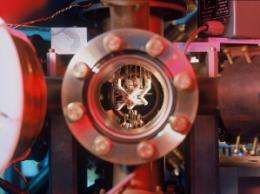
Ion trap. Photo: C. Lackner
(PhysOrg.com) -- In comparison to classical physics, quantum physics predicts that the properties of a quantum mechanical system depend on the measurement context, i.e. whether or not other system measurements are carried out. A team of physicists from Innsbruck, Austria, led by Christian Roos and Rainer Blatt, have for the first time proven in a comprehensive experiment that it is not possible to explain quantum phenomena in non-contextual terms. The scientists report on their findings in the current issue of Nature.
Quantum mechanics describes the physical state of light and matter and formulates concepts that totally contradict the classical conception we have of nature. Thus, physicists have tried to explain non-causal phenomena in quantum mechanics by classical models of hidden variables, thereby excluding randomness, which is omnipresent in quantum theory.
In 1967, however, the physicists Simon Kochen and Ernst Specker proved that measurements have to be contextual when explaining quantum phenomena by hidden variables. This means that the result of one measurement depends on which other measurements are performed simultaneously. Interestingly, the simultaneous measurements here are compatible and do not disturb each other.
The physicists led by Christian Roos and Rainer Blatt from the Institute of Quantum Optics and Quantum Information (IQOQI) of the Austrian Academy of Sciences and the University of Innsbruck have now been able to prove this proposition and rule out non-contextual explanations of quantum theory experimentally. In a series of measurements on a quantum system consisting of two ions they have shown that the measurement of a certain property is dependent on other measurements of the system.
Technological headstart
The experiment was carried out by the PhD students Gerhard Kirchmair and Florian Zähringer as well as Rene Gerritsma, a Dutch postdoc at the IQOQI. The scientists trapped a pair of laser-cooled calcium ions in an electromagnetic trap and carried out a series of measurements.
"For this experiment we used techniques we had previously designed for building a quantum computer. We had to concatenate up to six quantum gates for this experiment," explains Christian Roos. "We were able to do this because, it is only recently that we can perform a quantum gate with high fidelity."
Only last year, a team of scientists led by Rainer Blatt realized an almost error-free quantum gate with a fidelity of 99 %. With this technological headstart, the scientists have now proven comprehensively in an experiment for the first time that the experimentally observed phenomena cannot be described by non-contextual models with hidden variables. The result is independent of the quantum state - it was tested in ten different states. Possible measurement disturbances could be ruled out by the experimental physicists with the help of theoreticians Otfried Gühne and Matthias Kleinmann from the group led by Prof. Hans Briegel at the IQOQI in Innsbruck.
Randomness cannot be excluded
In 1935 already, Albert Einstein, Boris Podolsky and Nathan Rosen questioned whether quantum mechanics theory is complete in the sense of a realistic physical theory - a criticism that is now well know in the scientific world as the EPR paradox. In the mid 1960s, John Bell showed that quantum theory cannot be a real and at the same time local theory, which, in the meantime, has also been proven experimentally.
Kochen and Specker’s results exclude other theoretical models but until now it was difficult to provide a convincing experimental proof. Following a proposition by the Spaniard Adán Cabello, the Innsbruck scientists have now successfully proven this point and produced unambiguous results experimentally.
The physicists are supported by the Austrian Science Funds (FWF), the European Union, the Federation of Austrian Industry Tyrol, and Intelligence Advanced Research Projects Activity (IARPA).
More information: State-independent experimental test of quantum contextuality. G. Kirchmair, F. Zähringer, R. Gerritsma, M. Kleinmann, O. Gühne, A. Cabello, R. Blatt, and C. F. Roos. Nature. July 23, 2009, DOI: 10.1038/nature08172
Provided by Austrian Academy of Sciences


Basically, God is, in fact, playing dice, or at least that's the only way we can see it. Think Godel's theorems applied to quantum theories.
I could be quite wrong, though.
The above experimental proof, like the Bell inequality tests, show that QM is complete as formulated, ... that this, that one cannot find a way of rationizing it using concepts of everyday experience.
The reason is, is that the conceptual structure of our knowledge of reality (i.e. phenomenal reality) is dependant on mind, and is added as it were to experience in the intellectual process of the understanding. In other words, concepts like time, space, and causality, (all of which fail to rationalize QM), are, with respect to noumenal Reality, an artificial coherence due to a functioning mind. The above concepts are not discoverable independantly of their use, they are not entities 'out there', they are forms in which the mind understands,.. they are the subjective component of phenomenal reality, and Reality proper is not oblidged to be tamed by them.
Furthermore, wouldn't any set of mathematical theories and axioms, regardless of their origin(real-world measurements, mental experiments), be subject to Godel's incompleteness theorems?
First, QM doesn't conflict with classical physics but is known from its inception to converge to classicality in large systems.
Second, QM phenomena and theory are eminently causal, it's the very idea behind the theory.
Third, QM has, again since its conception, been known to have context dependency as regards observers, today expressed as decoherence (formerly, "collapse of the wavefunction").
Fourth, again the very idea behind the theory, it expresses both realism and locality so compatible with special relativity. What it does clash with is counterfactual definitiveness, the "common sense" idea that observables exist outside of the observations that effect them. (As opposed to QM states or classically wave functions that are persistent, affected but not effected by observation.)
Really, all of this is so mainstream that even old Wikipedia is a good resource.
Little in physics is mathematics, applied or especially formal. That is why we need testing to throw out incorrect theories, and use other means to choose the likeliest of the correct. (Say, parsimony consistent with bayesian likelihoods.)
Specifically for QM, and a good test of the model of science above, I believe nobody has managed to formally derive 2nd quantization from any axiom set.
"much like Godel's theorems do with pure mathematics."
Gödel's theorems hasn't anything to say about physics today, see above. And in the future, even if, say, string theory one day would be found to be the theory that can predict basic physics there remains scores of emergent phenomena that can't be derived from it.
Also, even string theory can't derive our physics entirely from formalism, as it has 10^500 vacuums to choose between. The way to bet is that all theories of basic physics will be thus, have vacuum as free parameters. So take your pick, all physics theories are "context dependent" to use the article's terms, with a free non-axiomatizable sector.
In any case it is a mistake to think that Gödel prohibit exploration in math, when they do exactly the opposite. By them it is known that we can always extend math by new axioms to capture ever more powerful models, say the tiny islands of formal parts and even the majestic sea of algorithmic parts of physics.
D'oh! Better formulated, and as can be read from the term, _conterfactual_ [I blame my dumb spell checker! :-)] definiteness is "the ability to speak meaningfully about the definiteness of the results of measurements, even if they were not performed."
Are you considering, for instance, the machine measuring which slit a photon goes through as an "observer"? Because that interference is enough to collapse the wavefunction. No conscious awareness has to be involved.
Similarly, physicists seem to need more (11 and rising?) dimensions to explain the four common sense ones. This parallels the use of broader frameworks to overcome Godel's theory. Common sense ought to be mistrusted. What we take in with our senses is very limited. The article uses the word "real" ["cannot be a real and at the same time local theory"] although it might be being used in a technical sense that I am not familiar with. If it is not being used in a technical sense then it does not mean much. I imagine that matter/energy would be very rational and commonsensical if viewed in 11 dimensions using super senses. Or would it? Would 11-D beings need to postulate 20 dimensions to overcome more oddities in behaviour?
There is no end to our ignorance. But that is good news as it allows infinite advancement. Perhaps "Theory of Quite a Lot" would be better title?
Then how come a physics student's curriculum is mostly maths? Maths is the language of science and like common languages, it ultimately limits what we can know, or observe in its terms.
To quote Noumenon, "our knowledge of reality (i.e. phenomenal reality) is dependant on mind", to which I add the requirement of communication. Whatever view of the universe, or theory, prediction model or whatever anyone would come up with would have to be communicated to someone else, in virtue of the scientific method. Communication occurs via languages, maths is the language of science...Does anyone see my point here?
I think what Torbjorn is saying is that fundamentally physics is inductive rather than deductive. So in effect you don't need 'Godel's incompleteness theorem' to find an upper limit as it were, for science,.... the process of induction is already a limit, since it is based on an accumulation of observed events, so that the truth of conclusions drawn are never guaranteed.
[(1) Yes it does, Statistical convergence doesn't imply fundamental compatibility. 2) acausal, science is not purely mathematical as you state yourself (Schrodinger function causal) 4) Not so fast, either locality OR definiteness according to Bell. (Entanglement != locality)).]
disembodied smile is (somehow) taken to Mars. My friend goes with his disembodied cat to Mars and
leaves the disembodied smile of his cat with me.
I bring a photo of a snarling dog to the attention of my cat. And its smile, on Mars, changes to a
frown (I am trying to avoid deliberately standing on its tail, which would be more sure of an instant
effect.) Say Mars is four light minutes away. When my friend notes that the smile has changed to a
frown, he too shows his cat a photo of the snarling dog, and the disembodied smile with me changes to
a frown.
If non-locality (I think that is the right term) holds then all this could take place within a few
seconds. If non-locality was not operating then the whole process would take at least eight minutes.
If there are extra hidden dimensions, could the signals involved have resulted from local processes
which appear to us to be non-local? For example, a very long quasi-neuron connecting the cat's body
with its smile and the quasi-neuron being channelled through a hidden dimension. Much folding of our
three dimensions would be necessary? For example, a 2-D sheet of paper can be folded in the third
dimension to shortcut distances. But we cannot expect such drastic folding of our spacetime to
conveniently occur as and when we need it to explain every non-local occurrence? (Though I expect
that our spacetime framework is thrashing about and vibrating wildly on a larger scale than required
here.)
If I placed both hands wide apart on a sheet of paper, it might appear to 2-D dwellers in the paper
that I am simultaneously in two places at the same time. And my left and right hands would appear to
them to be entangled, and indeed they would be connected through the extra third dimension. But if
they somehow applied a shock to my left hand. The signal would have to pass up my arm through my
nervous system and it would be some time before my right hand flinched. Not an instantaneous effect.
Nor non-local? Generally, if you use extra dimensions in an explanation it ought to take more time
rather than less to send a signal, even for a connected body, assuming you don't make up convenient
contortions?
Language interferes with understanding as I think of my right and left hand as mine, but my left hand
is not the same as my right hand. Shocking one is not the same as shocking the other. "I" am in two
places at the same time, on the sheet of paper, but only because at any instant I take up rather a
lot of space.
(The plus sign was dropped somehow during the paste operation. I don't understand how.)
Word editor is playing up. The fourth line should have read "make sense in 4 PLUS dimensions ...".
(The plus sign was dropped somehow during the paste operation. I don't understand how.)