Geoscientists back from expedition to Labrador Sea
July 22, 2009 Geoscientists from the Alfred Wegener Institute back from an expedition to Labrador Sea

Enlarge

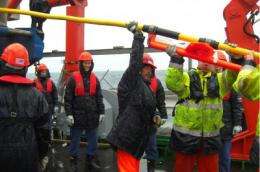
Members of the geophysical working group deploy the streamer, the 3,000-meter-long hydrophone cable used to receive the seismic signals. Credit: Ronald Freibothe, Alfred Wegener Institute

Scientists from the Alfred Wegener Institute have researched the geology of the seabed in the Labrador Sea on board of the research vessel Maria S. Merian. They have studied the so-called Eirik Drift at the southern tip of Greenland, a structure of several hundred kilometres length formed like a ridge. They discovered a submarine mountain (seamount) at the south-western fringe of their area of investigation that indicates volcanic eruptions during the past few million years.

The Eirik Drift rises 2,500 m above the surrounding at the southern tip of Greenland. Sediments have been depositing there for the last ten million years, forming a ridge-like structure. These sediments are ablated by ocean currents in the Greenland Sea and deposited in the Labrador Sea. This is also known to be the case with sand displacements caused by ocean currents, for example on Sylt. Caused by changing climate - the transition from warmer times to our current climate - the current drifted and changed its strength. Additionally, icebergs transport rock material from Greenland onto the seabed. Glaciers planed it off the island, and on breaking apart into icebergs, deposited it all over the ocean. Caused by the constantly expanding and surface during the geological cycles of glacials and interglacials, this material finds its way into the Eirik Drift, too.

Therefore, the Eirik Drift is an archive for the activity of Greenland's western boundary current and the dynamics of ice cover. Climate changes and current shifts of the last ten million years can be examined here. First results show that the drift shifted strongly to the North and the West. This event took place about 5.6 million years ago. A sediment drift can be observed for the period prior to that, but velocity and path of the current changed strongly. Researchers will be able to further analyse these data by means of computer models in order to describe these changes in more detail.
Geoscientists from the Alfred Wegener Institute back from an expedition to Labrador Sea
Enlarge

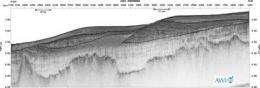
This is the seismic profile through the Erik Drift. The deepest horizon to be observed is the magmatic basement. On top the sedimentary sequences have been deposited. The sediment drift comprises a wedge-like sediment body, which has been relocated from the east to the west and eastwards again. This is a result of a relocation of the generating current. Modifications in paths of oceanic currents can be attributed to climate changes. Credit: Gabriele Uenzelmann-Neben, Alfred Wegener Institute

The researchers discovered something unexpected during the seismic investigation using a recording cable of 3.000 m length: "Surprisingly, an unknown elevation appeared on the images of the subsurface in the western area of the Eirik Drift, which almost breaks through the sediments to the top of the seabed at two places", reports chief scientist Dr. Gabriele Uenzelmann-Neben from the Alfred Wegener Institute for Polar and Marine Research in the Helmholtz Association. "The sedimentary layers are disturbed", the geophysicist continues. This elevation at the seabed, called Mount Maria S. Merian by the researchers, is about 1.500 m high - approximately as high as the Feldberg in the Black Forest. The seamount was formed by volcanism which pushed sediments upwards. Even the youngest sediment packages are affected by this movement.

It can therefore be concluded that this is a young event have occurred during the last few million years. This result changes the picture of the geological development of the outer part of the Labrador Sea. So far it was assumed that the formation of the seafloor in the Labrador Sea (tectonic activity) ended about 45 million years ago. The discovery of the seamount indicates that the seabed at the exit of the Labrador Sea changed in more recent times. A distinct changing seabed has an enormous impact on the circulation paths of deepwater, which maintains ocean currents like the Gulf Stream.

The expedition of RV Maria S. Merian, operated by the Leitstelle Merian/Meteor of the University of Hamburg, began June 17th 2009 in Reykjavik where it also ended July 13th.

Source: Helmholtz Association of German Research Centres (news : web)


print this article email this article download pdf blog this article bookmark this article     Stumble it Digg this share on Facebook retweet share on Reddit add to delicious
Rate this story - 5 /5 (1 vote)


July 22, 2009 all stories

Comments: 0

5 /5 (1 vote)
  • Stumble this up

  • Digg this

  • share this

  • hide
  • Related Stories

  • RV Polarstern on its way to East Siberian Sea
    created Aug 21, 2008 | popularity not rated yet | comments 0
  • Research around the North Pole
    created Oct 20, 2008 | popularity not rated yet | comments 0
  • Iceberg Scour Affects Biodiversity
    created Jul 17, 2008 | popularity not rated yet | comments 0
  • The sea ice is getting thinner
    created Sep 13, 2007 | popularity not rated yet | comments 0
  • Less ice in the Arctic Ocean 6000-7000 years ago
    created Oct 20, 2008 | popularity not rated yet | comments 0


  • hide
  • Relevant PhysicsForums posts

  • The IPCC and the term "most"
    created 21 hours ago
  • Is global warming a fact?
    created 22 hours ago
  • Random variability of wind patterns
    created Nov 23, 2009
  • Record precipitation in the UK
    created Nov 22, 2009
  • How to move cloud from one time to another..
    created Nov 22, 2009
  • Which countries around the world cause the most destruction to the rain forest
    created Nov 21, 2009
  • More from Physics Forums - Earth

Other News

Researchers Establish Common Seasonal Patterns Among Bacterial Communities in Arctic Rivers

Researchers Establish Common Seasonal Patterns Among Bacterial Communities in Arctic Rivers

Space & Earth / Earth Sciences

created 2 hours ago | popularity not rated yet | comments 0

(PhysOrg.com) -- New research on bacterial communities throughout six large Arctic river ecosystems reveals predictable temporal patterns, suggesting that scientists could use these communities as markers ...


From Greenhouse to Icehouse

From Greenhouse to Icehouse

Space & Earth / Earth Sciences

created 5 hours ago | popularity 4.5 / 5 (4) | comments 6

A new study that reconstructed ocean temperatures from millions of years ago could provide new insight into how the Earth responds to climate change.


Humanity would need five Earths to create the resources needed if everyone lived as like Americans, a report has stated

Mankind using Earth's resources at alarming rate

Space & Earth / Environment

created 5 hours ago | popularity 2.5 / 5 (8) | comments 7

Humanity would need five Earths to produce the resources needed if everyone lived as profligately as Americans, according to a report issued Tuesday.


'Cosmic fruit machine' matches collisions

'Cosmic fruit machine' matches collisions

Space & Earth / Astronomy

created 7 hours ago | popularity 4.5 / 5 (2) | comments 1

(PhysOrg.com) -- A new website will give everyone the chance to contribute to science by playing a 'cosmic fruit machine' and compare images of colliding galaxies with millions of simulated images of galactic ...


Supervolcano eruption -- in Sumatra -- deforested India 73,000 years ago

Supervolcano eruption -- in Sumatra -- deforested India 73,000 years ago

Space & Earth / Earth Sciences

created 22 hours ago | popularity 4.4 / 5 (14) | comments 2

A new study provides "incontrovertible evidence" that the volcanic super-eruption of Toba on the island of Sumatra about 73,000 years ago deforested much of central India, some 3,000 miles from the epicenter, ...