Trees evolved camouflage defense against long extinct predator: First evidence of camouflage defense in plants
July 22, 2009
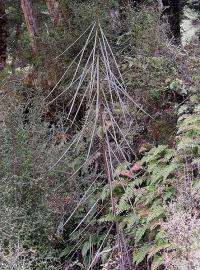
Lance wood (Pseudopanax crassifolius) in native bush in the Owen River valley, South Island, New Zealand. Image: Wikimedia Commons
(PhysOrg.com) -- Many animal species such as snakes, insects and fish have evolved camouflage defences to deter attack from their predators. However research published in New Phytologist has discovered that trees in New Zealand have evolved a similar defence to protect themselves from extinct giant birds, providing the first evidence of this strategy in plant life.
"Plants are attacked by a bewildering array of herbivores and in response they have evolved a variety of defences to deter predators such as thorns and noxious chemicals," said lead researcher Dr Kevin Burns from Victoria University of Wellington, New Zealand. "In contrast animals often use colours to hide from predators or advertise defences, but until now there has been little evidence of colour based defences in plants."
Dr Burns' team studied the leaves of the Araliaceae tree (P. crassifolius) a heteroblastic species which is native to New Zealand. This species goes through several strange colour transitions during the process from germination to maturity and the reason for these changes is now thought to be a defence strategy from an extinct predator, the moa.
Before the arrival of humans New Zealand had no native land mammals, but was home to moa, giant flightless birds, closely related to the modern ostrich and the top herbivore predator in the food chain. However moa were hunted to extinction 750 years ago.
The Araliaceae tree has several defences which the team suggest are linked to the historic presence of moa. Seedlings produce small narrow leaves, which appear mottled to the human eye. Saplings meanwhile produce larger, more elongated leaves with thorn-like dentitions.
The mottled colours of seedling leaves are similar to the appearance of leaf litter, which would have made them difficult for a moa to distinguish. The unusual colouring may also reduce the probability of leaf outlines and help camouflage leaves against the sunlight-draped forest floor.
Moa also lacked teeth and swallowed leaves by placing them in their bills and snapping their head forward. The long rigid leaves produced by P. crassifolius would have been difficult for a moa to swallow. The maximum browsing height of the largest known moa was approximately 300cm and once P. crassifolius grow above this height they produce leaves that are ordinary in size, shape and colour, lacking any defence.
To prove that these defences were linked to the presence of moa the team compared Araliaceae leaves to samples from a similar species of tree, P chathamicus, from the Chatham Islands, which are 800 kilometres east of New Zealand. Unlike New Zealand the islands lacked large browsers such as Moa and so the plant life did not evolve a defence against them.
"The Chatham island species displays less morphological changes between adults and juveniles," said Burns. "If these colouring changes developed in response to the presence of moa in New Zealand they are reduced when they have evolved in the absence of moa."
More information: Fadzly.N, Cameron.J, Schaefer.M, Burns.KC, Ontogenetic colour changes in an insular tree species: signalling to extinct browsing birds, New Phytologist, 2009: DOI 10.1111/j.1469-8137.2009.02926x


If there was a kind of rock that would break down when wet, you wouldn't expect to find it in the ocean would you? Natural selection occurs in rocks~!!!
There is no strategy, it's all consequential. If it's not being attacked or destroyed it goes on. The effect lends to the illusion that there is some kind of 'intention' or 'strategy.'
http://www.livesc...ion.html
He's NOT joking, and he is quite correct. What 'survives' is only that which CAN exist in the environment being considered. There were NO 'rocks' on our earth during the 'molten' phase of earth's beginnings .. they formed and were allowed to form because of changing environmental conditions. Living organisms do the same. DNA did the same: it evolved .. and that is accepted scientific fact. If it is true for an acid molecule why do you have difficulty accepting that it's true for 'geological' entities?
It's not correct, there is no natural selection mechanism that determines what chemicals break down in the presence of other chemicals. A rock doesn't create a "child" rock that deviates from the "parent" rock in order to endure unsuitable conditions.
Granite doesn't become better or worse at being granite over time, it's just granite all the time.
You wouldn't say Americanium is a poorly evolved element because it's not naturally occuring (as far as we know).
Favored characteristics survive, and that very much applies to everything.
Also; I would not say ANY element is 'poorly evolved,' I would say that an environment where it can exist naturally favors it and so it does exist there naturally.
Natural selection is the mechanism by which evolution takes place in a living creature, you have to carefully distinguish between the two concepts in order to appreciate what the terms are precisely* referring to.
Of course there will be favorable environments, where natural selection is involved there is typically competition, not just existence and non existence.
I believe the error stems from your attribution of quality to any given change. Nothing in the natural world can be considered "good" or "bad," ergo nothing can be considered "better" or "worse." Things can only fit more simply in a given environment.
After all, life is simply an eons-old continuous chemical reaction. Materially speaking, there is no fundamental difference between rocks and humans. We're all just groups of quarks, electrons, electron neutrinos, etc. acting on the basic principles of physics as a result of that which came earlier along the fourth dimension.
It's deceptive and inaccurate to imply that anything which is not biotic, evolves in the biological sense. Or that such is subject to natural selection or survives. To apply these terms to non-biotic objects is merely faulty semantic maneuvering and deceptive and less accurate than another description of the process they go through could be. Such as aggregation, deaggregation, metamorphism, etc. You're obscuring facts of differentiation, not revealing any greater truth.
IMO, your statement would probably be more effective in your argument by saying: "After all, physical existence is simply an eons-old continuous transmutation of energy."
There is no "selection" there, all other rocks will decay as well (and/or aggregate or be deformed by temperature and pressure), that's just decay, entropy, the shifting of energy from one place to another. Natural selection is not a term that applies meaningfully to rocks, try again.
When I said natural selection I was not refering to evolution, I was specifically refering to the traits of objects that persist through time within a given environment. ;p
And yea, using the rock was reaching a bit, I was just attempting to point out the ultimate lack of 'surprise' in the fact that we find evolution taking place in plants, I guess I'm arrogant for exclaiming how painfully obvious the subject of the article is. >:]
I was drawn to the article by the prospect of an animal that hunts trees...
I think you missed the point of the articvle.
It's not that plants evolve, it's that plants evolved visual camoflage and this is the only known example.
lol when I said 'evolve' I meant in every way possible. Remember above how we spoke about 'traits' being selected for? I figured one safe assumption was not to assume that 'traits' as a term implied only a handful of possible genes.
Do you seriously think that these words are so ambiguous? Honestly, how do you expect coherent communication to occur if terminology is so meaningless as to just be mixed together with a magic 8-ball?
Also, plants evolving with defensive traits seems to be discovered frequently. Though not often have I heard of people inferring on previously existing life-forms from it... that seems to be the more important point of the article - that logical leap in to discovering things indirectly, ... that is kinda neat.
Wow... this is quite the blunder on your part, thales.
First, you are completely wrong in saying that NS is the same as SB. The fossil record allows us to take into account those lifeforms which failed in natural selection, indeed the theory of natural selection probably never would have been seen if there was biological "survivorship bias". Please stop talking if you don't know what you are saying.
Second, natural selection is a very specific MECHANISM IN BIOLOGY, the word is INAPPLICABLE TO anything NON-BIOTIC. There are better terms to apply to the MECHANISMS affecting rocks and business, use those terms as they are the truth of that matter.
Maybe SB was not the most apt comparison. Still, natural selection means naturally selected. That's all. If you insist on trying to make it apply only to biological entities you will have some trouble - not least of all because biological is tough to define at the edges. What about the self-replicating molecules that preceded the first organisms? Were they subject to natural selection? What about viruses? Are they?
Blunders are acceptable, as long as one learns from them. It's narrow thinking that leads to systemic mistakes.
Not in the least. Is it capable of response to stimuli, development, reproduction. This isn't some great mystery we're belaboring here, these are very simple definite concepts. There is nothing existent that I can think of that you cannot delineate as either biotic or non-biotic.
No, you see, there's something very fundamental and basic you're missing here and I think it's the definition of natural selection. Breaking NS down into it's phonetic components serves no purpose, academically (which these discussions are purely academic), because there are other, better (more descriptive) singular collections of words for other applications. The term NS refers to a very specific mechanism involving genes and environmental pressures, and how these factors act on a population. Natural selection does not act on individuals (rocks) or anything that cannot respond to stimuli, develop or grow and reproduce.
Self-replicating molecules? I think you're concept of how life began is flawed. Or are you trying to say, mono-cellular? There was a very specific point, probably while the first aggregates of chemicals that would become life were still trapped in the tiny pockets of space in rock or ice or whatever your favorite origin of life theory is, when the chemicals formed chains inside of a membrane that were capable of breaking the chemicals down around it and using them in the development of it's own structure. This would be the most basic of biotic organisms. And yes, they were subject to natural selection, and yes, viruses are too.
I'm relieved to hear that it's not a great mystery! But somehow your "simple" definition falls short. Many viruses aren't capable of reproduction, so they use cells to do it for them. So: are viruses "biotic" or not?
Flawed? You say that as if there's a concept out there that's not flawed. Anyway, I have some good company: Richard Dawkins had a similar idea, and well-known biologist Stuart Kauffman does too. Wiki to the rescue:
http://en.wikiped...ytic_set
http://en.wikiped...atalysis
Allow me to direct your attention to this section:
"Several models of the origin of life are based on the notion that life may have arisen through the development of an initial molecular autocatalytic set which evolved over time. Most of these models which have emerged from the studies of complex systems predict that life arose not from a molecule with any particular trait (such as self-replicating RNA) but from an autocatalytic set.
Modern life has the traits of an autocatalytic set, since no particular molecule, nor any class of molecules, is able to replicate itself. There are several models based on autocatalytic sets, including those of Stuart Kauffman and others."
I'm not trying to change the definition of NS as it is used in biology. Many terms, however, mean different things in different contexts. For example, the word "theory" in American vernacular means something quite different from what it means in a scientific context.
Similarly, "natural selection" takes on a rigorous, specific meaning in biology. However, the basic principle of natural selection is that the environment acts as a filter on a group of items. So we can apply the term to, say, memes as well as genes.
So what you said is they do reproduce. Yes, they are biotic.
YOURS:
MINE:
Same thing, I had just never heard of it referred to as a self-replicating molecule. My mistake, I apologize for the misunderstanding.
... is not natural selection, it is the basic principle. So why don't you just say "the environment acts as a filter on a group of items", that's more accurate, instead of trying to call it natural selection. That's all I'm saying.
Thank you for a brief summary of the relevant terms. Let me add that self-organizing systems do not need to be biological, but without a DNA analogue they will lack "memory" and thus be unable to accumulate complexity over generations.
Also, (biological) evolution may sometimes lead to loss of complexity (for instance in parasitic organisms). Details like this tend to cause a lot of confusion. :-)
The reason I gotta be an ass about this type of thing is because I could see Creationists and Intelligent Designers use these types of fuzzy definitions to try and discredit biological evolution.