New silver nanoparticle skin gel for healing burns
July 22, 2009
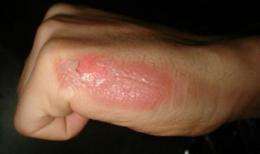
A new skin gel made of silver nanoparticles may help improve the treatment of burns, researchers say. Credit: The American Chemical Society
Scientists in India are reporting successful laboratory tests of a new and potentially safer alternative to silver-based gels applied to the skin of burn patients to treat infections. With names like silver sulfadiazine and silver nitrate, these germ-fighters save lives and speed healing. The researchers describe gel composed of silver nanoparticles — each 1/50,000th the width of a human hair — that appears more effective than these traditional gels. Their study is scheduled for the Aug. 3 issue of ACS' Molecular Pharmaceutics.
Kishore Paknikar and colleagues note that antimicrobial silver compounds have been used for decades on burn patients, whose damaged skin is highly vulnerable to bacterial infections. However, topical silver agents now in use can loose effectiveness in the body, cause skin discoloration, and damage cells. Drug-resistant bacteria can make these treatments less effective.
The scientists demonstrated that their gel killed a broad range of harmful bacteria, including Pseudomonas aeruginosa, one of the most common causes of burn infections, as well as several drug-resistant microbes. The gel, which contains 30 times less silver than silver sulfadiazine, did not have any apparent toxic effects when applied to the healthy skin of test animals. "These results clearly indicate that silver nanoparticles could provide a safer alternative to conventional antimicrobial agents in the form of a topical antimicrobial formulation," the article states.
More information: "Silver nanoparticles in therapeutics: development of an antimicrobial gel formulation for topical use" Molecular Pharmaceutics
-
Silver-coated endotracheal tube dramatically reduces resistant infections
May 19, 2008 |
not rated yet |
0
-
Silver nanoparticles show 'immense potential' in prevention of blood clots
May 27, 2009 |
not rated yet |
0
-
Scientists to tackle illness with 'silver nanobullet'
Mar 31, 2006 |
not rated yet |
0
-
Too much nanotechnology may be killing beneficial bacteria
Apr 29, 2008 |
not rated yet |
0
-
Silver Nanoparticles Deadly to Bacteria
Mar 10, 2008 |
not rated yet |
0
-
Engineers build first sub-10-nm carbon nanotube transistor
Feb 01, 2012 |
4.9 / 5 (31) |
30
-
Something old, something new: Evolution and the structural divergence of duplicate genes
Jan 31, 2012 |
4.6 / 5 (7) |
1
-
The hidden nanoworld of ice crystals: Revealing the dynamic behavior of quasi-liquid layers
Jan 30, 2012 |
5 / 5 (3) |
1
-
Stock market network reveals investor clustering
Jan 27, 2012 |
3.9 / 5 (23) |
8
-
Of microchemistry and molecules: Electronic microfluidic device synthesizes biocompatible probes
Jan 26, 2012 |
5 / 5 (1) |
0
-
Mitosis
3 hours ago
-
Stem cell question.
5 hours ago
-
Protease cleavage
11 hours ago
-
Pertubance in a model
18 hours ago
-
Cancer drugs and Alzheimer's, Oh my!
Feb 09, 2012
-
Squishing cells
Feb 09, 2012
- More from Physics Forums - Biology
More news stories
What lies beneath: Mapping hidden nanostructures
The ability to diagnose and predict the properties of materials is vital, particularly in the expanding field of nanotechnology. Electron and atom-probe microscopy can categorize atoms in thin sheets of material, ...
16 hours ago |
5 / 5 (3) |
1
New kind of solar cell could capture significantly more energy than current cells
New solar cells could increase the maximum efficiency of solar panels by over 25%, according to scientists from the University of Cambridge.
Feb 08, 2012 |
4.5 / 5 (12) |
14
|
Nanoshell whispering galleries improve thin solar panels
Visitors to Statuary Hall in the U.S. Capitol Building may have experienced a curious acoustic feature that allows a person to whisper softly at one side of the cavernous, half-domed room and for another on ...
Nanotechnology / Nanomaterials
Feb 07, 2012 |
4.3 / 5 (6) |
6
|
'Dark plasmons' transmit energy
Microscopic channels of gold nanoparticles have the ability to transmit electromagnetic energy that starts as light and propagates via "dark plasmons," according to researchers at Rice University.
Feb 09, 2012 |
4.8 / 5 (8) |
1
|
Revealing how a battery material works
Since its discovery 15 years ago, lithium iron phosphate (LiFePO4) has become one of the most promising materials for rechargeable batteries because of its stability, durability, safety and ability to deliver ...
Nanotechnology / Nanomaterials
Feb 08, 2012 |
5 / 5 (5) |
0
|
Anonymous knocks CIA website offline (Update)
The website of the Central Intelligence Agency was inaccessible on Friday after the hacker group Anonymous claimed to have knocked it offline.
Google users warned of threat to smartphone wallets
Users of Google smartphone wallets were being warned on Friday that there is a way to crack pass codes intended to thwart thieves from going on illicit shopping sprees.
New error-correcting codes guarantee the fastest possible rate of data transmission
Error-correcting codes are one of the triumphs of the digital age. Theyre a way of encoding information so that it can be transmitted across a communication channel such as an optical fiber o ...
Humans may have helped the decline of African rainforests 3000 years ago
(PhysOrg.com) -- Large areas of rainforests in Central Africa mysteriously disappeared over three thousand years ago, to be replaced by savannas. The prevailing theory has been that the cause was a change ...
New power source discovered
(PhysOrg.com) -- Researchers at the Massachusetts Institute of Technology (MIT) and RMIT University have made a breakthrough in energy storage and power generation.
Small modular reactor design could be a 'SUPERSTAR'
(PhysOrg.com) -- Though most of today's nuclear reactors are cooled by water, we've long known that there are alternatives; in fact, the world's first nuclear-powered electricity in 1951 came from a reactor ...
Jul 23, 2009
Rank: not rated yet